Critical Mineral Competition and Building Processing Capacity
Question
Is competition for critical minerals increasingly centred on developing industrial processing capacity to strengthen supply chain resilience?
Significance
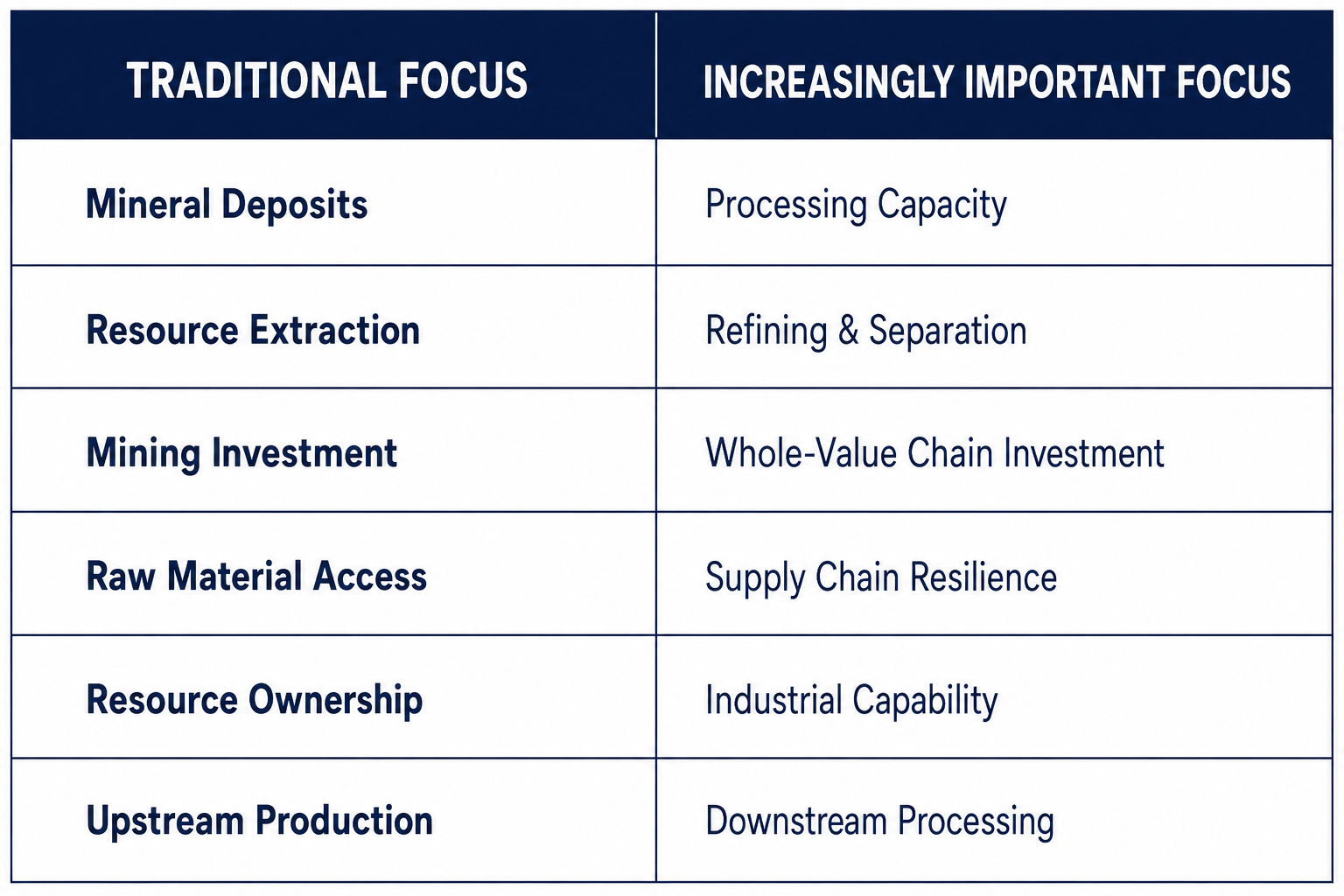
Critical minerals are essential for advanced technologies, defence systems, semiconductors, renewable energy, and permanent magnets. The concentration of critical mineral processing capacity has increased supply chain dependency and prompted governments to reduce vulnerabilities. Consequently, competition is extending beyond securing mineral deposits and extraction towards developing industrial capabilities to process critical minerals and strengthen supply chain resilience.
Strategic Shift
Executive Judgements
Competition to strengthen critical mineral supply chains is increasingly driven by developing industrial processing capacity through investment, stockpiling, infrastructure, legislation, and partnerships.
Governments view processing capabilities as an economic and national security priority.
Strengthening supply chains is likely to remain a prominent feature of geopolitical competition in the near term.
Analysis
As critical minerals underpin advanced technologies and defence systems, strengthening supply chains is emerging as an important feature of geopolitical competition. China’s dominance of rare earth processing has reshaped government policy, prompting increased investment in supply chain diversification and domestic processing capacity. As critical minerals are required for defence systems and advanced manufacturing, they are no longer viewed solely as economic resources but also as a matter of national security. As a result, governments are making greater efforts to reduce strategic dependencies and building supply chain resilience.
Globalisation resulted in the outsourcing of manufacturing and industry, facilitating the transfer of technological knowledge to emerging economies. China spent decades developing processing expertise and constructing infrastructure, while progress was also accelerated through subsidies as well as different environmental and labour standards. These policies enabled China to dominate key stages of critical mineral supply chains, such as 88% of the global oxide separation capacity and 93% of global metal refining. In terms of heavy rare earths, the dominance is even greater with mining, oxide separation, metal refining, and permanent magnets in the 90% range of global supply chains. Regardless of where rare earth minerals are sourced, most separation and refining stages rely on Chinese processing, creating a supply chain bottleneck and dependencies.
Despite U.S. efforts to reduce reliance on Chinese critical minerals by January 2027, its processing capacity remains underdeveloped. The U.S. administration had made mining and processing of critical minerals a national security objective, with billions allocated to almost 150 mining companies to expand domestic processing capacity. Some of the funding has been through the Department of War, highlighting that the policy is considered a national security priority. Recently, White Mesa Mill invested in a USD 104 million expansion into heavy rare earth separation largely through government funding, with targets of commercial production by the end of 2027. Other efforts include the recently announced order that gives federal officials the power to block the exports of electronic waste that could be recycled for critical minerals. Although the U.S. has set production deadlines, companies have been granted waivers to access Chinese outputs to meet domestic demand, which indicates that despite significant investment and policy, domestic processing capacity remains insufficient.
The U.S. critical mineral policy is not isolated and is part of a broader global trend towards developing domestic processing capacity. Africa is increasingly becoming part of critical mineral competition, with several countries indicating extraction conditions that now include domestic processing. Kenya’s Mrima Hill held a tender process to access deposits, with added conditions that Kenya will develop processing capacity, shifting from extraction alone. The U.S. International Development Finance Corporation pledged millions in the Ampasindava rare earth project in Madagascar to expand its strategy of investment in the mining sector, illustrating an approach of building mineral alliances and countering competitors.
Other global efforts include EU initiatives and allied coordination to reduce dependencies. The EU announced several initiatives, such as the Critical Raw Materials Act (CRMA), which supports projects, diversification, resource efficiency, risk monitoring, and incentivising technological progress. The European Raw Materials Alliance was established to strengthen rare-earth magnet supply chains, while the REsourceEU Initiative focuses on stockpiling, joint purchasing, support for domestic projects, and partnership diversification. As part of the REsourceEU Initiative, the EU Critical Minerals Centre will focus on embedding economic security into company supply chains. Other cooperation includes the G7 leaders' declaration that recognised the importance of strengthening downstream industries, establishing the Critical Minerals Production Alliance to develop processing capacity and diversification, and supporting domestic innovation. These policies indicate a convergence of legislation, industrial policy, alliances, investment, stockpiling, and partnerships to reduce dependencies and strengthen critical supply chain resilience.
Assessment
China’s global dominance of critical mineral supply chains, developed over decades, has resulted in an international policy shift. Previously, securing mineral deposits and extraction was considered the primary objective for countries seeking rare earths. With China’s near monopoly on some critical mineral processing, governments have recognised that industrial sectors, including defence, remain exposed and vulnerable to supply disruptions. The U.S. has reframed the topic as a national security issue, investing billions to develop domestic processing and expand its refinery capacity. Despite the policy, the strategy is proving to require significant resources and time to acquire the expertise and infrastructure to meet domestic production objectives. The rapid policy shift suggests that the U.S. may consider critical mineral supply chain resilience part of broader great-power competition.
Similarly, both the EU and G7 have acknowledged that critical mineral resilience is now a priority. The development of several EU initiatives demonstrates that developing domestic processing capacity is becoming essential for European industry and the defence sector, and supply chain resilience will be built through investment, innovation, partnerships, and stockpiling. As the G7 is comprised of some EU member states and the U.S., amongst others, the declaration that highlighted concerns over critical mineral supply chains remains consistent with G7 countries' national policy approaches.
The simultaneous policy shifts indicate that investing across the critical mineral value chain is strategically important, with concerns now being realised about the dependence on the China processing bottleneck. Geopolitical competition is evolving, with critical mineral alliances and partnerships being built, while African countries that were previously involved in the extraction process are now leveraging deposits to also partake in the development of processing capacity. Mineral deposits remain essential; however, processing capabilities are rapidly becoming strategically crucial.
U.S. funding through the Department of War indicates that critical supply chains are a national security concern. With many minerals essential for defence systems, bottlenecks could pose a risk to military defence industries and the ability to manufacture weapons systems. The EU’s integration of critical minerals into wider policy areas also indicates wider concerns across industrial sectors. Although these policy initiatives show awareness of the exposure, the inability for U.S. mining companies to meet national objectives implies that while policy intentions remain, capabilities do not.
Strategic Indicators
Industrial processing capacity outside China ▲ Increasing
Government investment in domestic processing capacity ▲ Increasing
International critical mineral partnerships ▲ Increasing
Strategic competition over downstream processing ▲ Increasing
Indicators to Monitor
Progress on domestic processing expansion.
Progress towards U.S. domestic critical mineral production objectives and responses to unmet targets.
Partnerships, alliances, and processing agreements.
African critical mineral agreements and investment in domestic processing.
Expansion of downstream manufacturing.
Critical mineral policy developments affecting industrial and defence sectors.
Conclusion
Competition for supply chain resilience has moved beyond critical mineral extraction and access to deposits. Building capabilities in processing, refining, and integrating critical minerals into supply chains is becoming an important component of economic and defence security. Governments are developing policy to enhance value chain capabilities, with more recognition that the ability to do so will provide greater strategic influence in geopolitical rivalry.
Sources
International Organisations
International Monetary Fund (IMF). World Economic Outlook, April 2026.https://www.imf.org/-/media/files/publications/weo/2026/april/english/text.pdf
European Institutions
European Parliament Research Service (EPRS). Critical Raw Materials Act. 2025.https://www.europarl.europa.eu/RegData/etudes/ATAG/2025/779220/EPRS_ATA%282025%29779220_EN.pdf
News Reporting
Reuters. Trump may need to allow Chinese minerals as U.S. industry struggles to meet 2027 deadline. 27 July 2026.https://www.reuters.com/legal/government/trump-may-need-allow-chinese-minerals-us-industry-struggles-meet-2027-deadline-2026-07-27/
Reuters. U.S. backs Madagascar rare earths project in push to loosen China's supply chain grip. 28 July 2026.https://www.reuters.com/world/africa/us-backs-madagascar-rare-earths-project-push-loosen-chinas-supply-chain-grip-2026-07-28/
Reuters. Trump orders restrictions on exports of critical minerals scrap. 30 July 2026.https://www.reuters.com/legal/government/trump-orders-restrictions-export-critical-minerals-scrap-white-house-officials-2026-07-30/
Industry Sources
Rare Earth Exchanges. Energy Fuels Takes the Next Step Toward Heavy Rare Earth Separation, but the Hardest Part Still Lies Ahead.https://rareearthexchanges.com/news/energy-fuels-takes-the-next-step-toward-heavy-rare-earth-separation-but-the-hardest-part-still-lies-ahead/
Regional Reporting
Kenyans.co.ke. Critical Metals Corp Among Firms Shortlisted for Kenya's Mrima Hill Minerals Project.https://www.kenyans.co.ke/news/125552-critical-metals-corp-among-firms-shortlisted-kenyas-mrima-hill-minerals-project