Chokepoint Route Resilience: Expanding Alternative Trade Routes
Strategic Question
Are Maritime Chokepoint Disruptions Accelerating the Development of Alternative Trade Routes?
Significance
Maritime chokepoints remain crucial for global trade and energy flows, with predictable access required for shipping operators to calculate costs and risks. Recent chokepoint disruptions through conflict and insecurity have created uncertainty for commercial shipping operators. Maritime transit constraints have affected routing, costs, insurance premiums, transit times, and shipping decisions, all of which can impact supply availability.
The initial disruption in the Strait of Hormuz led shipping operators to seek alternative routes. With the added instability now in the Red Sea, commercial operators may be considering routes that previously had limited advantages. As demand for energy and trade continues, the development of alternative maritime corridors is becoming more significant.
Executive Judgements
Chokepoint disruption has increased reliance on existing oil infrastructure such as the East-West and Habshan-Fujairah pipelines.
Planned pipelines aim to expand capacity to bypass the Strait of Hormuz.
Saudi Arabia Railways plans to develop improved transport hub infrastructure for overland oil transfers.
Land-based routes are providing an alternative alongside a combination of land and sea transfers.
Chinese shipping operators are conducting ship-to-ship transfers to reduce exposure to disrupted chokepoints.
A Chinese company has begun using the Northern Sea Route, demonstrating the development of previously limited transit routes.
Analysis
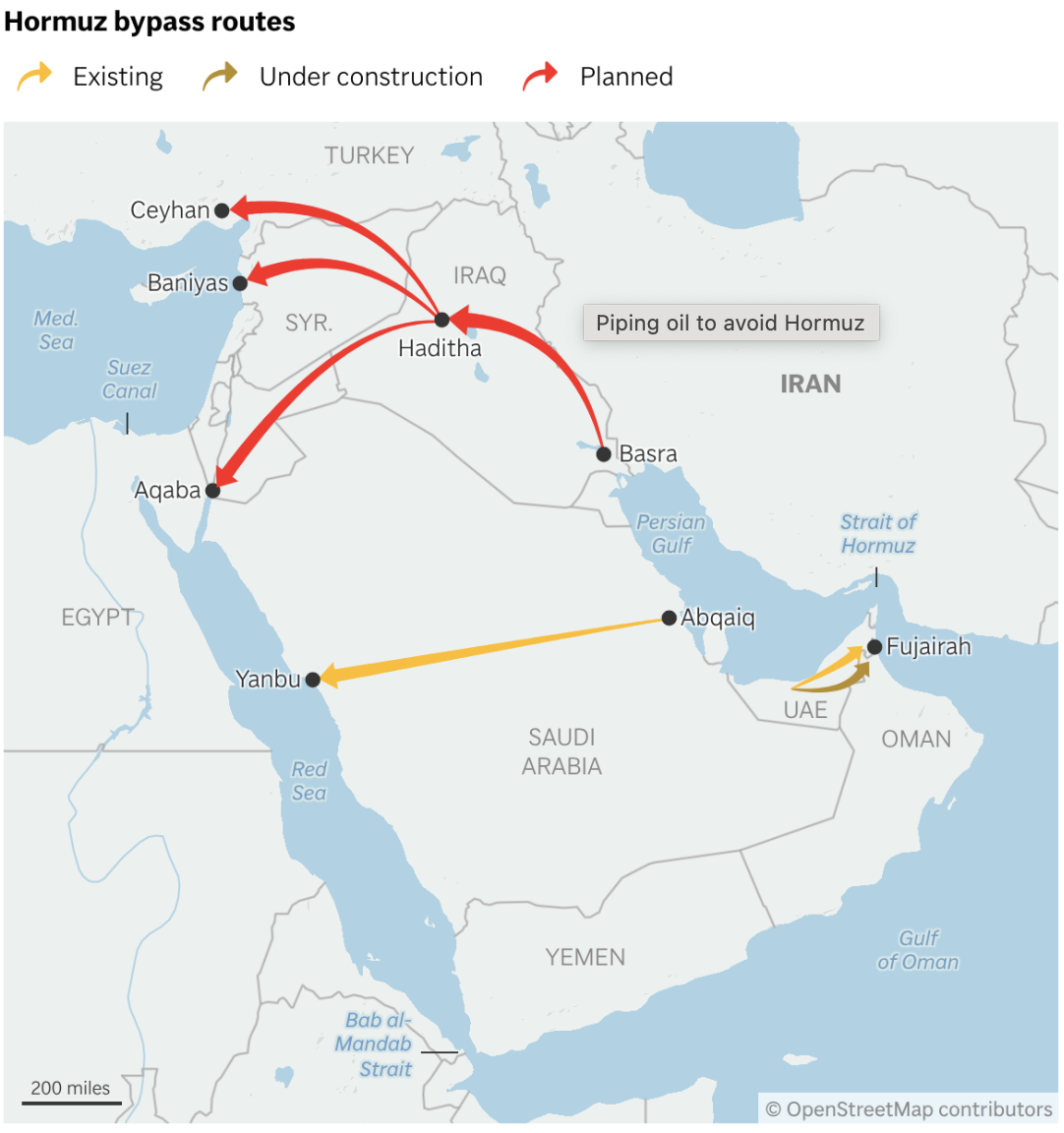
Hormuz Bypass Routes
Source: AP
Maritime disruption in the Strait of Hormuz has restricted commercial shipping through uncertainty created by limited projectile strikes. Recent maritime data indicates that ship crossings in the Strait of Hormuz remain at single digits, forcing some shipping operators to seek alternative routes. The Panama Canal has experienced congestion, with record transit prices and increased competition for slots. The added disruption in the Bab el-Mandeb chokepoint in the Red Sea has also resulted in a reduction in traffic, while Saudi Arabia has shifted towards exporting via the Suez Canal and transporting oil to Oman by truck to export from Sohar port.
As chokepoint disruption persists and expands in the Middle East, alongside downstream impacts, adaptation efforts are emerging, and existing alternatives are increasingly used. Saudi Aramco increased its use of the East-West pipeline with the energy corridor pumping at its maximum capacity of 7 million barrels of oil per day. Likewise, the UAE’s use of the Habshan-Fujairah pipeline rose by approximately 15%. The importance of oil pipelines is evident with recent reports of seven pipelines either planned, under construction, or in discussion. Of the four planned pipelines, three will avoid both Hormuz and Bab el-Mandeb altogether. Some estimates suggest the planned projects could allow 60% of pre-conflict Gulf oil exports to completely bypass Hormuz by 2028. Other pre-conflict overland options are being expanded, such as Saudi Arabian Railways seeking to develop access from rail hubs to Red Sea ports. The overland options have led logistics companies to adapt by offering a combination of land and sea transport connecting Europe to the Middle East. Chokepoint disruption has increased the use of existing bypass infrastructure and contributed to the development of new routes.
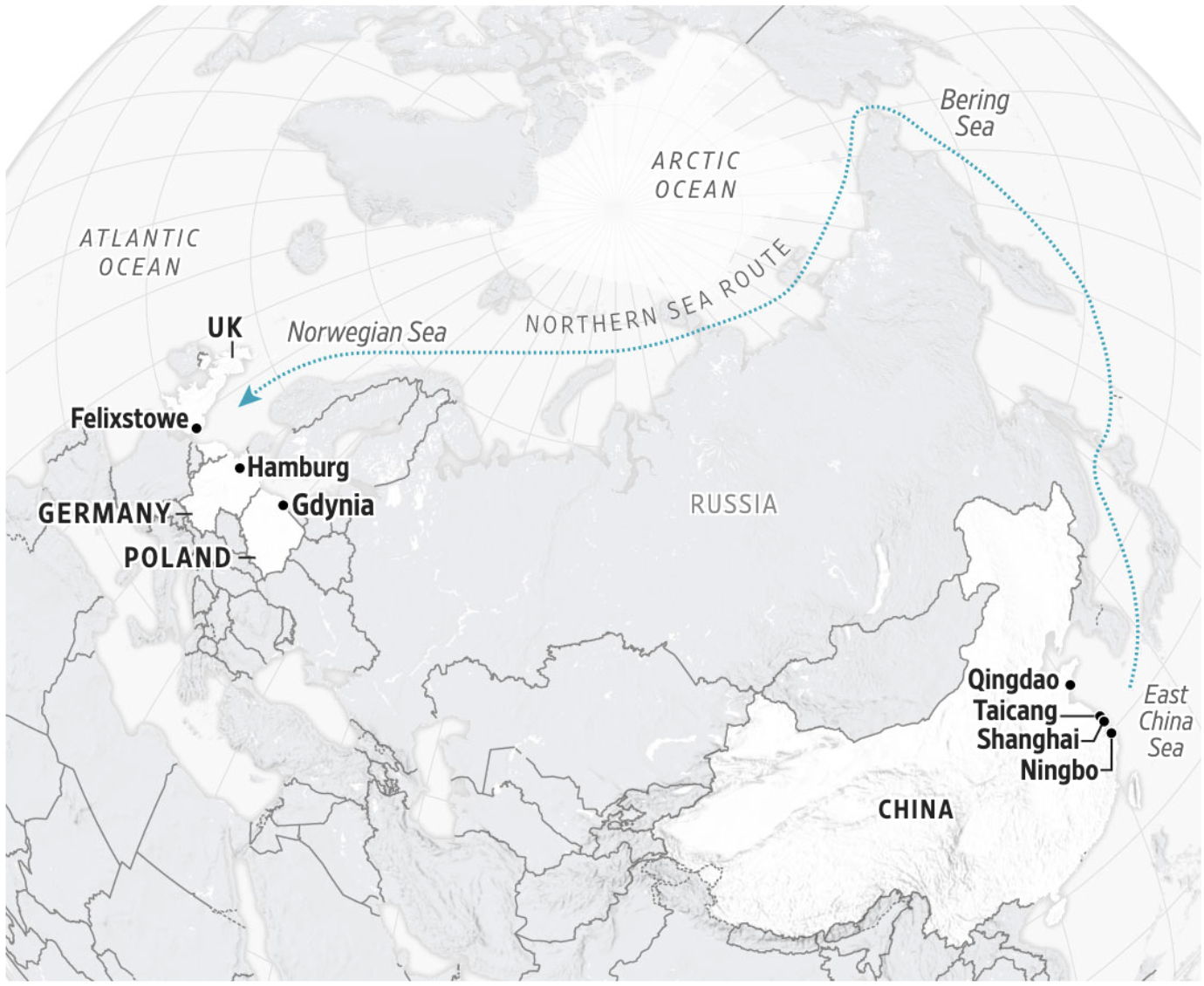
Northern Sea Route
Source: Sea Legend
New services on previously limited routes are also commencing. A Chinese company has commenced a Northern Sea Route (NSR) service connecting Asia with Europe through the Arctic, with the intention of reducing both travel time and fuel costs. Benefits of the NSR include almost halving the transit time for some voyages and the route being more suitable for temperature-sensitive cargo such as electric vehicles, lithium batteries, and solar products. Other Asian states such as India, Korea, and Japan have expressed interest in the NSR. Although the NSR may seem a viable alternative, it comes with risks which reportedly include the route being under Russian control, with the U.S. on the other side of the Bering Strait, only operating for three months during the summer, icebreaker costs, unpredictability, and environmental concerns. For now, the NSR remains a commercially limited and largely untested alternative that may develop into a more frequently used route.
China has demonstrated other logistical adaptation measures due to the insecurity in the Strait of Hormuz. Two Chinese shipping companies that carry approximately 50% of China’s oil imports from the Middle East are reportedly avoiding transiting Hormuz and Bab el-Mandeb, preferring ship-to-ship transfers outside the Gulf. Other efforts include Chinese tankers using Omani ports or Fujairah in the UAE, as well as loading Saudi oil at Egypt's Mediterranean port of Sidi Kerir. The alternative import measures suggest logistical methods and routes are developing and that arrangements between exporters, importers, and shipping companies are having to adapt.
Assessment
Chokepoint disruption has accelerated the development of alternative routes and increased the use of existing infrastructure. While avoiding the Strait of Hormuz and Bab el-Mandeb is possible, the various methods to continue oil flows may have reduced some supply shortages but have not sustained pre-conflict levels. Commercial shipping and oil exporters remain dependent on maritime transport chokepoints to meet the global demand for oil. For now, the alternative routes provide some additional options for trade and oil flows to continue but do not entirely replace maritime chokepoints.
Adaptation to maritime disruption has been diverse, with no single option offering an alternative to the two disrupted chokepoints. Greater reliance on the two existing pipelines in Saudi Arabia and the UAE demonstrates that bypass infrastructure remains important, and with other pipelines planned, future reliance on Gulf chokepoints may be reduced. Overland railway hubs that connect to ports indicate that a combination of land and sea transport is also mitigating the impact of disruption. For companies that remain dependent on maritime routes, ship-to-ship transfers have developed as another option to reduce exposure to insecurity in the Gulf. Resilience to chokepoint disruption increasingly appears to depend on having multiple options and to be determined by the geographical location of importers.
Commercial shipping operators and insurers require stability to calculate costs. Unpredictable conditions in the Gulf mean constant risk assessments are required, while transit times can fluctuate with downstream effects, including congestion and price increases. These factors can make alternative routes more attractive. The NSR may illustrate how an alternative route can be developed with perceived benefits such as reduced transit times. Commercial corridors like the NSR may take time to prove viable, as they face challenges of their own, but they could provide temporary relief in the immediate term.
The conflict in the Gulf has highlighted the importance of supply chain resilience and export route diversification. Chokepoints remain significant, but access has proven vulnerable to limited kinetic activity. Globally, states are reliant on trade and energy flows, and the vulnerabilities exposed in the Gulf chokepoints mean states may place increased value on developing and investing in alternative routes and infrastructure. For global trade and energy flows to continue, commercial shipping operators, states, exporters, and importers may need to collaborate to build route resilience to bypass chokepoints or adapt to other future disruptions, including disruptions to land-based routes.
Strategic Indicators
Maritime Chokepoint Pressure ▲ Increasing
Alternative Trade Route Development ▲ Increasing
Maritime Logistics Adaptation ▲ Increasing
Energy Export Route Diversification ▲ Increasing
Indicators to Monitor
Commercial shipping volumes transiting the Strait of Hormuz and Bab el-Mandeb, and maritime data indicating operators using alternative routes.
Congestion and transit costs through the Panama Canal.
Daily oil throughput of the East-West and Habshan-Fujairah pipelines.
Announcements indicating progress in the development of regional pipelines.
Saudi Arabia Railways investment in transport hubs.
Maritime data on Chinese ship-to-ship transfers.
Maritime data on commercial shipping volumes using the NSR.
Conclusion
Energy supply chain resilience is developing beyond chokepoints in the Gulf as disruption accelerates efforts to find alternative routes. Insecurity has increased the need to diversify by expanding oil exports using existing infrastructure while also developing pipelines, using land-sea connections, and using previously limited routes such as the NSR. As the chokepoint disruption persists, these alternatives may become more reliable and permanent over time; however, they will also depend on geography, cost, capacity, and investment in infrastructure. For the immediate term, chokepoints will remain central to energy and trade flows.
Sources
Corporate and Official Sources
Saudi Aramco. Aramco announces first quarter 2026 results. 10 May 2026.
Aramco source
News Reporting
Reuters. Hormuz crossings rise slightly over weekend, remain in single digits, data shows. 18 August 2026.
Reuters source Reuters. China's state shippers deploy oil tankers outside Gulf, avoid chokepoints, sources say. 18 August 2026.
Reuters source Associated Press. Mideast oil producers step up plans to bypass the Strait of Hormuz. 23 July 2026.
Associated Press source The National. UAE's Hormuz oil exports more than halve in July as tankers avoid route. 3 August 2026.
The National source The Guardian. Strait of Hormuz alternative: China ships Northern Sea Route through Arctic. 17 August 2026.
The Guardian source
Maritime and Industry Reporting
Lloyd's List. The Week in Charts: Red Sea traffic holds firm despite Houthi blockade — NOAA upgrades El Niño warning and outlook for Panama Canal worsens.
Lloyd's List source The Maritime Executive. Shipping Companies Leverage Arabian Peninsula Truck Routes to Bypass Hormuz. 11 May 2026.
The Maritime Executive source
Financial and Business Reporting
The Wall Street Journal. China Is Opening the First Regular Cargo Route Through the Arctic. 15 August 2026.
The Wall Street Journal source Financial Times. Northern Sea Route analysis.
Financial Times source