Chokepoint or Control Point? Guardians of the Strait.
KEY TAKEAWAYS
Limited projectile strikes have contributed to reduced transit shipping volumes through the Strait of Hormuz.
The U.S. announced the reinstatement of a shipping blockade and a proposed 20% surcharge for transit protection.
Iran claims to be targeting infrastructure that sustains U.S. operations, including a refuelling facility in Oman.
Maritime data indicates shipping volumes have fallen significantly, with traffic using the Omani corridor having almost “disappeared.”
The contest in the Strait of Hormuz continues to challenge the principle of freedom of navigation and is expanding towards competition over maritime governance. Transit through the Strait is increasingly influenced by the intersection of military power, commercial behaviour, insurance premiums, diplomatic engagement, and international law. While two transit corridors had emerged, one close to Oman and the other Iran, the UKMTO reported a projectile attack on the Omani route, raising the possibility that the risk is no longer confined to a single corridor. President Trump's announcement of a 20% charge on cargo ships for U.S. transit protection adds another layer to an evolving situation. Strategic competition is no longer centred solely on access to the Strait, but on shaping the conditions under which that access is exercised. The legal principles governing the Strait remain; however, the strategic environment in which those rights are exercised is increasingly being challenged.
Under the United Nations Convention on the Law of the Sea (UNCLOS), vessels have the right to transit through international straits that connect one part of an exclusive economic zone (EEZ) and the high seas to another EEZ or high seas. With the Strait of Hormuz carrying approximately 20% of global oil trade, freedom of transit underpins one of the most strategically important maritime supply routes. The principle enables vessels to transit the Strait unimpeded, provided the passage is continuous and solely for the purpose of transit. On July 13, the International Maritime Organization (IMO) reaffirmed the importance of maintaining navigational rights and freedoms, without tolls or charges, in accordance with international law. The statement came on the same day the Trump administration announced a proposed 20% service fee for transit protection.
Transit passage under UNCLOS is intended to preserve navigation through international straits, regardless of maritime territory claims that may exist by coastal states. It does not require coastal states to guarantee safe passage. Recent developments in the Strait of Hormuz suggest that the practical exercise of transit passage is becoming increasingly dependent on military protection, commercial confidence, and security arrangements, rather than international law alone.
Iranian threats to the Strait of Hormuz are neither rare nor surprising, given what decades of war games have demonstrated. Threats to disrupt the Strait have long been anticipated, particularly during periods of heightened tension, but the Strait has rarely been considered closed. Iran’s geographic position allows it to create disruption and maintain leverage through the threat of mines, drones, fast-attack boats, and projectiles.
The ambiguous status of the Strait has contributed to the emergence of two transit corridors: one close to the Iranian coast and another close to Oman. Shipping data indicates that vessels are assessing the perceived risk of each route, with sanctioned vessels using the Iranian corridor and unsanctioned vessels generally favouring the Omani route.
Projectile attacks on vessels have been sporadic and limited, often occurring when transit volumes increase or in response to U.S. rhetoric or military action. The use of projectiles suggests that Iran is seeking to influence access the Strait as a source of strategic leverage, rather than pursuing complete closure. The objective may be to demonstrate the ability to impose risk, and that risk carries a cost that is likely to affect freight rates, insurance premiums, and commodity prices.
Iran’s claimed targeting of naval supply chains across the Gulf also demonstrates a strategy of limited tactical engagement. Rather than targeting military platforms directly, Iran targeted a refuelling facility at Duqm in Oman used to support U.S. naval operations. Iran claimed the facility was used to support U.S. carrier strike groups. U.S. naval vessels in the region depend on refuelling, maintenance, and regional port infrastructure, and targeting these sites seeks to degrade the systems that sustain U.S. military operations in the region. U.S. allies in the region are increasingly becoming part of the maritime battlespace, while the logistics infrastructure used to sustain operations may also become a continuing target.
Control over passage extends beyond military security to commercial costs created by insecurity. According to Kpler maritime data, crossings between July 10 and 12 were down 52% week-on-week, with traffic using the Omani corridor having almost "disappeared." Combined with the proposed 20% U.S. transit charge, Lloyd's List estimates that a fully laden crude carrier would cost US$32 million to transit. Those additional costs would likely be transmitted through higher insurance premiums, freight rates, commodity prices, and wider supply chain disruption. Transit passage under UNCLOS was intended to prevent international navigation from becoming subject to territorial disputes or conflict. Although some vessels may continue to transit the Strait, the costs imposed by insecurity may become commercially prohibitive.
Governance of the Strait is therefore exercised not only through military security but also through the economic costs imposed on those seeking to use it. While Iran uses coercion and risk to influence passage through the Strait, the U.S. is using security provision to influence it.
In a White House statement, President Trump referred to “…reinstating the blockade.” As part of the strategy to restore freedom of navigation, President Trump described the U.S. as "The Guardian of the Hormuz Strait." The proposal includes a 20% surcharge for U.S. transit protection. Providing security can itself be a form of governance by influencing access to the Strait.
Details of the charge are unclear, including how it would be collected and who would bear the cost. A 20% surcharge may increase commercial shipping costs; however, whether it proves inflationary may depend on whether shipping volumes and commercial confidence increase. The legal implications are also uncertain. UNCLOS permits charges only for specific services rendered and prohibits fees that would impede transit passage. Whether the surcharge would be interpreted as payment for a service or as an impediment to transit remains open to legal interpretation. Security provision is becoming another form of strategic influence alongside coercion, adding a further dimension to the contest over maritime governance.
Assessment
The situation in the Strait of Hormuz continues to evolve as access to the chokepoint is increasingly contested. Military, commercial, diplomatic, political, and legal instruments are interacting to influence passage through the Strait. Military intervention in the Strait has remained limited, and neither Iran nor the U.S. is relying solely on military power to influence passage. Transit data continues to reflect projectile attacks and commercial risk assessments. While recent statements by the IMO and NATO have reaffirmed international law, it has not, by itself, been sufficient to guarantee freedom of navigation. For strategic maritime chokepoints, developments in the Strait of Hormuz may serve as a warning that neither international law nor military power alone can guarantee unimpeded transit and that governing access may be as important as controlling territory.
Strategic implications
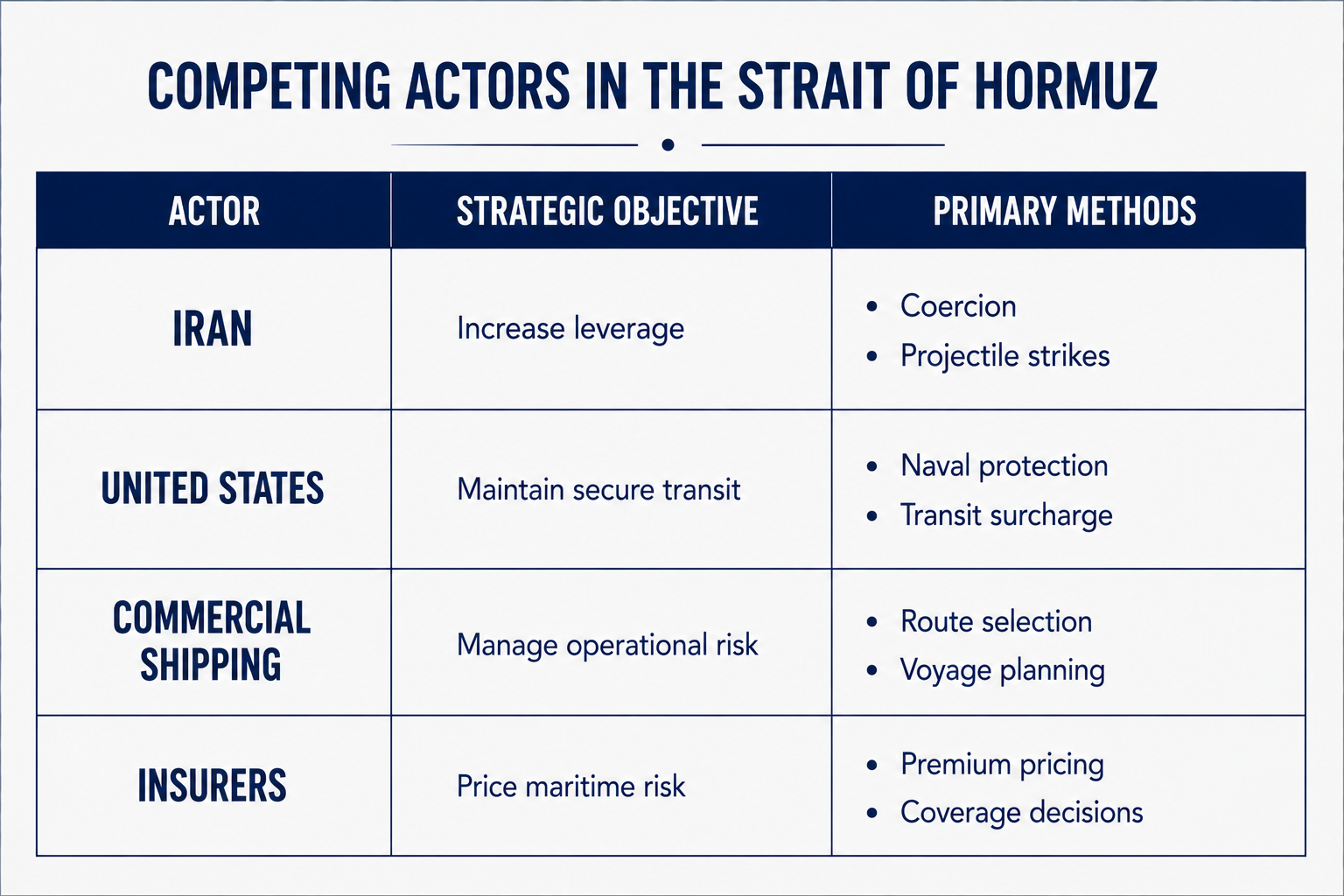
Maritime governance can become contested through even limited threats. Safe passage through a strait may depend on the interaction of security arrangements, routing corridors, economic conditions, and commercial behaviour. International law functions during peacetime; however, during conflict, its practical application is dependent on naval power, commercial confidence, logistics, coalition support, and states willingness to uphold it. Commercial actors also become geopolitical actors shaping the maritime environment through pricing, insurance, routing decisions, and investment.
Insurers and commodity traders will continue to reassess risk, while supply chains may face disruption as vessels rely on ports and logistics to absorb operational shocks. Disruption to chokepoints adds costs that can have downstream effects on shipping, commodity prices, insurance, investment decisions, and global supply chains.
To avoid direct escalation, adversaries may target military logistics rather than combat capabilities. By targeting infrastructure that sustains military operations, such as fuel depots, ports, communications, maintenance hubs, and logistics networks, adversaries can reduce a military’s ability to sustain and project force. It may also limit escalation by avoiding direct attacks on combat platforms that carry a greater risk of immediate retaliation.
Maritime chokepoint disruption requires endurance. A resolution is not easily achieved, as maritime disruption can be sustained with relatively limited means while requiring significant resources to counter. Even with institutional support, a resolution to maritime disruption is challenging.
Sources
International Law
United Nations Convention on the Law of the Sea (UNCLOS)
https://www.un.org/depts/los/convention_agreements/texts/unclos/unclos_e.pdf
International Maritime Organization (IMO)
https://www.imo.org/en/mediacentre/pressbriefings/pages/imo-council-reaffirms-commitment-to-protecting-vital-shipping-lanes.aspx
Military Analysis
Brookings Institution – The U.S.–Iran Crisis Simulation
https://www.brookings.edu/wp-content/uploads/2016/06/us-iran-crisis-simulation-pollack-paper.pdf
Just Security – War Game: Iran
https://www.justsecurity.org/137609/war-game-iran/
Maritime Security
UK Maritime Trade Operations (UKMTO)
https://www.ukmto.org/
Kpler – Strait of Hormuz Shipping Data
https://x.com/Kpler/status/2076600222109630907
Lloyd's List – Tanker Transits Through Strait of Hormuz Plunge
https://www.lloydslist.com/LL1157824/Tanker-transits-through-Strait-of-Hormuz-plunge-as-Iran-attack-kills-crew-member
Government Statements
The White House – Strait of Hormuz Statement
https://x.com/WhiteHouse/status/2076677069577007330
Reporting
The Daily Telegraph (via New Zealand Herald) – Iran Aims to Cripple U.S. Navy Supply Chain with Wave of Strikes in Middle East
https://www.nzherald.co.nz/world/iran-aims-to-cripple-us-navy-supply-chain-with-wave-of-strikes-in-middle-east/GRPOGQVYWVFHTJATY5VYQR3MW4/