Critical Mineral Competition: Restrictions, Disruptions and Resilience
Key Takeaways
Chinese critical mineral restrictions on Japan have led to projected supply shortages in the fourth quarter.
Restrictions are expected to reduce Japan’s GDP and cost businesses billions.
Japan has spent more than fifteen years diversifying critical mineral supply chains through investment, deep-sea mining and a strategic cooperation with the U.S.
U.S. domestic investment reflects a broader strategy to build and strengthen supply chain resilience.
Control over processing and supply chains may provide states with leverage beyond access to critical minerals.
China’s restrictions on rare earth exports to Japan have led to corporate warnings about supply disruptions for the next quarter. Following heightened tensions over Japan’s position on Taiwan, China implemented export bans on rare earths used in dual-use technologies, including Japan’s defence industry. Chinese export data illustrated the extent of the restrictions, with zero exports of terbium or dysprosium over the seven months between November and May. With only small amounts of yttrium oxide recorded, the restrictions could also be interpreted as an effective ban on certain minerals. The restrictions suggest that critical minerals and rare earths are not merely traded commodities but strategic instruments that can be used for coercive influence.
China’s export restrictions on rare earths to Japan can be traced back to a territorial disagreement over the Senkaku/Diaoyu Islands. The dispute surfaced after a collision between a Chinese fishing trawler and the Japanese Coast Guard vessel led to the trawler being detained. In retaliation for the territorial dispute, China leveraged its market dominance and implemented a trade embargo on rare earths to Japan. With almost 90% of Japan’s rare earth imports coming from China, the implications of relying on a single supplier became evident. Since 2010, Japan has made efforts to diversify and strengthen its critical mineral supply chain resilience.
Despite 15 years of effort to diversify critical mineral supply chains, Japan remains reliant on China for key rare earths. Initial attempts to secure supplies from Vietnam were constrained by Vietnam’s own export restrictions. By 2017, however, Vietnam accounted for 42% of Japan's rare earth imports. Japan also invested in domestic processing technologies, deep-sea exploration, recycling, and overseas resource development while expanding strategic partnerships with Australia and South Korea. Japan is set to begin deep-sea mining in 2026, with surveys showing the presence of minerals at 5,000 to 6,000 metres. Significant efforts may have reduced dependence, but not eliminated strategic supply vulnerability.
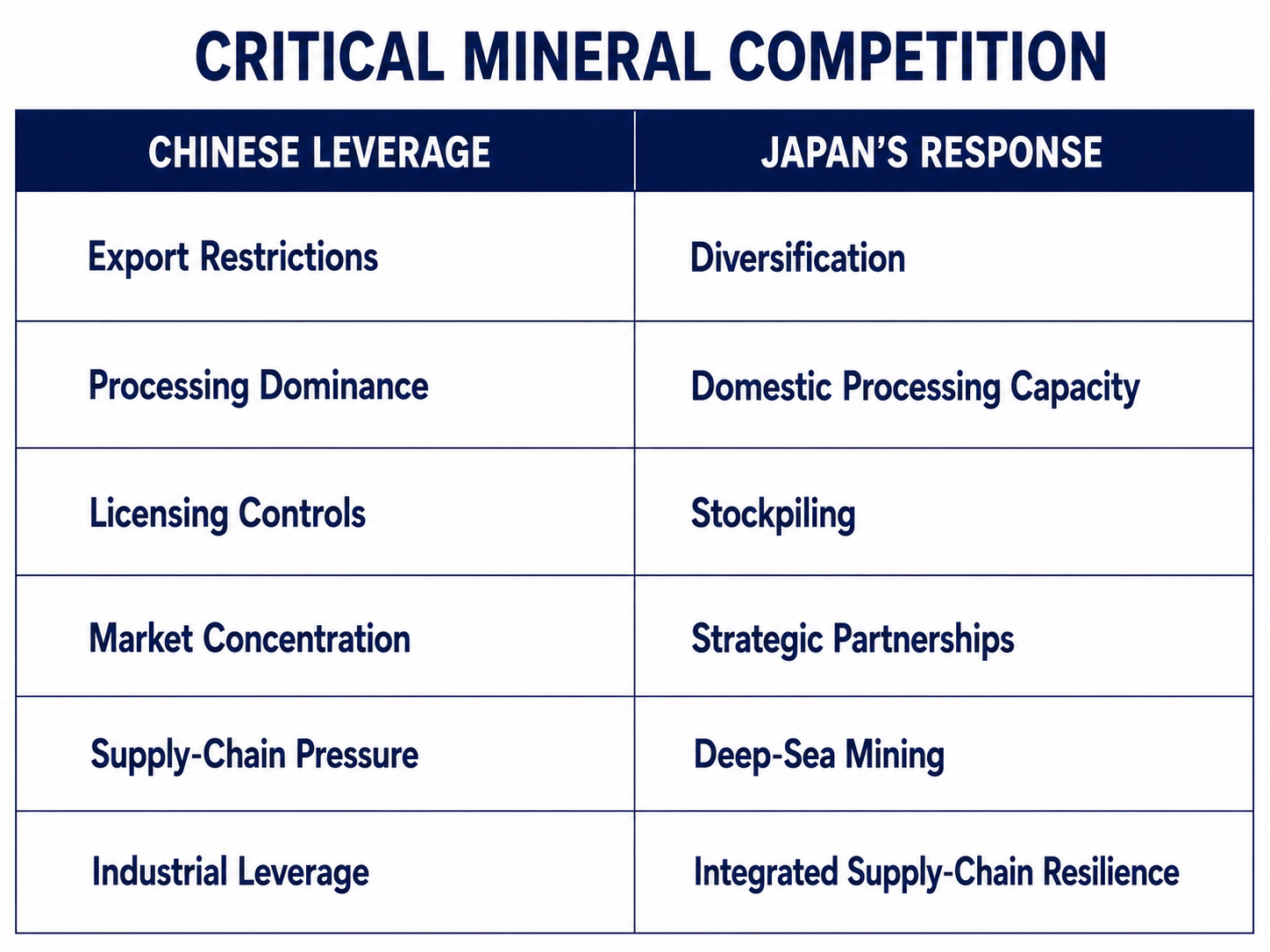
Japan’s diversification response has expanded beyond investment to include strategic cooperation. In October 2025, Japan and the U.S. signed a framework agreement as part of a strategy to build supply chain resilience. The two countries have agreed to share information on mining cooperation and geological mapping, alongside stockpiling of critical minerals and a rapid response to supply disruptions. Recent reports indicate the U.S. has invested billions to expand domestic critical mineral production, with producers selling to Asian markets, including Japan. The collaboration underpins strategic cooperation to build integrated supply chain systems. However, magnet production remains a challenge, with U.S. manufacturing yet to develop, leaving buyers dependent on China.
Japan’s reliance on Chinese critical mineral supply chains has had economic impacts. The 2010 restrictions are estimated to have reduced Japan’s GDP by 0.9%, while the current restrictions are estimated to affect both businesses and economic growth. The Nomura Research Institute estimates that the January restrictions could cost businesses approximately USD 4.2 billion during the first three months and reduce GDP by 0.11%. At the same time, supply chain disruptions linked to the Middle East have caused further pressure. With Japanese car manufacturers reliant on aluminium imports, prices spiked to a four-year high last month, with Japanese buyers agreeing to pay a higher premium for the third quarter. Dual disruptions demonstrate how geopolitical developments interact to compound supply chain pressure, creating simultaneous supply chain shocks.
Japan has demonstrated adaptability in responding to critical supply chain pressure for over a decade. Despite diversification in sources, processing and magnet manufacturing are concentrated. Developing industrial capacity requires significant investment, technology, and expertise, and international partnerships. Alternative sources of critical minerals may ease supply pressure; however, they do not eliminate dependence while processing capacity remains concentrated.
Assessment
Japan’s experience highlights that supply chain competition is not only about access to critical minerals but also about the industrial capacity to process and distribute them. Critical mineral coercion means that states controlling processing retain influence over supply chains that can be used as strategic leverage. A state that can impose restrictions or disrupt supply chains may influence other states' strategic decisions towards the dominant critical mineral supplier. Restrictions or disruptions may act as a form of deterrence. Japan has shown that diversification is a long-term process, requiring multiple interacting policies to reduce exposure. For states pursuing similar policies to mitigate supply chain risks, they may face similar challenges.
What to watch
U.S. critical mineral companies' acquisitions of international mining and processing facilities.
U.S. investments in domestic critical mineral production, processing, and magnet production.
U.S. federal pricing for targeted products.
Japanese expansion of seabed mining and domestic processing capacity.
New critical mineral partnerships, stockpiling agreements, and joint supply-chain initiatives between allied states.
Chinese responses to diversification efforts, including export controls, licensing requirements, and processing restrictions.
Chinese and Western investment in emerging economies to secure access to critical minerals.
Sources
News Reporting
Reuters. Corporate Japan's Rare-Earth Warnings Get Louder as China Keeps Spigot Closedhttps://www.reuters.com/world/china/corporate-japans-rare-earth-warnings-get-louder-china-keeps-spigot-closed-2026-07-06/
Reuters. U.S.-Japan Focus on Rare Earth Cooperation, Select Group of Minerals Firsthttps://www.reuters.com/business/aerospace-defense/us-japan-focus-rare-earths-cooperation-select-group-minerals-first-2026-03-19/
Kyodo News. China Halts Key Mineral Exports to Japanhttps://english.kyodonews.net/articles/-/79292
Mining Weekly. Japan to Begin Test Mining Rare Earth Mud from Seabed in Early 2026https://www.miningweekly.com/article/japan-to-begin-test-mining-rare-earth-mud-from-seabed-in-early-2026-2025-07-04
Mining.com. Billions in U.S.-Funded Rare Earths Flowing to Asian Marketshttps://www.mining.com/billions-in-us-funded-rare-earths-flowing-to-asian-markets-report/
Mining.com. Japan Buyers Agree on Higher Aluminium Fees Due to War Disruptionhttps://www.mining.com/web/japan-buyers-agree-on-higher-aluminum-fees-due-to-war-disruption/
IDN Financials. Japan Seeks Alternative Supplies as China Tightens Rare Earth Exportshttps://www.idnfinancials.com/news/65722/japan-seeks-alternative-supplies-as-china-tightens-rare-earth-exports
Academic Research
ScienceDirect. Research on Japan's Critical Mineral Diversification and Energy Securityhttps://www.sciencedirect.com/science/article/abs/pii/S0301420725001734
Strategic Analysis
CSIS. G7 Critical Minerals Ambitions and Iran's Natural Resourceshttps://www.csis.org/analysis/g7-critical-minerals-ambitions-and-irans-natural-resources