Saudi Arabia's Security Diversification: An Alliance with a NATO Member and Nuclear Power
Strategic Question
Does the Saudi Arabia–Turkey–Pakistan defence agreement signal the emergence of a new Middle Eastern security architecture and a broadening of Saudi Arabia’s security guarantees?
Key Judgements
Saudi Arabia is expanding its regional security partnerships through formal agreements.
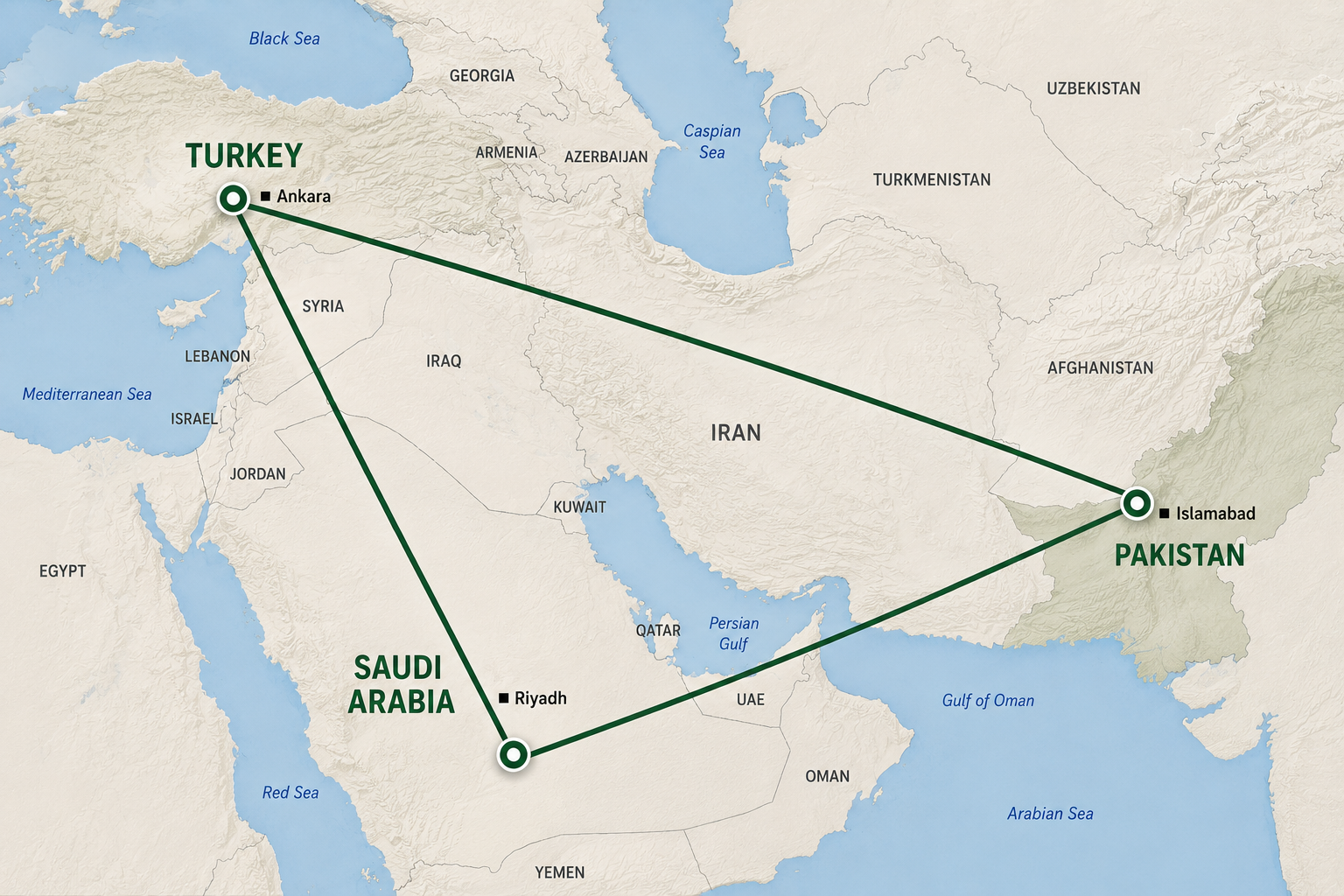
The Mecca Joint Defence Agreement contains mutual defence commitments between Saudi Arabia, Pakistan, and Turkey, creating a trilateral partnership and geographical triangulation across the Middle East and Asia.
The inclusion of Pakistan, a nuclear power, and Turkey, a NATO member, creates strategic ambiguity as to how the mutual defence will be operationalised.
Core Assessment
The signing of a defence pact between Saudi Arabia, Turkey, and Pakistan expands the existing Saudi-Pakistani defence agreement into a trilateral security arrangement. The addition of Turkey gives the group a geographic triangulation in the Middle East.
The Mecca Joint Defence Agreement (MJDA), which stipulates mutual defence, was signed amid attacks on Saudi Arabia originating from Iraq and Yemen. The Saudi-Pakistan defence agreement also contains mutual defence, but this has yet to result in a kinetic response despite heightened tensions in the Middle East and attacks on Saudi Arabia.
While Saudi Arabia maintains diplomatic and military relations with the U.S., the joint defence agreement suggests Riyadh is broadening its military partnerships through overlapping regional security guarantees. The effectiveness of the joint defence pact may be measured by how operational it becomes through military deployments, joint planning and exercises, intelligence sharing, and responses to future attacks.
Background
The MJDA was signed on 7 August 2026 in Mecca, establishing a trilateral defence pact between Saudi Arabia, Turkey, and Pakistan. The trilateral agreement builds on the bilateral defence agreement between Pakistan and Saudi Arabia and the existing military and economic ties between Saudi Arabia and Turkey.
The Saudi-Pakistan defence agreement was signed in September 2025, formalising a collective defence commitment connecting the Middle East and South Asia. The countries had an existing military relationship, with the agreement deepening strategic cooperation during a period of conflict in the Middle East.
In February 2026, Turkey’s President Recep Tayyip Erdoğan visited Riyadh to discuss expanding bilateral cooperation in defence and renewable energy. In 2023, Saudi Arabia agreed to purchase military equipment, including drones, as part of efforts to increase domestic production and reduce military reliance on imports. The elevated bilateral relationship may have been accelerated by increasing tensions in the Middle East while also aligning with Saudi Arabia’s Vision 2030 strategy, which includes economic and defence diversification.
Strategic Assessment
Saudi Arabia continues to diversify security partnerships, broadening its regional security guarantees through agreements. The halting of arms sales by the Biden administration may have highlighted Saudi Arabia’s vulnerabilities while the Kingdom was engaged in an ongoing conflict with the Houthis. While the U.S. weapons sales ban was lifted in 2024, the decision may have exposed Saudi Arabia’s dependence on U.S. supply chains, which may have contributed to the country’s efforts to establish military and energy ties with Turkey in 2023 and deepen its defence partnership with Pakistan in 2025. The MJDA now strengthens regional alliances amid heightened tensions and U.S. security policy ambiguity.
There are several strategic outcomes of the MJDA for Saudi Arabia. With Turkey to the north-west of Iran, Pakistan to the south-east, and Saudi Arabia to the south-west, the alliance forms a triangulation of Iran, although not stipulated as a containment agreement. As Pakistan is a nuclear power, its inclusion may introduce nuclear deterrence ambiguity while potentially reducing Saudi Arabia’s incentive to pursue its own nuclear capability. Turkey’s NATO experience may contribute to improved training and interoperability during military exercises alongside military and naval production capacity, while Saudi financing may support increased defence production. Together, the MJDA may create a regional deterrence mechanism.
The existing Saudi-Pakistan agreement and the MJDA both contain mutual defence commitments; however, how these will be operationalised remains to be seen. Saudi Arabia has been engaged in an ongoing conflict with the Houthis and was also struck by Iran during the U.S.–Iran conflict. Despite the regional risk, the MJDA suggests that Saudi Arabia has managed to deepen security ties, with Pakistan and Turkey willing to sign a pact with a country facing security threats. The MJDA contains a collective defence commitment; however, the similar provision in the Saudi–Pakistan defence agreement did not result in a kinetic response during strikes on the Kingdom. The lack of Pakistani intervention may indicate an activation threshold rather than an immediate joint response, which could also apply to the MJDA. With the full details yet to be released, the MJDA could focus on developing joint military exercises, intelligence sharing, and interoperability. The addition of a NATO member, Turkey, may also create wider security implications.
The inclusion of Turkey in the MJDA adds another dynamic to regional security. As a NATO member, an attack against Turkey could raise questions over the application of Article 5 and NATO’s collective defence commitments. If Turkey responded to an attack on Saudi Arabia under the MJDA and was subsequently struck, this could raise questions over NATO’s obligations towards Turkey. Turkey’s membership in the MJDA could provide additional deterrence, as how MJDA members and NATO states would respond to escalation remains ambiguous. The MJDA could therefore intersect with NATO security commitments, creating greater deterrence or strategic ambiguity, as an attack on Saudi Arabia may have even wider implications. With NATO yet to respond to the MJDA, Turkey’s inclusion remains difficult to interpret.
What to Watch
Regional diplomatic responses to the MJDA.
Escalation or deterrence of Houthi attacks on Saudi Arabia.
Turkey's and Pakistan's responses to any Houthi strikes.
Progress of the MJDA, including joint military drills, arms sales, interoperability, and intelligence sharing.
NATO diplomatic response to the MJDA.
U.S. diplomatic responses to the MJDA.
Strategic Indicator
Saudi Security and Military Alliance Diversification
Assessment ▲ Increasing
Saudi Arabia has made deliberate efforts to diversify not only its economy but also its defence strategy. After the Biden administration halted U.S. arms sales, the Kingdom made efforts to expand its military supply chains with regional and existing partners. Turkish President Erdoğan’s Gulf visit in 2023 resulted in an agreement for the Kingdom to purchase drones, followed by an agreement to manufacture them domestically.
The 2025 Saudi-Pakistan defence agreement deepened existing military ties into a formal security alliance, signalling that the Kingdom was diversifying and broadening its security alliances. With the addition of Turkey, the Kingdom has accelerated efforts to build partnerships even during heightened tensions and while facing attacks.
Sources
International Organisations
NATO — Collective defence and Article 5
https://www.nato.int/en/what-we-do/introduction-to-nato/collective-defence-and-article-5Research and Analysis
Chatham House — Talk of a Turkish military alliance with Saudi Arabia and Pakistan reflects Ankara's opportunistic foreign policy
https://www.chathamhouse.org/2026/01/talk-turkish-military-alliance-saudi-arabia-and-pakistan-reflects-ankaras-opportunisticTurkey Analyst — The Growing Alignment of Turkey and Saudi Arabia
https://turkeyanalyst.org/publications/turkey-analyst-articles/item/743-the-growing-alignment-of-turkey-and-saudi-arabia.htmlNews Reporting
Reuters — Saudi Arabia, Turkey, Pakistan sign joint defence deal amid regional turmoil
https://www.reuters.com/world/asia-pacific/saudi-arabia-turkey-pakistan-sign-joint-defence-deal-amid-regional-turmoil-2026-08-07/Reuters — Pakistan deploys jet squadron, thousands of troops to Saudi Arabia during Iran war
https://www.streetinsider.com/Reuters/Exclusive-Pakistan%2Bdeploys%2Bjet%2Bsquadron%2C%2Bthousands%2Bof%2Btroops%2Bto%2BSaudi%2BArabia%2Bduring%2BIran%2Bwar/26510077.htmlAssociated Press — Saudi Arabia, Turkey and Pakistan defence agreement
https://apnews.com/article/saudi-arabia-turkey-pakistan-defense-agreement-58048d4a100befd4d2c18e0cbae58b7cCNN — U.S. pauses Saudi and UAE arms sales
https://edition.cnn.com/2021/01/27/politics/us-pauses-saudi-uae-arms-sales