Saudi Arabia Develops Alternative Oil Routes, But at a Cost
STRATEGIC QUESTION
How is Saudi Arabia maintaining oil exports as disruption to the East–West Pipeline reduces its ability to bypass the Strait of Hormuz?
KEY JUDGEMENTS
Saudi Arabia has adapted its oil export routes in response to the closure of the East–West Pipeline through ship-to-ship transfers off Oman.
The new Saudi export route will rely on the Strait of Hormuz, which the East–West Pipeline was previously bypassing.
The emergence of the Saudi alternative routes requires additional logistics, including very large crude carriers, coordination, delays, rescheduling, increased shipping costs, and potentially greater exposure to risk.
Continued disruption to Saudi export infrastructure and export routes may further increase shipping costs and crude prices and change shipping behaviour as Asian markets seek alternative crude supplies.
CORE ASSESSMENT
Saudi Arabia’s East–West Pipeline, used to transfer crude to the port of Yanbu in the Red Sea, was closed on Friday after drone attacks along with loadings from Yanbu. Saudi Aramco had increased its use of the East–West Pipeline, pumping 7 million barrels of oil per day (bpd), which has now ceased. Saudi Arabia has reportedly adapted its export route by offering crude oil via ship-to-ship transfers off Sohar port in Oman. Other reports have indicated four very large crude carriers with a combined capacity of 8 million barrels also being loaded from Saudi Arabia’s Eastern Province.
Saudi Arabia’s adaptation has demonstrated export route resilience through developing alternative export options. With the overland East–West Pipeline now disrupted, Saudi exports have increased their reliance on maritime export movements. Although now operating under greater uncertainty with delays and rescheduling, Saudi Arabia may have secured vessels to ship supplies through the Strait of Hormuz for onward transfer outside the Gulf.
BACKGROUND
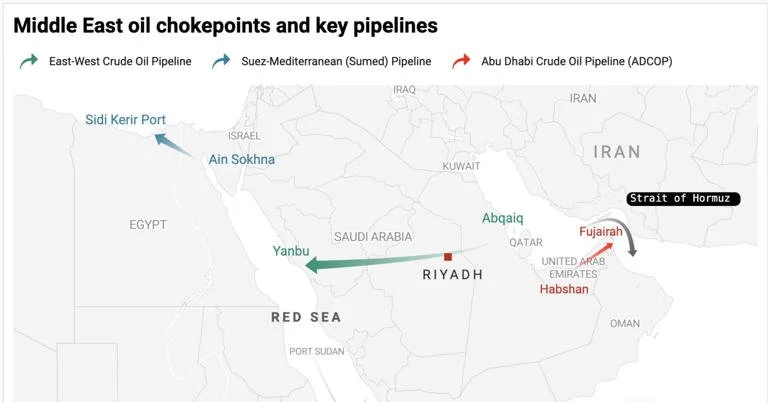
Source MSN
Disruption in the Strait of Hormuz has reduced shipping transits to single digits recently, with only seven vessels recorded on 9 September. As maritime disruption persists, Saudi exporters have increasingly relied on the East–West Pipeline, which carries crude to the port city of Yanbu on the Red Sea to bypass the Strait of Hormuz, offering onward routes through Bab el-Mandeb or the Suez Canal. Some estimates indicate the pipeline was pumping around 3 million bpd in early September, allowing exporters to continue crude flows; however, volumes were down from the 7 million bpd recorded earlier in the crisis. Simultaneously, loadings from Yanbu added to export capacity. Despite months of ongoing disruption in the Strait of Hormuz, Saudi Arabia maintained routes that enabled it to continue crude oil exports via a combination of overland and sea.
STRATEGIC ASSESSMENT
Saudi Arabia is experiencing multiple disruptions and pressures on its crude exports; however, it is displaying route resilience. With the closure of the East–West Pipeline, Asian importers have reportedly already been offered crude via ship-to-ship transfers off Sohar, although there are some scheduling delays. The rapid adaptation, although yet to reach pre-disruption levels, indicates Saudi Arabia’s ability to adjust oil export logistics to continue supplying crude. Despite Saudi Arabia’s efforts to find an export mechanism, oil exports continue to rely on Hormuz before ship-to-ship transfers outside the Gulf.
Alternative routes still require additional logistics and remain exposed to additional risks. Saudi Arabia’s maritime ship-to-ship transfers shift exports back toward Hormuz, which the East–West Pipeline was bypassing. Ship-to-ship transfers require additional tankers in the supply chain, which importers and shipping operators will need to coordinate while also potentially increasing shipping costs. Although Saudi Arabia is developing an alternative route, it may be one that is more complex, costly, and requires agreement from importers. Transits through Hormuz remain disrupted and continue to be exposed to further disruption; if attacks escalate, Saudi exports may be restricted by the limited alternatives to the current route proposed.
As export options become more complex, limited, and resource-intensive, prices will likely increase. VLCC earnings for the Middle East Gulf–China route increased to a daily rate of USD 1.1 million as of September 11, alongside some prices for European oil cargoes rising to more than USD 130 a barrel, with shipping insurance premiums potentially rising due to increased risk. Asian importers had already pivoted to purchasing U.S. oil after the disruption in Hormuz, which could increase further as buyers search for a more stable alternative. Disruption to Saudi Arabian exports may lead to delays, increased shipping costs and higher crude prices, while also creating additional pressure on other oil markets and shipping routes as states seek alternative oil supplies.
WHAT TO WATCH
Shipping and crude volumes to indicate the emergence of an alternative Saudi export route.
Crude prices and shipping costs in response to logistical, supply, and risk increases.
Militia or Houthi attempts to further disrupt Saudi energy infrastructure and supply chains.
Congestion in the Panama Canal as Asian markets increasingly rely on alternative suppliers, alongside U.S. crude export volumes to Asia.
STRATEGIC INDICATORS
Disruption of Saudi Arabian Energy Exports
▲ Increasing
Saudi Arabia’s Energy Export Adaptation
↔ Mixed
Risks and Costs of Gulf Crude Oil
▲ Increasing
SOURCES
International Reporting and Energy Markets
Reuters — Saudi Offers More Crude via Oman Loading After Pipeline Attacks
Reuters source
Reuters — Hormuz Shipping Traffic Falls to Single Digits
Reuters source
Reuters — Saudi Pipeline Outage Threatens Global Oil Supply
Reuters source
Reuters — Physical Oil Cargoes Rise Above $130 per Barrel Amid Saudi Disruption
Reuters source
Reuters — European Buyers Seek Alternatives to Saudi Oil Supply
Reuters source
Shipping and Maritime Markets
Lloyd’s List — With Yanbu Exports in Peril, VLCC Spot Rates Continue to Spike
Lloyd’s List source
Lloyd’s List — Why VLCC Rates Just Went Ballistic and How They Could Go Even Higher
Lloyd’s List source
Energy Infrastructure and Background
U.S. Energy Information Administration — World Oil Transit Chokepoints
U.S. EIA source
Saudi Aramco — Q1 2026 Results and Earnings Call
Saudi Aramco source
Institute for Energy Research — Saudi East-West Oil Pipeline Damaged by Drones
Institute for Energy Research source