Signs of Naval Escorts Forming
Key Takeaways
Iran’s maritime disruption strategy in the Strait of Hormuz is applying global economic pressure.
The conflict may shift from degradation strikes to securing the Strait.
Early indications suggest a coalition of naval escorts that will require coordination and risk management.
The strategic dilemma is the imbalance between rapid disruption and a slow response.
The Iranian disruption in the Strait of Hormuz was always a possible outcome of U.S. conflict. Roughly 20% of the global oil supply transits through the Strait, which is why the disruption is having global economic repercussions. The disruption of the narrow passage of water enables Iran to apply international pressure by stopping oil transits, which creates domestic pressure through inflation and price increases at the pump. This Iranian maritime strategy also impacts insurance prices with flow-on effects. Critically, even the threat of mines creates enough uncertainty and tanker disruption. The move is likely to elicit a U.S. response to relieve international pressure, and there are indications that the Strait will become militarised.
Recent U.S. operations indicate that strikes have targeted specific facilities as part of a maritime prevention strategy. The risk to the Strait is the deployment of mines and drone launches from the coast, which are difficult to counter. U.S. strikes have reportedly destroyed a number of mine-laying vessels, as well as mine and drone facilities, to degrade Iranian stockpiles and manufacturing capacity. The conflict is shifting towards a maritime denial phase where competition to control the Strait will be contested. The removal of the threat to the Strait will require more than the recent strikes, with the decision to move towards naval escorts to stabilise shipping routes a possibility. It is likely the U.S. will need assurance that the Iranian capabilities are degraded so they pose a minimal threat to naval escorts, which may take time. The added focus is now on securing maritime transit.
With the airspace largely controlled and targeted strikes on Iranian mine and drone capabilities, the next move for the U.S. may be a naval deployment. Escorts require significant planning and coordination, with some early signs indicating the beginning of this phase. The U.S. 5th Fleet operates in the Gulf and has provided maritime security in the region, protecting energy ships. Any naval escort is likely to be under the 5th Fleet due to its regional knowledge and capabilities to mitigate threats. The repercussions of the Strait disruption are evident in the wider naval response. One indicator that the response may be part of an international coalition is that Europe has responded. The French president is reportedly assembling a defensive and supportive naval force that includes an additional two frigates to the European Union's Naval Force (EUNAVFOR), which is also building a presence in the Mediterranean.
Beyond European and U.S. collaboration, another indicator could be the inclusion of Gulf states. The 5th Fleet has already led multinational maritime security operations with some Gulf states participating; therefore, there is already a U.S.-led command structure. Additionally, the U.S. has naval and logistical bases in the region that the host Gulf states can use to coordinate joint naval patrols. Gulf states also rely economically on the Strait for energy exports, which may provide more incentive to resolve the disruption as soon as possible. Simultaneously, naval escorts could bring participants into conflict with Iran, which poses a greater risk to state autonomy and the region. While there may be pressure on Gulf states, there is also pressure on Iran; the Strait also provides it an economic and military lifeline.
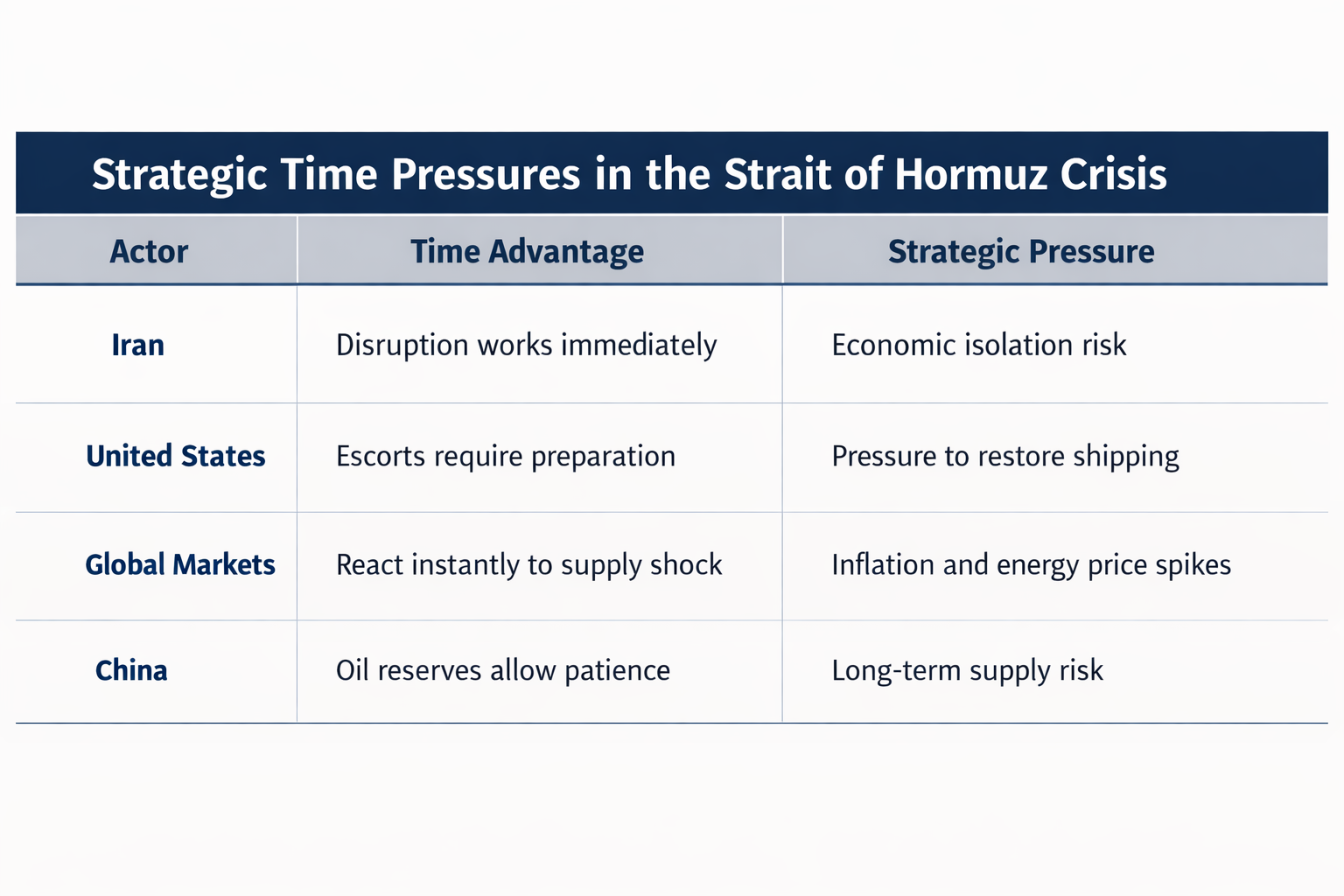
Iran faces its own challenges if it chooses to employ tactics to close the Strait. Even the threat of Iran deploying mines can cause disruption, and as a strategy, it is likely one of its safest options. Depending on Iran’s remaining capabilities, any attempt to close the Strait may also inflict economic and diplomatic damage on the country. Mines are indiscriminate, and if Iran deploys mines, they will restrict its own movement. The effects already indicate the impact, as some shipping analysis shows shadow fleet numbers down to about half the number for March. The shadow fleet can operate under disruption; however, it is likely the oil flows are restricted and now slower. China relies significantly on Iranian oil, and although it has remained strategically patient in response, there could be a point where Beijing is drawn into addressing the situation in its interest. Some estimates put China’s oil reserve at 120 days, which allows some time before it may respond. Nevertheless, a Chinese response could be pressure on Iran as opposed to joining a multilateral naval escort, and if so, it would further isolate Iran in the region.
The Iranian strategic Strait disruption creates a time dilemma for the U.S. as it moves to mitigate the risk. The advantage of the disruption is that it applies rapid pressure that requires a timely naval response. It is unlikely that joint naval escorts will appear before the end of the month, as an operation of this level requires coordination of an array of naval vessels and air support. As it may also be a multilateral approach, further coordination with European and Gulf allies adds another level to the challenge. The European willingness to commit naval vessels suggests that European leaders are concerned with the economic impact, and they are looking for an efficient solution. Other global actors reliant on oil flows, such as China, may also apply pressure on Iran to find a solution to the conflict zone. However, China has about three months of oil reserves and has remained diplomatically silent on the conflict to date. China may be similar to the international community; anticipating a solution can be reached prior to involvement or escalation. Essentially, the Strait dilemma is disruption vs. U.S. response time and how quickly oil flows can be reestablished and economic impacts reduced.