The Pacific Pivot: U.S.–China and the Shadow Fleet Connection
Key Takeaways
U.S. re-engagement in the Pacific reflects a region of increasing U.S.–China competition.
New Zealand holds a strategic position but faces the dilemma of balancing economic ties with China and Western security interests.
The Cook Islands-China partnership illustrates how small states are emerging as actors in great-power competition.
Open maritime registries illustrate how shadow fleet activity is linked to Pacific states, enabling evasion and grey-zone tactics.
The Indo-Pacific is increasingly a contested space shaped by small states, exposing vulnerabilities in regulation and governance.
President Trump's nominee for ambassador to New Zealand, Jared Novelly, indicated his strategic intentions for the region. As part of the wider U.S. Indo-Pacific strategy, Novelly’s comments suggest renewed diplomatic engagement. The U.S. redirected attention away from the Pacific for several decades, as U.S. interests during the War on Terror required significant economic and military resources. Many of these small Pacific Island states are gaining the attention of regional actors, including China, due to minerals, fisheries, maritime regulations, and diplomatic support. Over recent years, China has increased its diplomatic engagement and economic partnerships with Pacific Island states, which has created diplomatic pressure on traditional Pacific partners like New Zealand and Australia. China’s incremental initiatives in the Pacific have shifted the region into a zone of geopolitical competition.
The U.S. could view New Zealand as a key partner in the Pacific for several reasons. New Zealand is part of Five Eyes, the intelligence-sharing alliance along with the U.K., Canada, the U.S., and Australia. The alliance can monitor Chinese activities in Antarctica, the Southern Ocean, and maritime activity in the Tasman Sea. The Pacific Island states have long-standing diplomatic ties with New Zealand, which could allow the U.S. to establish channels of diplomatic communication. Additionally, New Zealand has provided aid and disaster relief response, proving to be active in the region. However, the increasing Chinese presence has placed pressure on New Zealand's Pacific diplomacy, as China provides economic incentives for engagement. For this reason, New Zealand may find U.S. support crucial to maintain its role.
Although New Zealand has had ties with the U.S. throughout its history, the strategic partnership may be challenging. Despite shared security interests and democratic values, the relationship has experienced strain and disagreements, particularly over the last few decades. Following New Zealand’s nuclear-free policy in the 1980s, the U.S. suspended its security obligations with New Zealand under the ANZUS alliance. Although the relationship has not been officially reestablished, the two countries have formed closer military cooperation since 2010. New Zealand has also attempted to gain greater U.S. market access through a free trade deal, which has not yet been successful. The failure to sign a free trade deal has resulted in New Zealand seeking broader market access, which has made China its largest trading partner. New Zealand has long professed to maintain an independent foreign policy. However, it may now need to manage competing interests to maintain its economic ties with China and security interests with the U.S. It highlights the strategic dilemma that middle and smaller powers face as they try to balance U.S.–China competition.
New Zealand has a constitutional relationship with the Cook Islands as a self-governing state in free association. The arrangement allows the Cook Islands to self-manage domestic and foreign affairs. However, the Cook Islands maintains political, economic, and institutional ties with New Zealand, with the population holding New Zealand citizenship. Recently, the New Zealand–Cook Islands relationship experienced increased tension due to accusations from New Zealand that the Cook Islands had breached the 2001 Joint Centenary Declaration. The Declaration marked 100 years of the Cook Islands being part of the Realm of New Zealand and included defence and strategic matters. The decline in diplomatic relations occurred after the Cook Islands signed a 2025 ‘Comprehensive Strategic Partnership’ (CSP) with China. The dispute resulted in New Zealand suspending NZ$30 million in direct financial aid. As the Cook Islands has an exclusive economic zone (EEZ), it has drawn the attention of larger actors such as China. The EEZ is critical for fisheries and holds significant seabed mineral deposits. The CSP includes cooperative seabed exploration and a memorandum of understanding on maritime industries. Global resource competition and geographical importance have increased the significance of small island nations, and large and regional actors vie for Pacific influence. The geopolitical competition in the region poses a diplomatic challenge for traditional smaller partners, such as New Zealand.
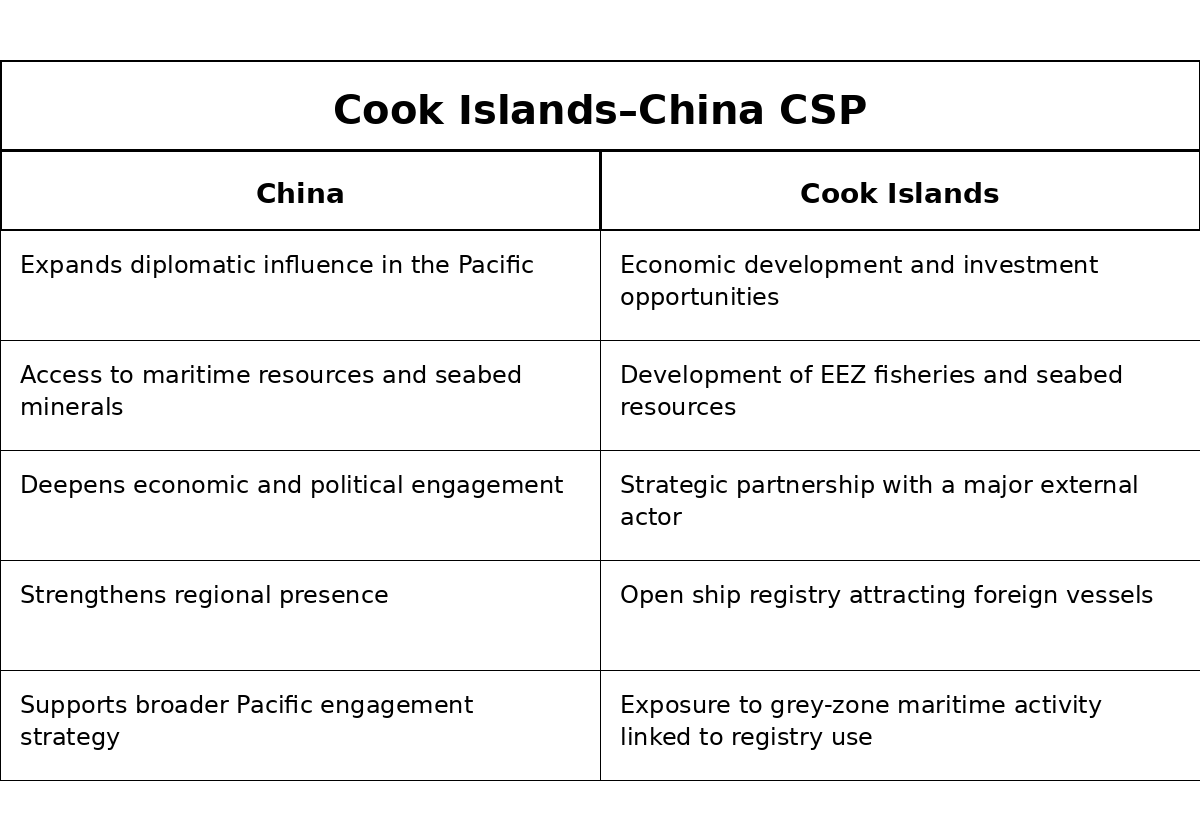
The U.S. may have mentioned the Cook Islands, as its flag was used on shadow fleet ships. As the Cook Islands operates an open ship register, the island allows foreign vessels to register under its flag without a presence in the Cook Islands. The register has exposed how vulnerable the Pacific Island states can be and how maritime regulations can be exploited. A number of the shadow fleet ships that move oil from Iran, Russia, and Venezuela to China to avoid Western sanctions have been found flying the Cook Islands flag. In fact, by 2024 an estimated 208 tankers registered to the Cook Islands were responsible for moving 93% of the deadweight tonnage. The small island has found itself entangled in grey-zone activities used to circumvent oil sanctions. The shadow fleet activities have not been limited to moving only oil but also reportedly include damaging cables in the Baltic Sea, espionage, drone launches, and radar jamming. The open maritime registry and murky ownership structures show how regulatory gaps and geopolitics collide to form unlikely partnerships.
The Cook Islands' signing of the CSP shows how small island nations can be increasingly utilised by large actors in great-power competition. Additionally, the open ship registry demonstrates that political and diplomatic alignment can rapidly shift as geopolitical rivalry between the U.S. and China expands. For traditional partners like New Zealand and the Cook Islands, strategic competition can lead to diplomatic embroilment. New Zealand has the added challenge of balancing trade and economic ties with China and Western security alliances while also continuing its role as a Pacific partner of importance. As geopolitics becomes more contested, the Cook Islands may serve as an example to small states. Regardless of size, small states may become more significant in shaping the Indo-Pacific.