Early Warning: Turkey and NATO’s Strategic Dilemma
Key Takeaways
Iranian missile incursions into Turkish airspace demonstrate the risk of escalation involving NATO territory.
Limited incursions allow Iran to apply pressure and test NATO’s response while maintaining deniability.
Turkey and NATO face pressure to respond while needing to balance escalation risks.
Grey-zone tactics challenge NATO’s deterrence and response thresholds.
Incursions risk normalisation, which may shape how adversaries test NATO’s thresholds in the future
For the second time in ten days, NATO has intercepted Iranian ballistic missiles in Turkish airspace, bringing the conflict closer to NATO territory. The incursion highlights the risk of the conflict spreading across multiple borders and to the NATO alliance. The repeated missile incidents did not cause damage or casualties but show that Iran has force projection, reach, and the ability to enter Turkey’s airspace. Turkey has yet to use the incidents to trigger the Article 4 NATO consultation mechanism that would require NATO members to consult when there is a potential threat. Nevertheless, it applies pressure on Turkey and NATO to balance threats and maintain diplomatic relations in an ongoing conflict.
It is unclear if Iran is intentionally targeting Turkish airspace, as its use of only two ballistic missiles allows a level of deniability. A single incursion into Turkish airspace could possibly be attributed to trajectory or navigation errors from the current conflict, and can be downplayed diplomatically. This type of grey-zone strategy has some benefits for Iran without entering into direct conflict with Turkey or NATO. As psychological warfare, it applies pressure on Turkey and NATO to respond militarily and diplomatically. Given the lack of clarity of Iranian intentions, it makes it more difficult for Turkey and NATO to respond. For Iran, it could be testing Turkish and NATO military response times and diplomatic reactions. One ballistic missile was intercepted in Hatay Province, which is close to Incirlik, the major U.S. Air Force Base and NATO logistical hub. Also located in Hatay Province is Kisecik Radar Station, which is a NATO early warning radar monitoring system. It suggests the geographic importance of the incursions, as the Iranian missile trajectory was within proximity of NATO infrastructure.
Incirlik Air Base and the Kisecik Radar Station could be considered high strategic targets, making them of interest to Iran. Incirlik Air Base is a major U.S. Air Force base and NATO logistical hub that is believed to also store nuclear weapons. Iran’s missile incursion could also be symbolic toward U.S. presence in the region and demonstrate Iran’s ability to impede logistics. The importance of the Kisecik Radar Station is to act as an integrated Turkish and NATO early warning system to monitor missile activity across the Levant. Given the level of strategic importance of both sites, it suggests that the missile incursion may have served a grey-zone probing purpose for Iran.
Iran’s potential grey-zone missile incursions create a strategic dilemma for Turkey and NATO. The two incursions within days of each other could signal escalation or serve as part of a provocation. As a NATO member, Turkey would need to trigger Article 4 if it perceives a threat to territorial integrity, political independence, or security. However, as a consultation mandate, it does not necessarily lead to an armed response but could be viewed as an escalation in diplomatic response. If missile incursions into Turkish airspace increase, it may force Turkey to respond beyond calling the Iranian ambassador. Turkey and NATO will need to balance deterrence and signal to Iran that there are limits, but without the risk of unnecessary escalation. For Turkey, it may be more complicated, as it also needs to balance regional dynamics and diplomacy as it places itself as an important regional partner. Simultaneously, a restrained Turkish and NATO response signals to others, such as Russia, that the threshold for triggering Article 4 can be as high as repeated missile incursions. Grey-zone incursions create ambiguity, as single missiles entering airspace can be regarded by actors as staying below the threshold of war. Even a single incursion can create strategic pressure and put large, capable alliances, such as NATO, in increasingly challenging positions. It demonstrates how a regional conflict can also impact alliances; despite having articles that can be used to counter threats and respond, NATO now has two flanks that face pressure. The southern flank with the Middle East and the eastern flank with Russia are in conflict zones, which raises questions about NATO’s willingness and readiness to respond.
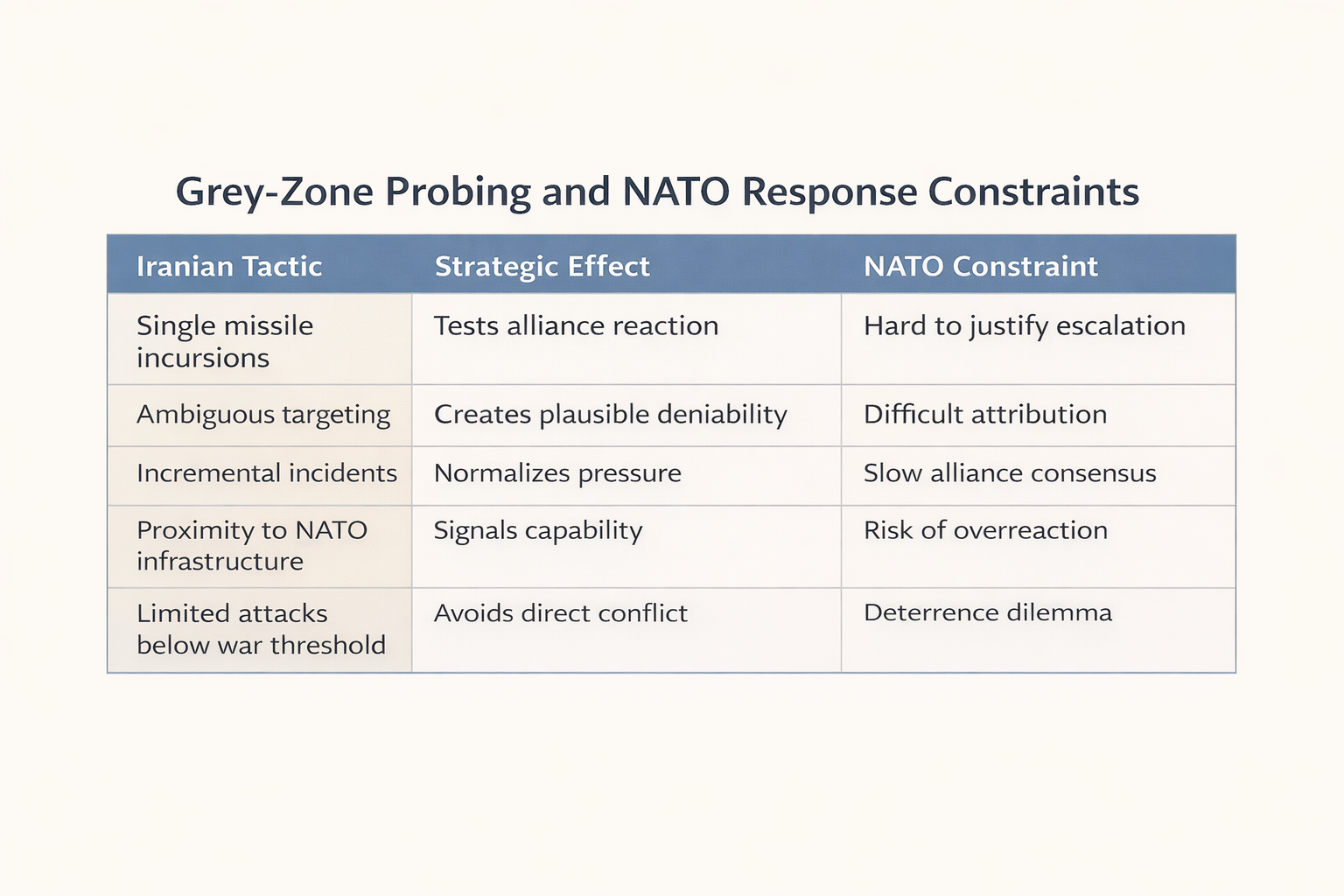
There have been repeated drone incursions into NATO territory and now missile incursions. Although these appear to be probing incidents, there is a risk of normalisation being interpreted as NATO weakness or tolerance by adversaries. For NATO, it highlights that although member states are not directly involved in conflicts, borders and alliances do not necessarily act as deterrence alone. Any potential NATO response will also need to be agreed upon, which adds another layer of complexity to the alliance. If Iran uses incremental grey-zone tactics, there is the possibility of increased use of missiles being more frequent and in greater numbers. In the event of a failure by NATO to intercept a missile that strikes Turkey or NATO interests, the regional dynamics could rapidly shift and force NATO into making a swift response. Just how quickly NATO could respond remains to be seen. With over thirty members, it may be difficult to reach an agreeable level of response.
Countering grey-zone threats and ambiguity requires a multipronged approach, such as diplomatic response, military posturing, and bilateral coordination. Turkey has summoned the Iranian ambassador to the Foreign Ministry to convey concerns as a first step. NATO may also increase military posturing through increased Airborne Warning and Control System aircraft patrols and naval presence in the Mediterranean, as well as joint statements to strengthen messaging. The U.S. and Turkey could choose to coordinate operations independent of NATO to avoid an escalation that could invoke Article 5 and address the intrusions as isolated events as opposed to intentional breaches of airspace.
The context of modern warfare demonstrates that drones and missiles can cross borders into regional airspace. It highlights that these probing grey-zone incidents may become more normalised where there is conflict close to alliance borders. For adversaries, the grey-zone provides ambiguity and incremental increases while staying below the threshold of war. The missile incursion into Turkish airspace demonstrates another challenge and risk to the NATO alliance. The challenge for grey-zone targets like Turkey and NATO is how to respond collaboratively and with credible deterrence while also showing restraint. If missile incursions are increasingly closer and more frequent to Turkey or NATO’s interests, it may cause escalation, further inflaming a volatile situation. For NATO, how it responds may influence how adversaries test its threshold in future situations.