Lebanon’s Dilemma: Remove Hezbollah and risk civil war
Key Takeaways
Israeli strikes have created a strategic window to degrade Hezbollah's military capability in southern Lebanon.
Hezbollah’s weakened position and diminished supply chains present overlapping interests between Israel and the Lebanese state.
The Lebanese state could face pressure to assert control south of the Litani River.
The situation presents a strategic dilemma, where efforts by the LAF to constrain Hezbollah could trigger military fragmentation and internal conflict.
The increasing Israeli military pressure inside Lebanon and along the Israel–Lebanon border has targeted both Iranian and Hezbollah positions. Israel reportedly struck five Iranian commanders in Lebanon in an effort to degrade Iran's presence and Hezbollah. In perhaps an unexpected move, the Lebanese government appears to be taking steps to increase its sovereignty and reduce Iran’s presence in the country. Iranians will now require a visa to enter Lebanon, and the Lebanese government has also expelled senior Iranian officials and designated the Islamic Revolutionary Guard Corps an illegal organisation. UN Resolution 1701 could see the withdrawal of UN troops at the end of 2026, leaving the Lebanese Armed Forces (LAF) the sole provider of security in the south of the Litani River. The strategic window may offer Israel and the Lebanese government a convergence of interests for the purpose of reducing or removing Hezbollah as an external and internal threat. However, removing Hezbollah comes with risks. With some reports of Hezbollah issuing orders to attack the LAF if they intervene in its operations, it may lead to internal conflict or wider regional escalation.
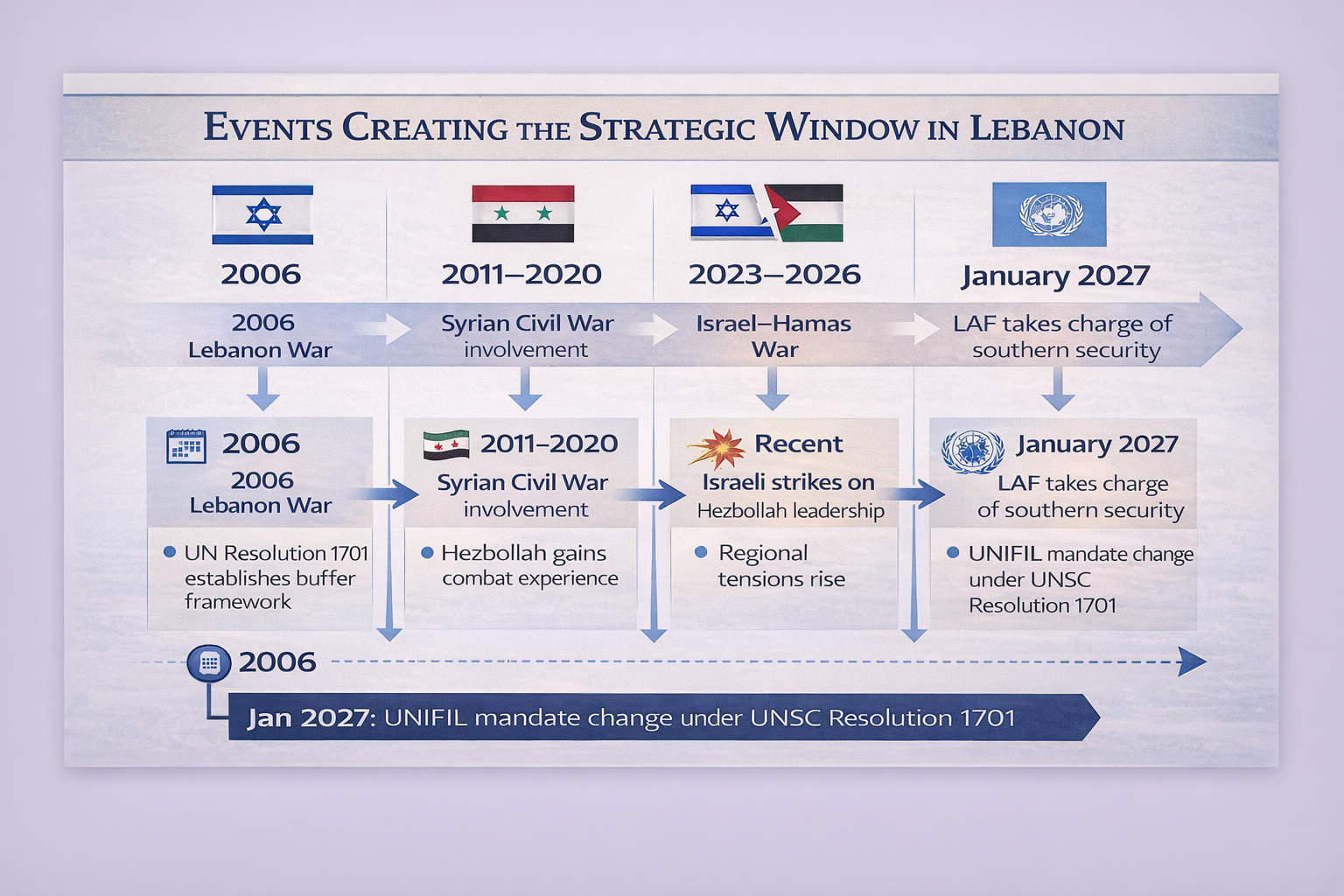
Several circumstances have created an opportunity for Israel and the Lebanese government to take control of southern Lebanon from Hezbollah. As Israel carries out strikes on Hezbollah targets and disrupts Iranian influence and weapons supply chains through Syria, Hezbollah continues to be weakened following the loss of its leadership in the pager detonation operation. Hezbollah will need to balance deterring both Israel and the Lebanese government without escalating to a two-front war, one that it may find challenging to sustain without Iranian support. The Lebanese government has some incentives to restrict Hezbollah. Lebanon is facing domestic economic pressure and is likely to want to avoid internal conflict. The LAF will soon be responsible for security south of the Litani River, which presents a challenging task with a strong Hezbollah presence in the region. The Lebanese government has reportedly ordered the LAF not to confront the Israelis on the ground and has withdrawn from the border, setting up checkpoints to restrict the flow of weapons to militants. Diplomatically, the Lebanese government has indicated a willingness to negotiate with Israel, perhaps motivated by avoiding being drawn into internal conflict, while France has committed humanitarian aid and military cooperation.
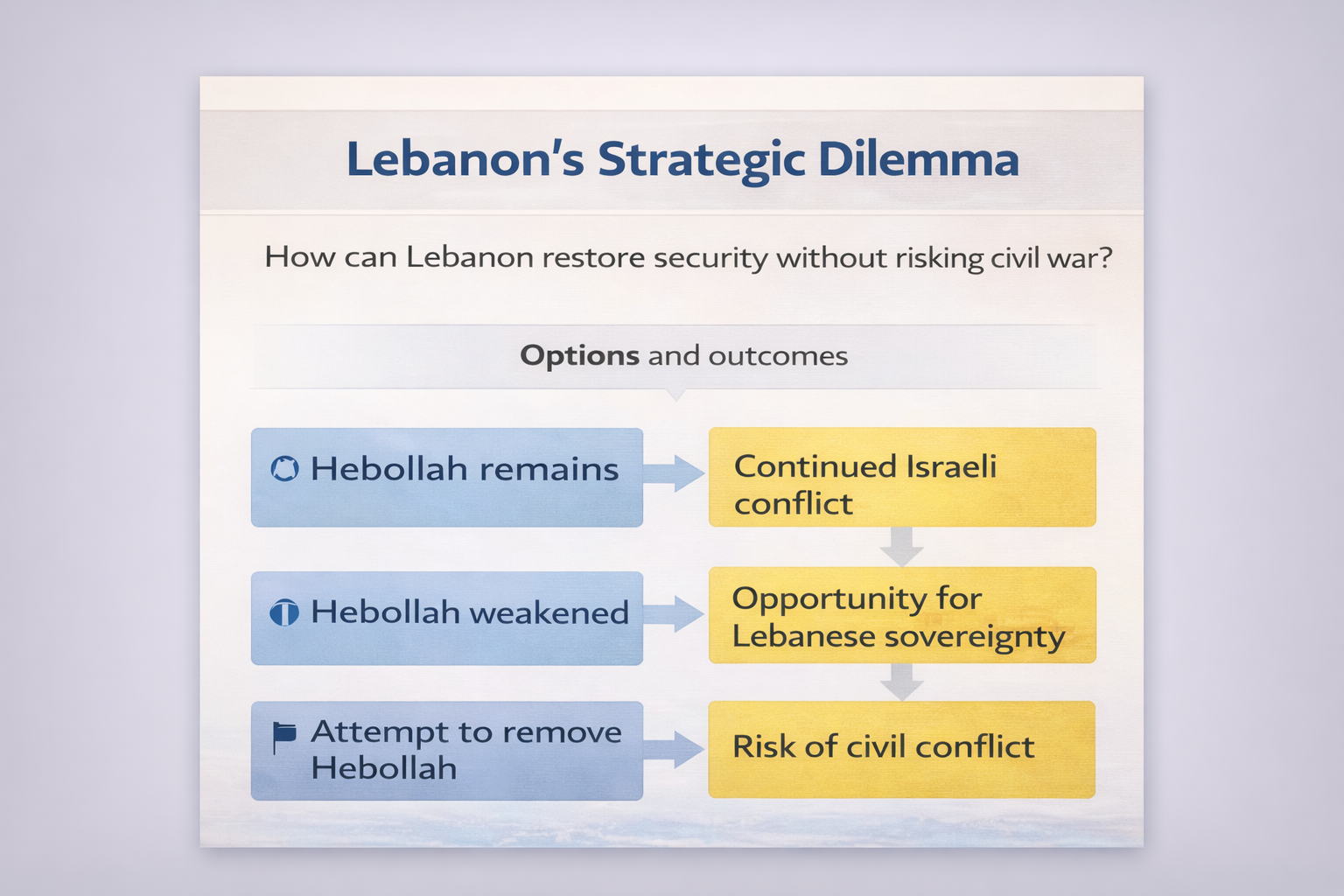
The Lebanese government's response may be a surprise change in policy, but perhaps it can be traced back to an earlier February meeting. LAF General Commander Rodolphe Haykal visited Washington officials for wide-ranging talks on military cooperation and internal security. It is reported that General Haykal met with counter-terrorism officials on cross-border financing, border threats, and militant non-state actors. The Lebanese government has indicated Hezbollah’s political representation can continue. Nevertheless, the objective to disarm Hezbollah remains, but the method to achieve this appears to be different. According to some reports, General Haykal believed that the disarmament of Hezbollah would be a gradual national process, one that required political consensus to avoid escalation to an internal military conflict. Furthermore, the LAF’s ability to move into frontline villages was hampered by Israel’s presence, and moves south of the Litani River would be part of phase two and would need to avoid conflict with Hezbollah. It suggests a calculated LAF plan to be conducted independently but over time. This is likely due to the complex dynamics of the area and limited capacity of the LAF. It appears that the strikes on Iran have altered this plan and forced some rapid decision-making.
Hezbollah may be weakened but continues to present a threat. It is difficult to accurately calculate Hezbollah’s current capacity, but it has thousands of short-, medium-, and long-range missiles, as well as tens of thousands of fighters. The ongoing Gaza conflict and diplomatic tension between the U.S. and Iran may have led Hezbollah to believe there was a potential threat increase to its existence as part of the Iranian proxy nexus. Some reports indicate that Hezbollah had made efforts to rearm and replenish drone and missile stocks using Iranian funds. Despite Israel's efforts to reduce arms flows and the Lebanese government’s weapons confiscation efforts, Hezbollah likely poses a significant threat, and it will not be easily dislodged. Furthermore, if Hezbollah believes there is an increased threat to its existence, it may resort to more extreme measures, including triggering an internal conflict.
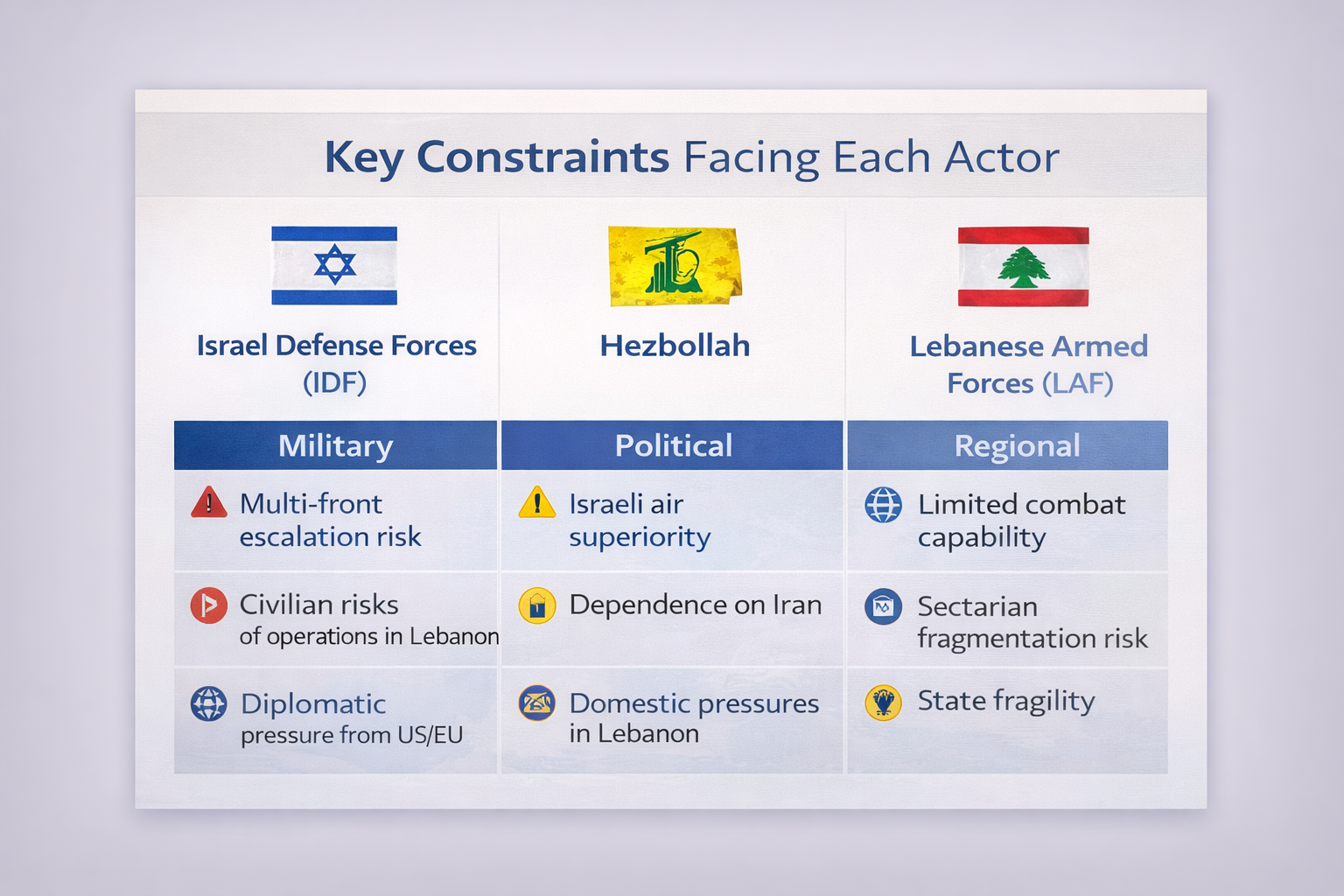
Internally, there seems to be disagreement already with how the Lebanese government and LAF should approach the current escalation. While politicians continue to call for Hezbollah to disarm, General Haykal reiterated the need to avoid confrontation with Hezbollah given the competing interests and limited LAF resources. General Haykal may have legitimate concerns about what Lebanon faces if the Israel–Lebanon border escalates to include internal conflict. His consistent message of conflict avoidance and limited military resources indicates that if the conflict does extend beyond the current clashes, Lebanon may collapse. Internal escalation could trigger sectarian clashes or split the LAF. At the same time, an unpredictable Iranian response to an attack on an important proxy may add another actor to the conflict. As the LAF has reinforced the Lebanon–Syria border, it suggests concerns that the repercussions could lead to a spillover. It places the LAF in a precarious position of wanting the autonomy and resources to support its operations in an increasingly volatile situation.
There is a rare opportunity for Israel and the Lebanese government to remove or degrade a significant regional and internal threat. Israel has signalled its intentions through Operation Roaring Lion to remove the Hezbollah threat while the current opportunity remains. However, the LAF response is less certain. The disconnect between the Lebanese politicians and the LAF is apparent, and politicians may be attempting to show potential international allies like the French and U.S. administrations that they are taking a harder stance towards Hezbollah. Nevertheless, the LAF response presents an assessment that indicates the various risks not only to the south of the Litani River but also to internal security and even to the Lebanon–Syria border. Hezbollah remains a powerful organisation that will also be trying to assess what role the LAF will likely play. The strategic opportunity could escalate with unintended consequences including fracturing an already vulnerable Lebanon.