Sanctioned Oil Strategy: Exposing China’s Energy Vulnerability
Key Takeaways
Disruption in the Strait of Hormuz exposes China’s dependence on maritime chokepoints.
U.S. actions in Iran and Venezuela have created dual shocks to China’s access to discounted sanctioned oil.
China is responding to the pressure with domestic measures, including reduced refinery output and export restrictions.
Russia is likely to become an important supplier, deepening Sino-Russian energy interdependence.
The disruption exposes vulnerabilities in China’s energy security and may accelerate diversification efforts.
China’s energy supply is under pressure following the disruption in the Strait of Hormuz. As the world's largest oil importer, roughly 40-50% of China’s crude oil imports transit through the Strait, showing its dependence on Gulf states and the narrow waterway. For China, the risk is beyond economic impact. China's immediate concern is exposure of its supply chain, which creates a strategic vulnerability to its energy security.
The current Iran–U.S. conflict has only exacerbated China’s energy supply dilemma, which had already been affected by the Venezuelan leadership change. Recent months have shown China that its reliance on sanctioned oil and chokepoints comes with risks, and these have strategic consequences.
China’s first dilemma was the U.S. removal of Maduro, placing its Venezuelan oil supply at risk. Although Venezuela supplies only a small percentage of China’s discounted imports, the impact was reportedly enough for Chinese refiners to increase heavy crude imports from Iran to mitigate the risk. Some reports suggested that Chinese independent oil refiners were expected to switch to Iranian and Russian oil by March or April. Given the current Iran–U.S. conflict, this plan is likely impeded and has placed additional pressure on Chinese energy supplies. Several indicators suggest China is taking measures to mitigate the dual disruption to its energy supply chains.
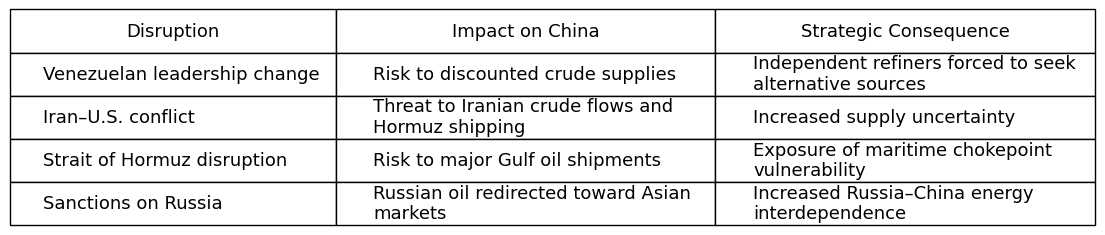
China is prioritising its domestic market by ordering a ban on gasoline, diesel, and aviation fuel exports. It signals Chinese concern about its ability to access sufficient crude oil to maintain its current refining rates. China’s Sinopec, one of the world’s largest refiners, is cutting refinery runs of crude oil by 10%. China has also reportedly denied the company access to the country’s oil reserves, which are estimated to be approximately 120 days of supply. The state-run Sinopec is responsible for about one-third of the country’s refinery output. The Chinese government’s decision suggests that it may not be confident that a solution to the disruption in the Strait will be found quickly. These decisions are a first step and may provide temporary reprieve; however, China will need to secure more oil. China’s supply challenge will likely see Russia as a supplier becoming increasingly more important.
Russia and China may provide mutual economic and energy relief to some of the current challenges. As China has tried to maintain a diverse energy policy, Russia currently supplies close to 20% of Chinese oil imports. The U.S. intervention in Venezuela and the current conflict in Iran have rapidly left China with fewer options. Russia’s prolonged war with Ukraine has resulted in oil infrastructure damage, and with European efforts to counter the shadow fleet and Western sanctions, it has limited markets for its oil. The situation is likely to increase energy interdependence between the two countries, as one is in need of discounted oil and the other in need of a client. Given the existing energy relationship, Russia can likely increase supplies relatively quickly. As Russia has limited clients, it is also likely that China can secure discounted oil, but possibly not at current rates.
The Venezuelan and Iranian supply shocks will not be an immediate crisis for China; however, Beijing may move towards short-term crisis management to stabilise supplies and its domestic market. Increased Russian imports should provide an immediate option, along with the possibility of using strategic reserves, which China is likely aiming to avoid at this stage. Independent Chinese refineries were reportedly preparing to adjust to the Venezuelan disruption; nevertheless, they will now need to reassess with the added Iranian conflict. Independent refineries rely on purchasing cheap sanctioned oil and operate at low margins, leaving two immediate options: purchase crude at higher prices or cut production. The Sinopec decision may indicate that reducing production is the first step to avoid purchasing more expensive oil. China’s reliance on discounted sanctioned oil is under increasing pressure with several possible ramifications. The Chinese domestic market will likely experience higher prices due to more expensive imports and the lower-quality crude, as well as the thinner margins for refineries. The dual disruption to sanctioned oil illustrates how geopolitical shocks can quickly expose vulnerabilities in energy security.
The two U.S. interventions send a signal to China that maritime supply routes can be disrupted and they are vulnerable to chokepoints. Beijing may view expanding pipelines, rail, and road networks with Russia as part of its diversification strategy as the U.S. applies supply chain pressure. The Ukraine war and oil supply disruptions are pushing Beijing and Moscow closer together and creating an increasing interdependence. The current situation may also highlight to Beijing the need for greater self-sufficiency and that navigating unstable and volatile energy supplies will place China at strategic risk. Long-term, China could increase domestic efforts to produce more oil and gas while also shifting to renewables. These options will not resolve China’s current challenges, but they may force Beijing to reshape its policy toward energy security.