Indonesia’s Evolving Foreign Policy
Key Takeaways
Indonesia’s traditional non-aligned foreign policy is under pressure from regional and global power dynamics.
Its geographic position gives Indonesia control over key maritime chokepoints, which may provide leverage in energy and trade flows.
Strategic defence purchases, including BrahMos missiles, signal a shift towards maritime deterrence and potential access denial.
The U.S.–Indonesia critical minerals agreement highlights Indonesia’s increasing importance in supply chain competition.
Indonesia’s strategic dilemma is balancing economic dependence on China, diversification, and foreign policy autonomy.
Indonesia has long maintained an independent foreign policy, but recent decisions suggest this may be changing. Post-WWII, Indonesia developed the doctrine 'Bebas-Aktif,' or free-active. The proactive strategy was designed to avoid military alliances and maintain autonomous decision-making while also being willing to mediate conflicts. The rise of China has intensified competition over existing maritime claims, which has led to territorial disputes in the South China Sea. Indonesia’s Exclusive Economic Zone, the North Natuna Sea, has been disputed, with Chinese claims of historical rights to the zone.
These neighbouring countries face the challenge of balancing economic and security relationships with China while avoiding maritime disputes. Two recent deals indicate that Indonesia’s free-active foreign policy is experiencing a strategic shift.
This suggests an adjustment from non-alignment to strategic balancing.
Indonesia’s geographical location bordering the Strait of Malacca has increased its strategic relevance. As a maritime chokepoint, the narrow passage of water is the shortest route for gas and oil between the Middle East and Asia. Approximately 60% of Gulf OPEC crude oil transits the passage, demonstrating the importance of the chokepoint for East Asian countries. With roughly half of the crude exports destined for China, it highlights China’s dependence on the route. The two other Pacific Ocean alternatives are the Sunda Strait and Lombok Strait, which also pass through Indonesian waters. As critical global energy and trade routes, Indonesia can potentially shape access conditions to all three straits.
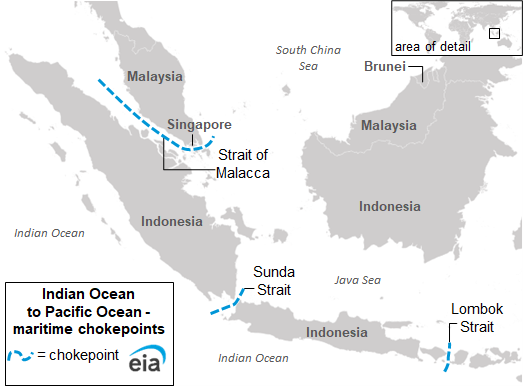
Source: U.S. Energy Information Administration (EIA)
Increasing maritime pressure in the South China Sea and the geographical importance of the Strait of Malacca have led Indonesia to adapt defence capabilities. Recently, Indonesia has agreed to purchase Indian BrahMos supersonic missiles, a system noted for its anti-ship effectiveness. The Indonesian purchase of a weapon with such specific capabilities may enhance its deterrence posture and develop maritime access denial capability. The missiles are difficult for ships to intercept due to their velocity, which could enable Indonesia to extend its maritime deterrence from its coastlines. The purchase enhances Indonesian maritime security and diplomatic leverage.
Indonesia is not only adapting its military capabilities but also its economic strategy. The signing of a U.S.-Indonesia trade agreement provides the U.S. with greater market access to Indonesia’s critical minerals, such as bauxite, nickel, and rare earth metals. Indonesia is the largest producer of nickel, which has positioned it as a central player in the critical mineral supply chain, especially between the U.S. and China. The agreement also includes direct foreign investment in the critical minerals sector between the U.S. and Indonesia. The agreement marks a shift in diversification from Beijing, which has been Indonesia’s largest market and invested in nickel facilities. As China controls 90% of the critical mineral refining, the U.S.-Indonesia agreement suggests the U.S. is aiming to reduce supply chain dependence and Chinese dominance. For Indonesia, the agreement offers another market.
Indonesia is maintaining its independent foreign policy; however, it is adapting how it operates within a region of increasing strategic importance. The challenge for Indonesia is to maintain its autonomy and economic relations in the midst of great power competition. Indonesia’s growing recognition of its geographical, resource, and global importance is influencing its policy. China remains Indonesia’s largest trading partner, which could place it under economic pressure.
Indonesia's critical minerals allow it some leverage with great powers, but if great power competition escalates, Indonesia may need to reconsider its long-held independent foreign policy.