Monetised Maritime Chokepoints: How Access is Becoming a Revenue Stream
key takeaways
Chokepoints are increasingly shaped by market forces as demand for access increases.
State and non-state actors are shifting toward controlling maritime access through price controls.
The increasing tension around chokepoints is eroding international law.
Limited global response highlights the complexity of the emerging pattern.
Maritime chokepoints are narrow maritime passages essential for global supply chains. A vessel paid $4 million to avoid the queue in the Panama Canal; previously, priority transit at the end of 2025 was priced at approximately $130,000. The sharp price increases indicate a tightening of control over access. Asian refineries have pivoted to purchasing U.S. oil and gas and shipping it via Panama, according to the Panama Canal Authority. As demand has increased on the route, auction prices for vessels to secure priority transit have surged. Asia’s reliance on the Strait of Hormuz is driving alternative routes to meet demand. The toll concept is gaining traction, with the Indonesian finance minister reportedly discussing a charge in the Strait of Malacca. A levy is unlikely to be imposed immediately; there is a growing trend in monetised maritime chokepoints.
Chokepoints are becoming revenue streams where access is shaped by demand. Control of chokepoint transit operates through pricing, with Panama offering priority passage through auction and Hormuz with a set toll. While Indonesia’s stance remains unclear, the finance minister has indicated revenue from passage being split with Singapore and Malaysia. The monetized maritime chokepoint model is being implemented or considered by peripheral states. The financial approach is not a disruption technique but rather is conditional access.
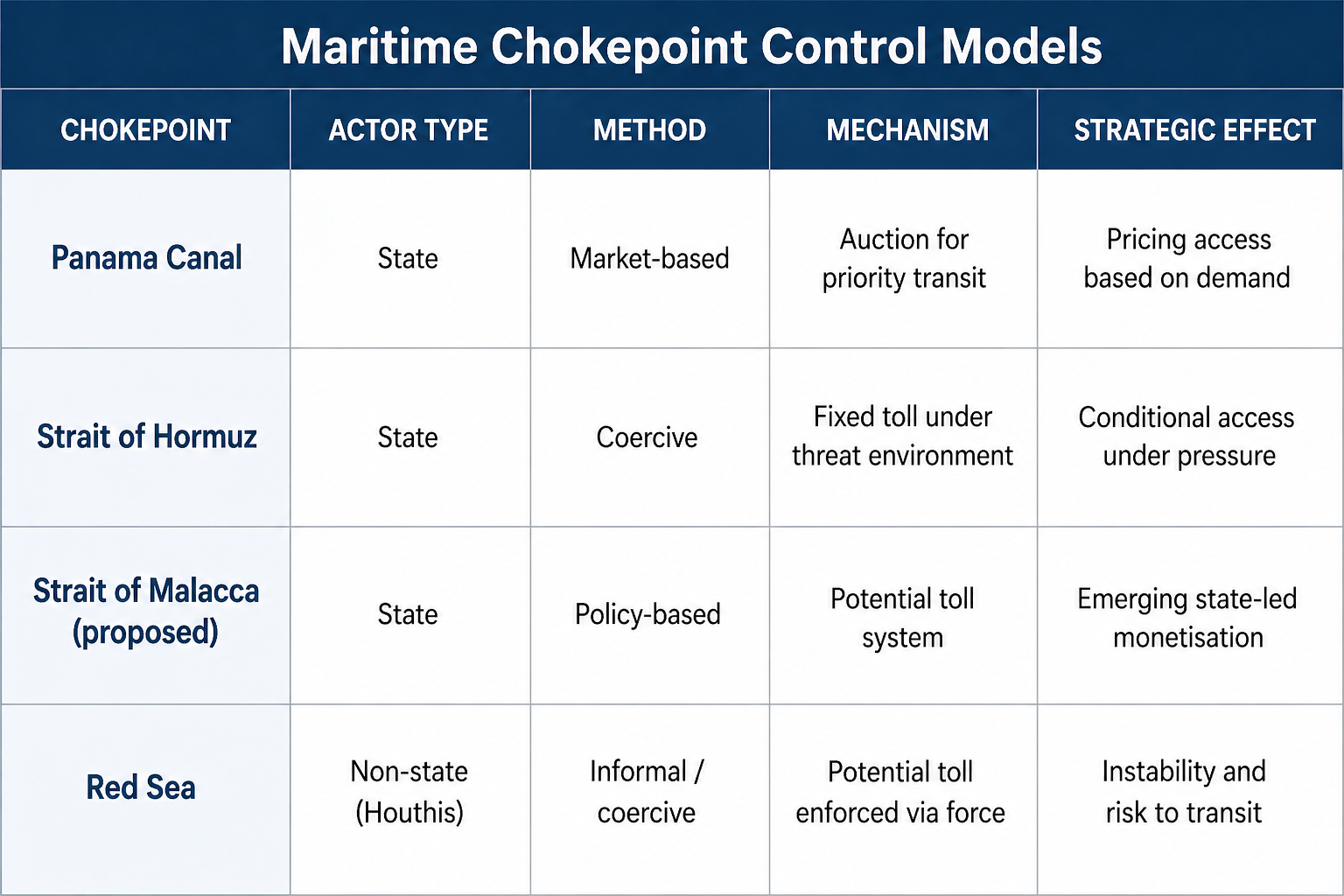
States are monetising chokepoints through different approaches. Panama has operated a formal transit slot auction system for almost two decades, but rising congestion has increased prices for premium slots. Iran’s toll system operates as a coercive model with a set transit price, although it is functioning in an ambiguous environment. The effect of Iran’s approach has prompted Indonesia to consider implementing a toll system; however, that would require agreement from Singapore and Malaysia.
Not only state actors control access through price, but non-state actors do as well. According to Lloyd's List, the Yemen-based Houthi militia group has Iranian support to implement a toll in the Red Sea. As a non-state actor, the Houthi militia is likely to have an informal toll approach supported through military means, which creates greater instability. Somalia also borders the Red Sea and has threatened to block Israeli vessels transiting. The Somali threats stem from a diplomatic dispute over Israel’s appointment of an ambassador to the breakaway region, Somaliland. The Red Sea is emerging as a chokepoint where state and non-state actors may converge to disrupt transit.
Under the United Nations Convention on the Law of the Sea (UNCLOS), flagged vessels can navigate the high seas unimpeded. Chokepoints present a legal complexity, as states can dispute the status of territorial waters. Inside the 12 nautical mile limit, vessels transit under ‘innocent passage', rather than ‘transit passage.' Under this framework, coastal states can suspend innocent passage if they have security concerns. Tolls are prohibited for transit but can be levied for services, which can create a grey zone. While not a collapse of international maritime law, the emerging chokepoint approach is eroding it. Access is no longer guaranteed but is becoming increasingly negotiated in a commercial maritime market.
State responses to the emerging chokepoint monetisation have been limited. Beyond the U.S. military restrictions in Hormuz, the international response has taken the form of broad multilateral statements. With dependence on chokepoints for supply chains, major powers may escalate in response if levies or access denial are imposed. China’s dependence on the Strait of Malacca could be a point of tension given the existing territorial disputes in the South China Sea with coastal states and China’s naval capacity. Indonesia’s consideration of a toll in Malacca alongside the strategic purchase of anti-ship missile capabilities may increase regional concern. Any instability will likely impact pricing and insurance, and alongside Panama and Hormuz, a third strait disruption will have global impacts. The limited international response demonstrates the complexity of addressing maritime disputes, even through diplomatic channels. Attempts to bypass Hormuz have led to congestion and price increases in Panama, showing that one maritime disruption has wider economic consequences.
An emerging pattern toward maritime chokepoint control is forming. While the approaches differ, whether through market forces in Panama, the coercive Hormuz model, or a potential state policy in Malacca, the objective remains as implementing price control. Chokepoint access is becoming negotiated and shaped by market forces, state, or non-state actors. Neutral passages of water that were previously unimpeded are now increasingly acting as controlled zones for coastal states, showing the slow erosion of international law.