Financial Chokepoint: Economic Fury Targeting Evasion Systems
U.S. sanctions are extending to Chinese oil refineries and financial institutions linked to Iranian oil.
The “Economic Fury” campaign illustrates how maritime coercion is shifting to financial systems and legal jurisdictions.
Secondary sanctions create pressure on international banks, shipping, and insurance companies through the risk of U.S. action.
China’s Blocking Rules demonstrate an escalation in legal response toward U.S. sanction enforcement.
U.S. dollar dominance acts as strategic leverage over international financial compliance.
The contest over Iranian oil flows is moving beyond suppliers to network facilitators. The U.S. is now targeting Chinese refineries and financial networks associated with the Iranian oil trade. The U.S. Department of the Treasury’s “Economic Fury” campaign targets Iranian oil revenue in an effort to restrict the regime's funding. Under U.S. counterterrorism authorities, Washington can target activities linked to terrorism, including facilitators, which could extend to foreign financial institutions. The U.S.-Iran conflict is becoming intertwined with shadow networks and sanctions evasion, where sanctions enforcement and financial pressure are converging.
China is the largest purchaser of Iranian sanctioned oil, with its refineries linked to the evasion network. Refineries have become part of the U.S. financial pressure campaign, with the U.S. having designated five Chinese independent refineries as part of the network. The recent addition of China’s second-largest refinery, Hengli Petrochemical, was significant due to its size.
The U.S. financial sanction strategy has wider repercussions through its ability to apply secondary sanctions. Secondary sanctions not only target Iran or the refineries but also potentially institutions like banks that facilitate the trade. Washington had warned that banks holding proceeds from Iranian oil transactions could face secondary sanctions. Sanctions impact networks such as shipping companies, logistics companies, international banks, and insurance companies as they cease to work with sanctioned refiners due to the risk. Beijing’s response to potential sanctions led to the invoking of China’s anti-foreign sanctions legislation under its “Blocking Rules" for the first time since its inception in 2021. Such a response from Beijing is now creating tension between two legal frameworks.
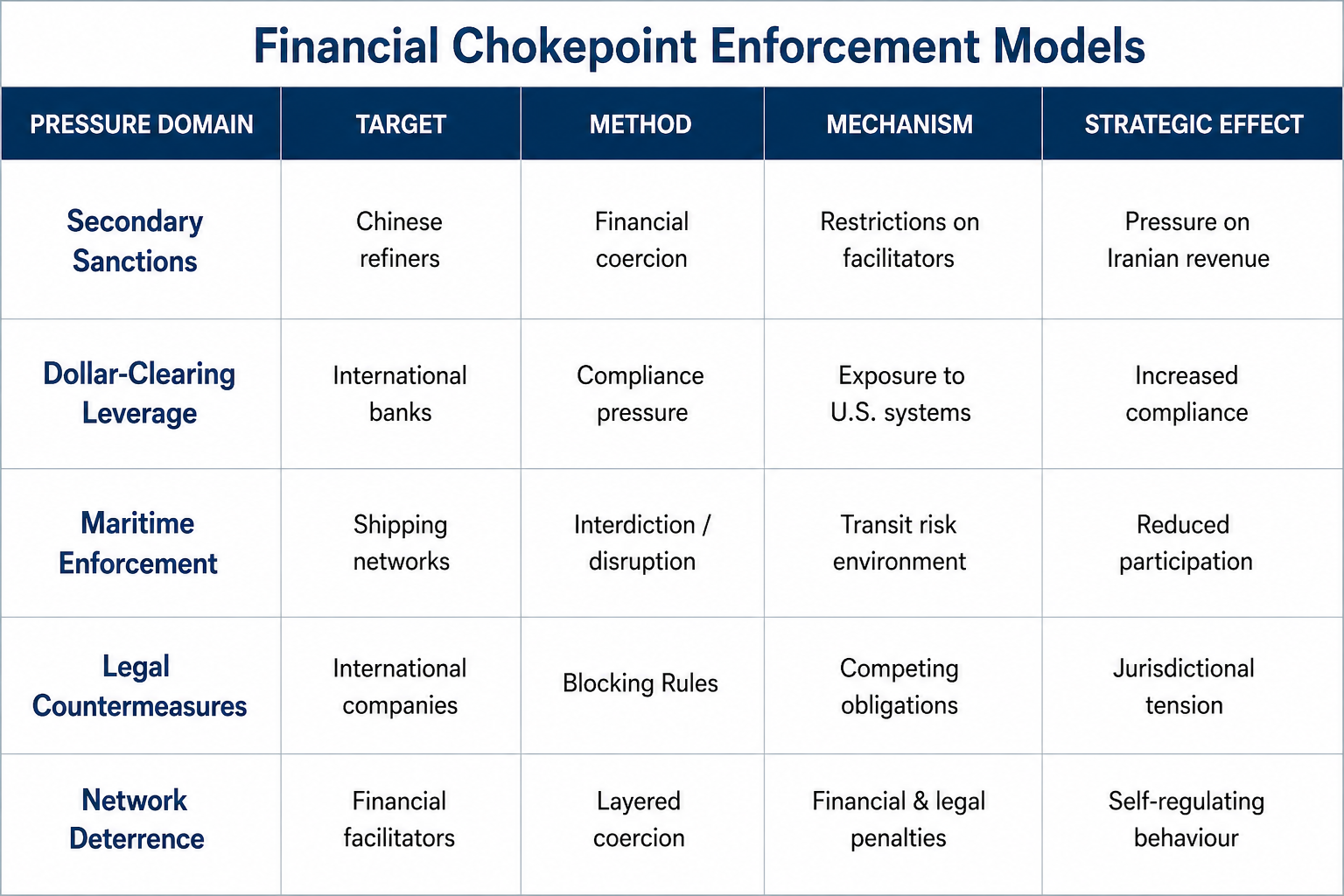
“Economic Fury" represents a broader U.S. strategy that is not only maritime interdiction but also financial disruption. The strategy demonstrates how maritime chokepoints are intertwined with global trade routes and financial systems and how sanctions create network deterrence through risk. Financial systems, international banks, and insurers become strategic leverage as the U.S. layered approach creates conditions that make being part of the Iranian network risky. With China invoking the Blocking Order, competing pressure between the U.S. and China is also applied to international companies with Chinese dealings. Companies that continue to financially deal with a sanctioned refinery may face U.S. repercussions; however, a company that halts transactions due to U.S. sanctions may face a Chinese judiciary. The U.S. currently has leverage as transactions mostly rely on U.S. dollars, dollar-clearing channels or U.S. financial systems, which means international banks may be more likely to comply with U.S. sanctions. Nevertheless, the Chinese Blocking Order indicates a shift from diplomatic protests towards an attempt at active enforcement.
The U.S. and China’s competing sanctions frameworks could accelerate Chinese motivation for an alternative financial system. With the increasing U.S. sanctions, it may incentivise states to reduce exposure to U.S. financial infrastructure. Dominance of the U.S. dollar may force China to pursue an alternative payment system, avoiding dependence on the current global system to reduce its exposure to U.S. sanctions through parallel banking and trade networks. The risk of a fragmented financial system is that it would place pressure on international companies to navigate between two systems, potentially creating more tension and repercussions. From a single maritime chokepoint conflict in the Middle East, the greater global impacts are becoming clearer, where finance and legal jurisdictions collide in Asia. Sanctioned oil enforcement is now broader, where great powers are increasingly competing over shaping the rules of commerce through economic coercion, financial pressure, maritime interdiction, and risk. Despite motivations to circumnavigate U.S. financial institutions, the dominance of the U.S. dollar will not result in a Chinese alternative in the near future.
The disruption in the Strait of Hormuz demonstrates how chokepoints extend beyond geography to financial systems. States do not need to fully engage in kinetic conflict to cause disruption to trade routes or shape strategic behaviour. Conditions for trade can be influenced through maritime interdiction and financial coercion. The layered approach applies pressure to networks through the risk of physical and financial punishment. Global trade is shaped by great powers through decisions that impact shipping companies, insurers, financial systems, and legal jurisdictions. The U.S. “Economic Fury” strategy demonstrates that rather than physically intervening to stop movement, increasing economic coercion on networks can reduce revenue streams. In a modern context, Hormuz is a strategic environment where geography, finance, law, and risk converge in great power competition. Any future chokepoint conflict may result in these approaches, where a blockade may only be the start. Rather than solely physical interdiction, financial coercion and legal pressure will combine in a financial choke strategy.