Managed Competition: The U.S.-China Stabilisation Phase
The U.S.-China summit indicates stabilisation over major developments
China continues to link Taiwan independence with U.S. involvement.
Trump's position on arms sales to Taiwan may reflect strategic ambiguity.
Trade increases appear more likely than immediate decoupling.
The summit reflects an approach of managed competition to reduce the risk of escalation.
The U.S.-China summit ended without any major outcomes. Instead, the meeting was an assessment of positions on a range of topics, with attempts at stabilisation. While the diplomatic optics were cordial, many areas of competition in trade, Taiwan, and technology remain largely unchanged. China’s position on Taiwan has been consistent; however, the firmer messaging from President Xi reinforced the issue of Taiwan’s independence as a central topic in U.S.-China relations. With Trump yet to approve a U.S. arms sale to Taiwan, the real test of the relationship may become clearer after the summit through Washington’s next moves.
The summit was unlikely to produce significant changes but was diplomatically important. Major issues such as maritime tensions, trade, and Taiwan remain unresolved; however, neither the U.S. nor China appeared to willingly escalate tensions publicly. Instead, the summit may have stabilised immediate tensions without influencing structural competition. Rather than rapprochement, the broader focus may be to contain escalation and avoid further global economic disruption. U.S.-China strategic rivalry remains; however, the objective may be to manage competition while avoiding direct confrontation. Trump's ambiguous messaging about the current U.S. position and China’s more overt messaging demonstrate that one of the most sensitive topics remains unresolved.
China has a clear position on Taiwan, but to reaffirm this during the summit could indicate just how significant Taiwan remains within U.S.-China relations. With Taiwan as the main flashpoint, China continues to associate Taiwanese independence with U.S. involvement. Although China raised Taiwan, the U.S. administration opted to avoid engaging in any public commitments on the issue. Instead, Trump has persisted with ambiguous positioning on potential U.S. arms sales to Taiwan, preferring to avoid the topic. Ambiguity on Taiwan may be a U.S. strategic tool to reduce public friction while also creating uncertainty among Chinese decision-makers. Simultaneously, Taiwan not only closely monitored the summit but also conducted live-fire beach defence drills as a form of defence signalling. Besides Taiwan, both the U.S. and China demonstrated a shared interest in economic and maritime stability.
Both the U.S. and China have overlapping interests in maintaining access in the Strait of Hormuz. The U.S. may have hoped that China’s heavy dependence on Hormuz for energy flows could be leveraged to pressure Iran to support unrestricted access. Although it appears that both countries agreed that the disruption in Hormuz needed to be resolved, the interpretation of access terms seems to have differed. U.S. Trade Representative (USTR) Jamieson Greer told Bloomberg that Chinese officials wanted Hormuz opened without military or toll restrictions; however, this was followed by Chinese Foreign Minister Wang Yi who avoided commenting on the toll restrictions other than stating Hormuz should be open as soon as possible. Both the U.S. and China appear cautious over the broader economic disruption, with strategic rivalry intertwined through shared economic systems.
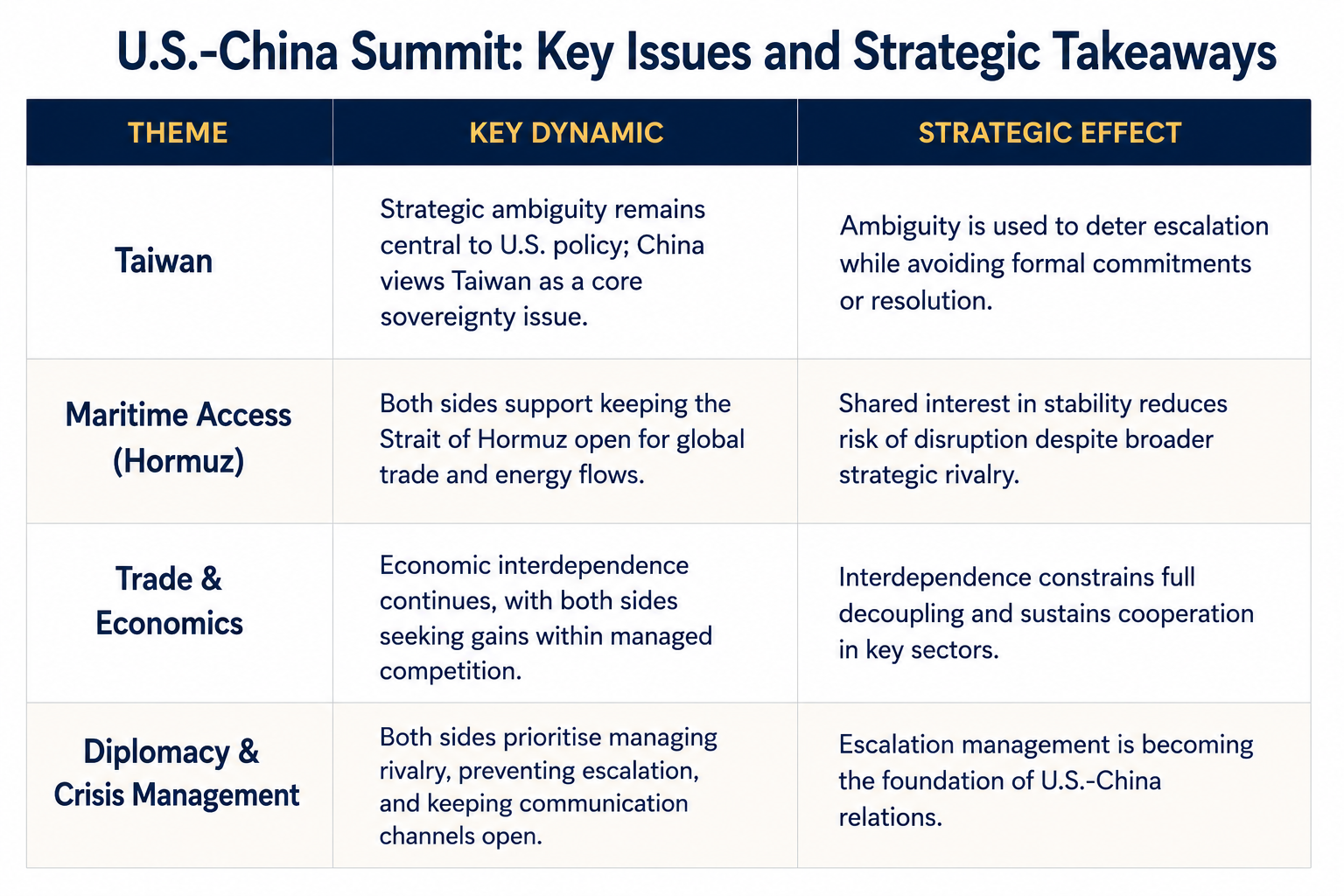
Despite a lack of specifics, trade discussions between the U.S. and China indicate moves towards stabilisation regardless of rivalry. USTR Greer reaffirmed the importance of the two economies in an ABC interview while also acknowledging the sensitivities with Taiwan and how the administration can approach that issue. Multiple U.S. industries would hope for increased trade with China, with USTR stating that the U.S. expects double-digit billions in agricultural products. As with Hormuz, China’s exact position was less clear, with a Chinese Ministry of Foreign Affairs spokesman stating at a press conference that China is willing to expand cooperation and "deliver for both sides in the spirit of equality, respect and mutual benefit.” It suggests that although economic competition exists, both sides are potentially moving toward broader economic engagement rather than decoupling, while remaining cautious.
The summit provided insights into how U.S.-China relations may be managed. Diplomatic comments suggest that managing competition and limiting escalation is of shared interest and crucial to preserving stability. Rivalry between the two powers will likely remain for the foreseeable future; however, as both sides are economically reliant, any global disruptions will have economic impacts for both sides. Stabilisation could be part of how both the U.S. and China manage competition long-term. The strategy will also likely attempt to avoid military escalation through diplomacy and deterrence mechanisms. Proposed trade increases will lead to greater economic interdependence and may also help to constrain the risk of confrontation. Rather than specifically resolving tensions, the summit reflects a shift toward managing strategic competition and strengthening communication channels.
Although the summit did not result in major breakthroughs, it did reflect a potential shift in approach. The future of U.S.-China relations may rely on how competition can be managed rather than resolved while maintaining some strategic ambiguity. Stabilisation for the time being may be the most effective approach, with economic and maritime interdependence likely to constrain direct confrontation. With the Taiwan question unlikely to be resolved in the immediate future, both the U.S. and China will need to accept that strategic competition exists within certain constraints. Rivalry remains, but both sides appear to be moving towards a period of managed tension while limiting escalation.