Beyond the Frontline: Ukraine’s Infrastructure Disruption Strategy
Ukraine’s drone strikes are targeting Russian infrastructure to degrade oil refineries, logistics, air defences, and military-industrial capacity.
Russian troops and supply chains may be more vulnerable, slowing territorial advances.
Ukraine’s mid- and deep-range strikes suggest rapid advances in drone capabilities.
Russia’s spring–summer offensive may have been disrupted.
Territorial gains remain crucial, but Ukraine may be using infrastructure disruption to balance Russia’s manpower and industrial advantages.
Much of the Ukraine conflict has focused on territorial gains. Advances in Ukrainian drone capabilities have resulted in strikes far from the front lines. Mid-range strikes are targeting infrastructure inside Russia to degrade military support systems. Oil refineries, logistics, air defences, and military-industrial capacity have been struck. Bloomberg reported that Russian oil refinery output is at its lowest since 2009, indicating the scale of disruption. Targeting military supply chains and infrastructure demonstrates Ukraine’s objective of degrading Russia’s systems that sustain the front line. Territorial gains remain infantry-reliant, costly, and incremental, which poses a challenge for Ukraine against a larger adversary. Success may now depend on asymmetrical tactics that degrade Russia’s ability to sustain operations.
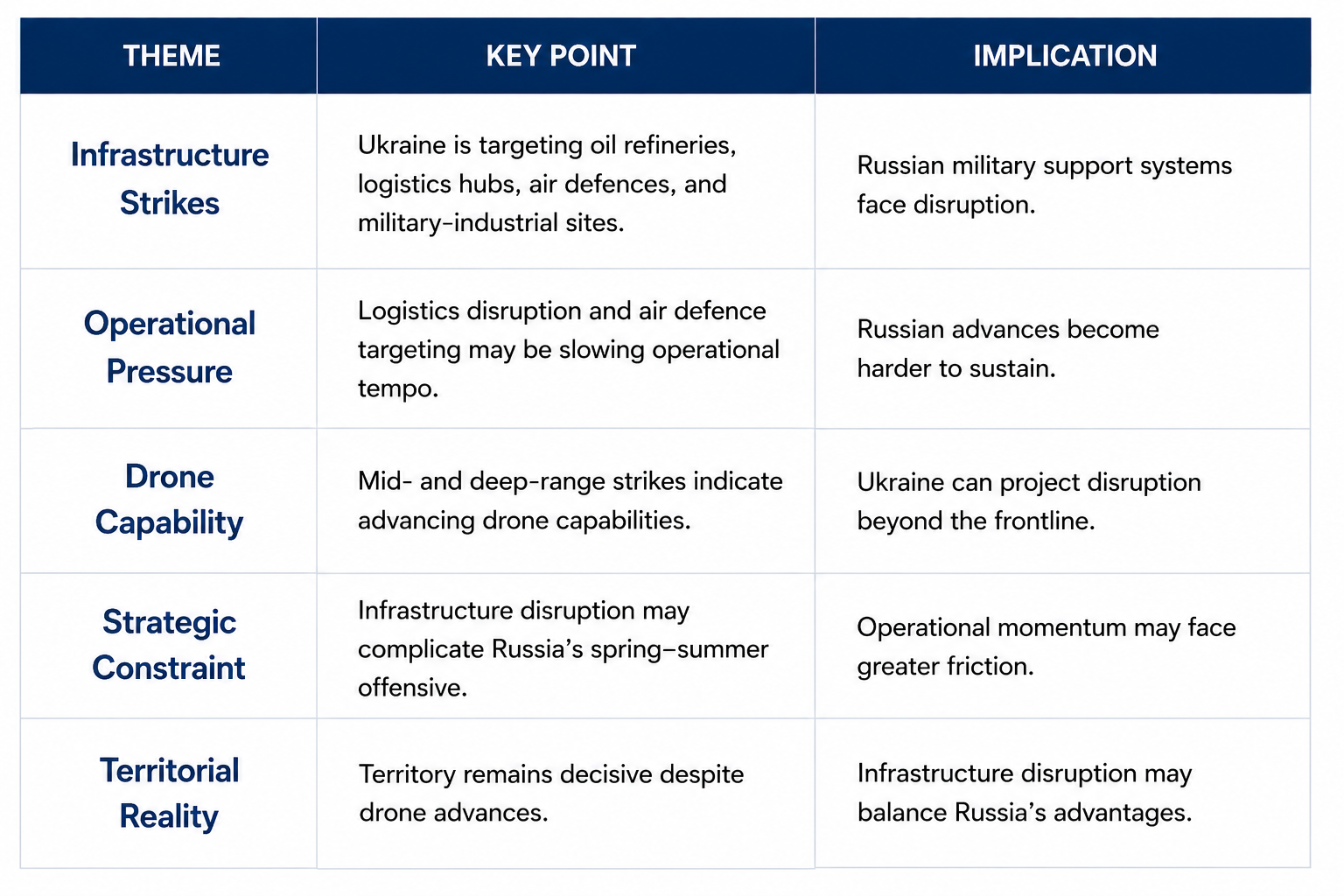
Ukraine's infrastructure strikes may have contributed to stalling Russian advances. With Russian oil refineries hit and front-line momentum slowing, the Institute for the Study of War reported that Russia may have slightly lost territory. The infrastructure attacks may have constrained Russia’s ability to conduct a spring–summer offensive, with logistics and troop movements disrupted. By targeting Russia’s air defence systems, Ukrainian strikes may have increased the vulnerability of troops and military movements, forcing infantry dispersion and slowing Russian advances.
While attention has centred on Ukraine's strikes inside Russia, territorial gains remain important. Instead, the tactic reinforces the role of territory while highlighting Ukraine’s asymmetric approach to holding or recapturing it. Vastly outnumbered in infantry, Ukraine’s ability to influence frontline outcomes through systems and supply disruption indicates the war is becoming a battle of attrition, making Russian advances harder to sustain.
Military supply chains and infrastructure carry greater strategic significance. Territorial gains remain crucial; however, modern conflict is increasingly shaped by low-cost advances in drone technology rather than multi-million-dollar conventional systems. The Ukraine conflict shows how technological innovation and evolving tactics can target industry, air defences, logistics, and oil infrastructure to shape battlefield outcomes in asymmetrical wars of attrition.
Ukrainian strikes inside Russia are significant, but not decisive. Mid-range or deep strikes are unlikely to lead to victory; territory still has to be recaptured, gained, or held. The tactic may, however, have altered Russia's operational trajectory. Yet with manpower, artillery, and military superiority, the long-term implications remain uncertain. Russia’s structural advantages persist, even as Ukraine inflicts disruption. Ukraine's strategy of systems disruption may shape battlefield outcomes, but it is unlikely to completely replace conventional combat. As tactics evolve, Russia may also adapt to counter these Ukrainian incursions.
Russia may also be concerned that Ukraine's drone capabilities will continue to improve. Low-cost drone technology is inflicting high-cost infrastructure damage, highlighting the financial gap between cause and effect. More concerning for Russia may be the rapid evolution of Ukraine’s drone capabilities, which are likely to improve further over time. The strategic implications are not just physical damage but also financial strain. Can Russia sustain war funding while absorbing infrastructure damage and achieving limited territorial gains? The result may be greater pressure on Russia toward negotiations rather than deeper entrenchment, though the opposite outcome is also possible.
The recent strikes deep inside Russia are unlikely to have been welcomed by Moscow. A Russian response, however, has yet to emerge. Russia may adapt by striking deeper into Ukrainian civilian infrastructure to counter Kyiv’s strategy. Drone tactics and air defences may also evolve to reduce the impact of future strikes. Russia could escalate rhetorically through nuclear signalling in media or diplomatic channels. If a spring–summer offensive has been disrupted, a Russian response may follow soon.