Beyond the Frontline: Russian Retaliation Against Ukrainian Drone Strikes
Key Takeaways
Ukraine’s deep drone strikes inside Russia have drawn a conventional response
Russia’s missile barrage demonstrates retaliation through escalation capacity
Russia’s use of lawfare attempts to reframe the response as retaliation for Ukraine’s alleged breaches of international law
The conflict has moved beyond the front line, with deep strikes increasingly shaping battlefield outcomes
The May 23-24 Russian strikes on Ukraine were a demonstration of significant force. Russia's battlefield momentum has potentially stalled due to the Ukrainian strikes on logistics infrastructure in Russia. The missile barrage over the weekend could be interpreted as force projection after setbacks on the front line. The Institute for the Study of War reported that for the third time in the conflict, Russia has employed the Oreshnik intermediate-range ballistic missile (IRBM) to strike Kyiv. Alongside the IRBM were swarms of Shahed drones used to draw Ukrainian air defences to enable IRBM strikes. According to Le Monde, the Russian Defence Ministry informed that the attack was in retaliation for Ukrainian attacks on civilian infrastructure inside Russian territory.
While Russia maintains escalation capacity with the use of IRBM and conventional weapons, this is revealing. Russia’s force projection suggests that its military is having difficulties countering the Ukrainian drone strikes on logistics systems. For the time being, Russia has yet to adapt its strategy sufficiently to counter the strikes effectively. The Russian missile barrage may not immediately sway battlefield momentum nor deter Ukrainian drone strikes; therefore, the question remains whether Russia continues to escalate or adapt strategically.
Russia’s tactics are focused on projection rather than battlefield gains. Kyiv citizens may be psychologically affected, while Russians may have hoped for increased morale after frontline stagnation and Ukrainian drone strikes. Missile barrages cause pressure, but unless they target key military installations or logistics, the impact is mostly psychological and economic. Escalation could indicate that Russia is having difficulties adapting a counter-strategy to reduce the Ukrainian strikes.
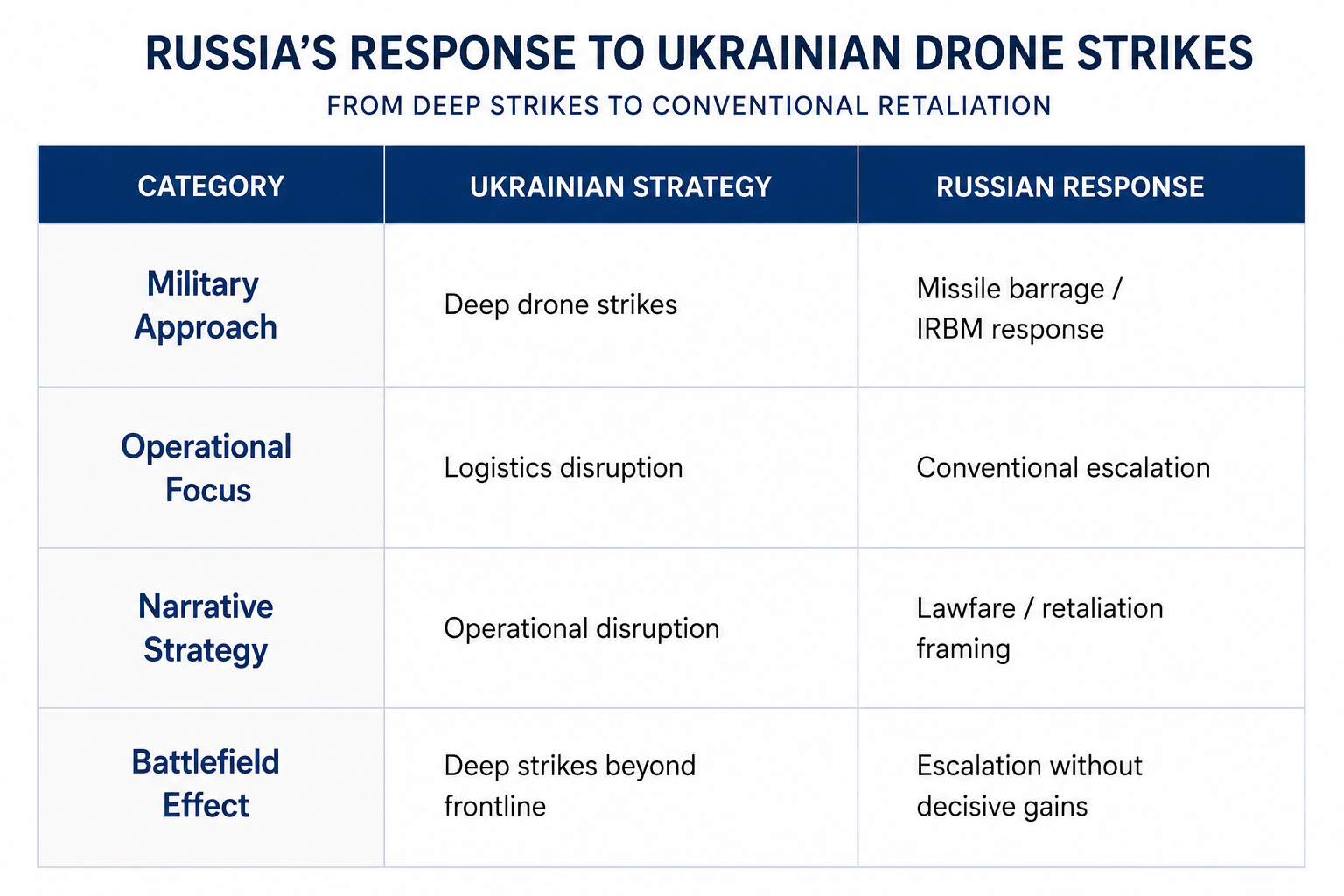
A statement on 25 May by the Russian Foreign Ministry indicated the barrages will continue. Citing breaches of the Geneva Conventions of 1949 and the 1989 Convention on the Rights of the Child, the Foreign Ministry warned Kyiv citizens to leave the city in anticipation of strikes on military infrastructure. By invoking international law, Russia is attempting to reframe the response as legitimate with Ukraine as the aggressor, assisted by NATO allies. It positions Russia’s narrative as justified retaliation. The recent strategy suggests Russia will respond conventionally and through lawfare as its options remain limited in the short term.
The Ukraine conflict is entering a new phase in what was once infantry-heavy. With shifts in strategy, the conflict has moved beyond the front line, with Ukrainian asymmetrical adaptation against Russian escalation. In the immediate future, Russia appears to be responding conventionally while Ukraine continues to develop its drone technology. Battlefield friction will continue, and territory retains importance; however, the front line could be determined by what happens deeper in Russian and Ukrainian territory. Neither side has demonstrated an outright advantage. Instead, the conflict is emerging as a war of adaptation and attrition. For now, Russia has escalation capacity, but to what extent it is willing to increase the use of missile barrages is yet to be seen. For Ukraine, how its military adapts to retaliation may also determine how it continues to fight the conflict.