Quad-Fiji: Supply Chains, Security, and a Regional Voice
Key Takeaways
The Quad-Fiji agreement may indicate the Quad becoming more operational in the Indo-Pacific
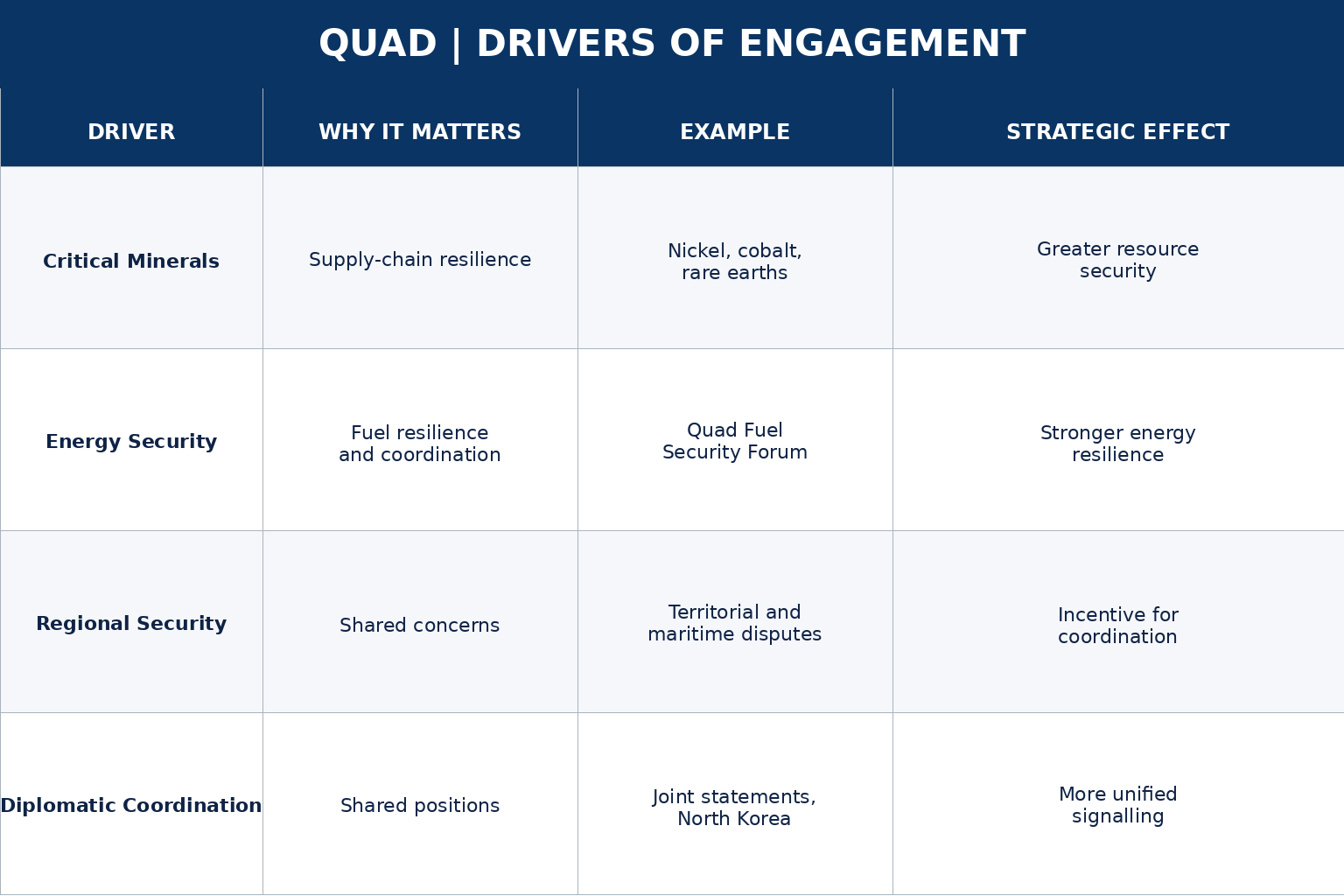
Regional security, energy security, and critical mineral supply chains appear to be motivating factors behind Quad engagement
The U.S. NSS outlines the importance of critical supply chains, which appear to be reflected in Quad engagement.
The agreement has drawn a diplomatic response from China criticising groupings that risk bloc confrontation
The Quad's overlapping interests may motivate members to expand regional engagement
On May 26, the Quad, made up of Australia, India, Japan, and the U.S., signed an agreement with Fiji on port construction and several key areas. In just the third meeting of the Quad, the Fiji agreement also includes critical mineral supply chains and energy security. The Quad joint statement released acknowledged the increasingly complex geopolitical landscape and the group’s “accelerating collaboration to ensure energy stability and security.” Although this first Quad initiative is with a small Pacific island, the statement also addresses future endeavors through an engagement plan for the region. Overlapping concerns in the Indo-Pacific may be strengthening Quad relations, with the group appearing to move towards practical coordination.
Although the Quad has existed for a decade, it appears to be becoming more operational. High-level discussions will be scheduled in a Quad Fuel Security Forum to build energy resilience with partners in the Indo-Pacific. Beyond energy security, the Quad plans to collaborate in other areas such as technology, policy, international market analysis, management, and emergency response. Rather than formal alliances, the Quad’s coordination approach will aim to build resilience through engagement and common interests. With overlapping interests in the Indo-Pacific, particularly around supply chains and regional security, countries may be willing to engage with the Quad for mutual benefit.
The Quad-Fiji agreement can be read as part of a wider resilience and supply-chain strategy outlined in the U.S. National Security Strategy. As part of the NSS, securing access and ending threats to critical supply chains and materials is linked with security and economic prosperity. Nickel, cobalt, and rare earth elements are important for defence systems, semiconductors, and energy infrastructure, making supply chains vital for economic and U.S. security. China is singled out as having strengthened its position on supply chains since 2017, which was also when the Quad was reestablished. The Pacific is increasingly engaging larger regional players, especially in areas of investment, infrastructure, and resources such as critical minerals. With the announcement of the Quad-Fiji agreement, the move appears to be consistent with the wider U.S. strategy to secure access to supply chains.
For Fiji, the island nation is having to balance international engagement and maintain its non-alignment principle within growing competition. Since 2006, China has invested in the Fijian economy and development, receiving considerable investment between 2011 and 2018, alongside limited police collaboration. Between 2022 and 2023, however, Fiji appeared to re-engage with Australia after receiving financial aid and the signing of the Vuvale Partnership, which signified a strategic partnership. Also in 2023, Fiji reinstated the Taiwanese mission’s name to Trade Mission of the Republic of China (Taiwan), and Prime Minister Rabuka cancelled a meeting with the visiting Chinese Foreign Minister. The shift in Fiji’s foreign policy toward China remained limited, as later the same year Fiji withdrew its signature on the UN statement condemning the treatment of the Uyghurs, and in 2024 Rabuka paid an official visit to China. However, Fiji has largely maintained economic engagement separate from security matters, as according to Reuters, Rabuka has stated that Fiji opposes a military base in the region.
China’s response to the Quad-Fiji agreement has been consistent with other statements on Pacific agreements. Similar to China’s response to the New Zealand-Cook Islands defence and security agreement, the Chinese Foreign Ministry stated that third parties should not be targeted. However, the Quad may have drawn more criticism given the scale and collective weight of its membership. In a press conference on May 28, Chinese Foreign Minister Mao Ning stated that "we are consistently against forming exclusive groupings and inciting bloc confrontation.” With the Quad also calling for the complete denuclearization of North Korea, which drew a similar response from Minister Ning, China may view the Quad as a more unified diplomatic voice. Although in the early stages, the Quad appears to be positioning itself as a diplomatic group willing to present shared positions on regional concerns.
The Quad-Fiji agreement is unlikely to have an immediate global impact, but it suggests the group is becoming more active. With ongoing concerns in the South and East China Seas, the acceleration from members may be partly through shared interests. Territorial and maritime disputes along the China-India border and around Japan’s Senkaku Islands provide regional security motivation from both India and Japan. Australia and the U.S. have interests in maintaining access to maritime trade routes alongside growing security concerns. Members may view deeper Quad cooperation as a way to address multiple growing concerns in the region through diplomatic messaging and regional engagement. Japan’s defence budget increase and India’s proposed sale of the BrahMos supersonic missile to Indonesia may also indicate broader regional security relationships that the Quad could build upon. Fiji is an early example of wider Quad engagement, but like Fiji, countries will also need to balance diplomatic relations and economic engagement amid growing competition. Developments to monitor include broader Quad working relationships across the Indo-Pacific and more consistent diplomatic messaging on sensitive issues. Although not a formal alliance, the re-emerging Quad could function as a practical grouping to address growing regional challenges while also drawing a stronger diplomatic response from China.
Sources
Quad Foreign Ministers’ Meeting Joint Statement (26 May 2026)https://www.state.gov/releases/office-of-the-spokesperson/2026/05/joint-statement-from-the-quad-foreign-ministers-meeting-in-new-delhi
U.S. National Security Strategy (2025)https://www.whitehouse.gov/wp-content/uploads/2025/12/2025-National-Security-Strategy.pdf
Reuters — Prime Minister Rabuka on military basing in Fijihttps://www.reuters.com/world/china/fiji-says-china-military-base-not-welcome-pacific-islands-steer-between-2025-07-02/
Chinese Foreign Ministry Press Conference (28 May 2026) — Mao Ning remarks on bloc confrontation and the Quadhttps://www.fmprc.gov.cn/mfa_eng/xw/fyrbt/202605/t20260528_11919951.html
Quad Statement on Indo-Pacific Energy Security (26 May 2026)https://www.foreignminister.gov.au/minister/penny-wong/media-release/quad-statement-indo-pacific-energy-security
Quad Critical Minerals Initiative Framework (26 May 2026)https://www.state.gov/releases/office-of-the-spokesperson/2026/05/quad-critical-minerals-initiative-framework-among-the-united-states-japan-australia-and-india