Controlling the Flow: The U.S. Maritime Enforcement Strategy
Key Takeaways
The U.S. is targeting Iran’s supply chains through blockade enforcement and vessel seizures.
Maritime enforcement now spans regions, with blockade operations in the Middle East and seizures in Asia.
Vessel interception risks escalation as states rely on shipments and may move toward naval escorts.
The U.S. seizure of the Iranian-flagged TOUSKA container ship reflects a shift toward managing maritime space rather than blockade enforcement. The specific targeting of the vessel signals how the U.S. aims to control maritime space beyond the blockade. The operation is targeting weapons supply chains. The U.S. is expanding enforcement of sanctions across Iranian oil flows and China-linked dual-use chemicals. The maritime interdiction and boarding of the sanctioned crude oil tanker TIFANI in Asia demonstrates that illicit oil shipments supporting Iran are being targeted globally.
After failing to comply for over six hours, the TOUSKA was boarded by U.S. forces. The TOUSKA is linked to the Islamic Republic of Iran Shipping Lines (IRISL) and sanctioned under the Office of Foreign Assets Control (OFAC). Sanctions were imposed on IRISL in 2019 by the U.S. for involvement in the procurement of military dual-use equipment. As an evasion technique, the TOUSKA is also suspected of reflagging. Having recently departed from a Chinese port, the route places the TOUSKA in a sanctioned trade corridor used for evasion.
The vessel's departure from Zhuhai port in China places it within a strategic chemical export hub. Currently, the UN arms embargo prohibits Iran from acquiring military equipment and conventional weapons. The embargo forces Iran to rely on external procurement networks for military capability and to supply proxies.
Overland transfers are challenging for moving large quantities of inputs, making maritime routes critical for Iran’s military capability. Chemicals such as sodium perchlorate are dual-use, allowing them to act as precursors for ballistic missile fuel. Sodium perchlorate is often used to make ammonium perchlorate for missile fuel and is also used in improvised rockets, warheads, or improvised explosive devices. Part of the evasion technique is that sodium perchlorate has legitimate industrial use and enables Iranian deniability.
While China is not providing direct military support, it is acting as an enabler through industrial outputs that may fuel Iran’s and its proxies' military capabilities. Sanctioned trade flows reveal patterns and routes vessels use for evasion, and the U.S. is now making efforts to disrupt Iran’s reliance on external inputs. Iran’s military capability is sustained through covert supply chains under the guise of civilian vessels transporting dual-use cargo. The seizure of the vessel reveals a wider supply network that is increasingly coming under U.S. pressure.
Despite U.S. pressure on Iran, the operation shows that the IRISL-sanctioned fleet continues to operate. The evasion strategy demonstrates how state-linked vessels, maritime logistics, and industrial inputs use trade routes to blend into commercial traffic. Vessels such as the TIFANI are registered in foreign countries, for example, Botswana, in an effort to maintain deniability. Sanctioned vessels reflect not just a maritime challenge but also a shadow network that enables supply chains to function. Vast marine space makes tracking vessels challenging, alongside transiting multiple state territories and jurisdictions. Enforcement becomes selective, not comprehensive given the number of commercial vessels. An ambiguous environment still provides sanctioned vessels a level of opportunity to evade enforcement. Even under pressure from a superpower, the sanctioned vessel systems can survive.
The U.S. is implementing a more assertive response to maritime enforcement. Chokepoint control through the U.S. restrictions of the Strait of Hormuz limits transit from Iran and applies economic pressure. The expanding strategy creates disruption in the network of Iranian vessels across the Middle East and Asia by restricting oil flows. It signals that sanctioned vessels are increasingly vulnerable in international waters, reflecting a U.S.-coordinated effort to seize oil and chemicals that may be used for weapons manufacturing. The dual U.S. approach shifts beyond blocking access but also disrupting flows by seizing vessels before arrival. Initially, the strategy was chokepoint restriction, which has now expanded to patrolling routes and networks to enforce sanctions pre-arrival. Operationally, the U.S. has the military capacity to implement an expansive enforcement strategy, which may impact how sanctioned vessels choose to function. Evasion techniques can include altering transit routes or stopping at ports to avoid suspicion or turning off its automatic identification system.
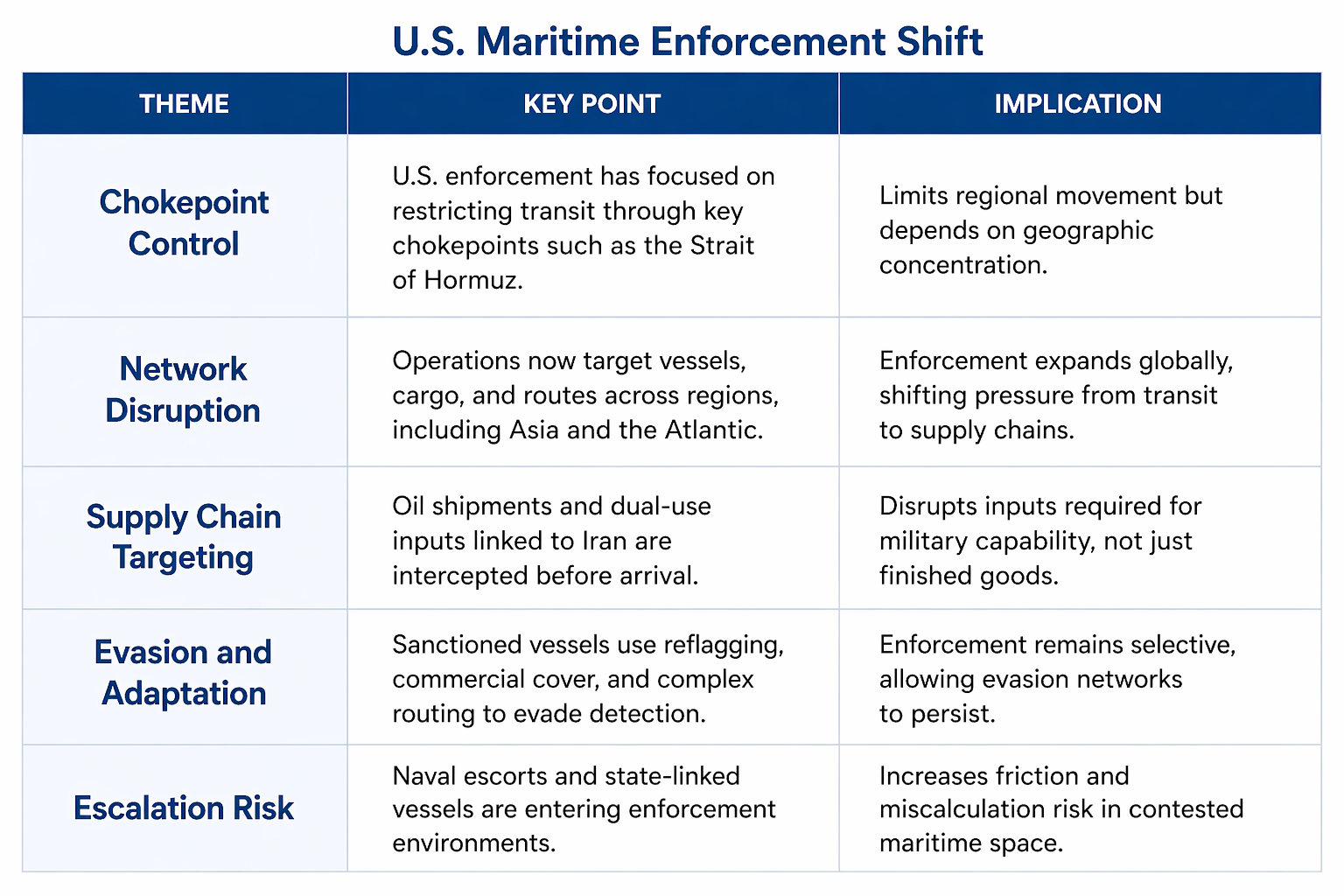
The maritime space is becoming increasingly contested, driven by chokepoint disruption and vessel seizures. The U.S. operations show that controlling supply chains and inputs apply pressure across multiple points. With the seizure of the TOUSKA and the TIFANI, the U.S. is implementing cross-regional enforcement that is both reactive and proactive. Regardless of where sanctioned vessels transit, the U.S. has demonstrated the capability and intent to carry out enforcement operations. China’s role as a supply enabler remains unclear; however, its response that the seizure was a “forced interception” suggests a concern over the expanding role of U.S. maritime enforcement. The U.S. focus remains on Iran, but with a more brazen shadow fleet with links to Russia and China, the enforcement strategy increases the risk of friction in great-power competition.
Maritime interception carries risks of escalation as sanctioned vessels become strategic assets. Sanction enforcement has resulted in naval escorts, which increase the risk of miscalculation or tension between states. Early this year, the U.S. targeted a vessel in the Atlantic carrying Venezuelan oil bound for Russia. The recent crossing through the English Channel of a sanctioned vessel being escorted by a Russian frigate suggests the strategic value of the cargo. Civilian and military lines are being blurred, creating friction between escorts and enforcement operations.