Hormuz ceasefire: Who controls the conditions in the Strait?
The Strait of Hormuz is shifting from disruption to controlled access.
A ceasefire does not restore pre-conflict levels of access without agreed terms and procedures.
The response is shaped by competing approaches: security, terms of access, and market forces.
Control of chokepoints is driven by risk factors and the viability of insurance coverage.
State responses risk eroding the principle of freedom of navigation.
The Strait of Hormuz could be entering a temporary post-disruption phase where terms, not force, control transit. With a potential agreement between the U.S. and Iran being discussed, the central question is who defines and controls the rules of transit. Any physical indication that the Strait is open may not suggest that a functional system exists. An open strait is not a return to normalisation. An outstanding issue could be who governs or authorises movement and whether the international community and, importantly, insurance companies are willing to accept potential risks. The agreement could signal a new phase, where tension and disruption may be replaced by an authority determining passage.
Part of the proposed ceasefire agreement is the opening of the Strait for transit. The temporary agreement is not likely to restore shipping to pre-conflict flows or resume immediately for several reasons. Without clear procedures or agreed transit conditions, it is unlikely that insurers will be able to rapidly determine the safe passage of vessels. Ceasefires can be volatile, and any sign of potential escalation from the various actors and proxy groups could unsettle an already unstable region. The agreement suggests a shift in the political environment; however, it does not set the practical conditions of movement yet. If other parts of the agreement are not upheld, the situation in the Strait could also rapidly decline. It still creates an environment for insurance and shipping companies where risk remains.
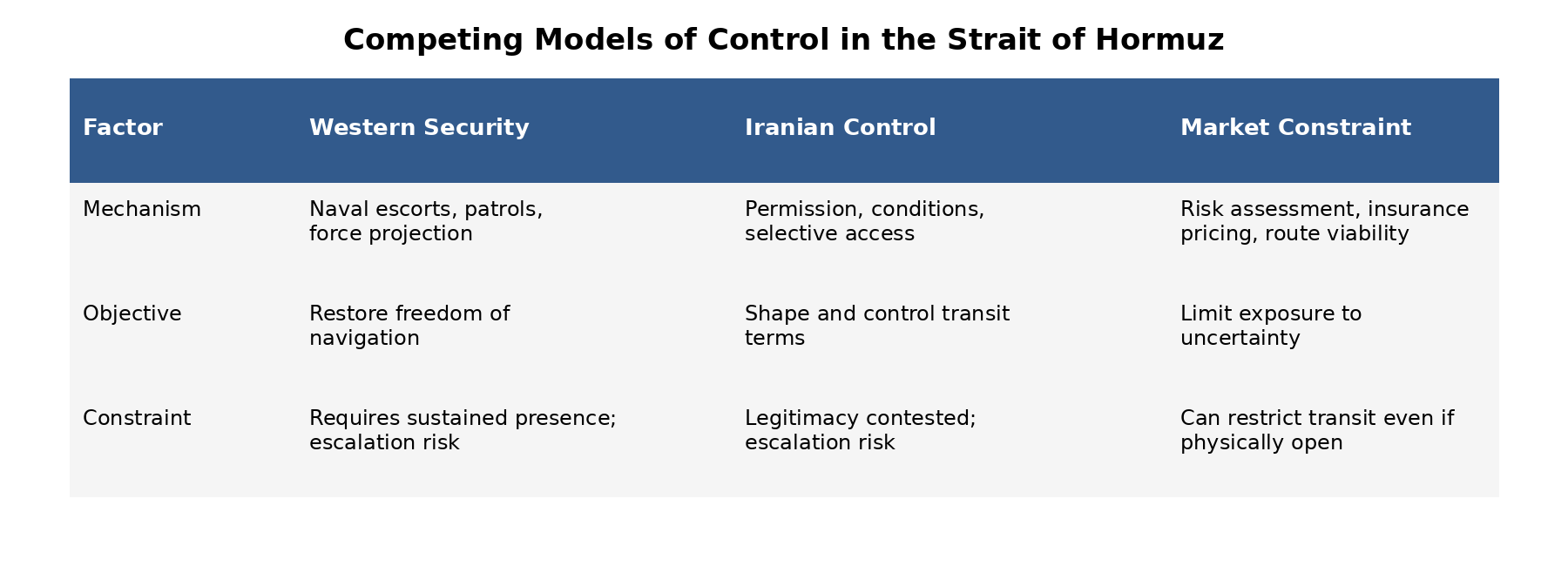
There are several approaches to Hormuz that could emerge to ensure safe passage. Early in the conflict, the U.S. appealed for a naval presence with escorts in a Western security approach. This approach would aim to restore transit through security provisions and force projection. Iran still holds procedural leverage over the Strait. The Iranian approach controls the process through granting permission and setting conditions for transit. Although movement occurs, it is Iran that sets the terms. Beyond states, market forces also determine transit as insurance companies require confidence that the level of risk does not pose a direct threat. Insurance companies will also need to agree to the terms set by Iran and the U.S., and these terms may not meet insurance standards.
Control of transit through the Strait of Hormuz will be significant beyond the crisis. The situation is not only about maintaining access but also about how control is exercised. Even with transit under a temporary ceasefire and the Strait not fully closed, complications remain. Control of the Strait creates friction between states, shipping companies, and the global market. Uncertainty about the terms of transit and whether Iran will grant permission increases insurance liabilities and destabilises market forces. The chokepoint demonstrates that a neighbouring state can determine flow without officially blocking it. The strategy effectively shows that risk itself is a tool. If Iran implements a toll system, there is also the possibility that it will remain beyond the conflict indefinitely.
The Strait of Hormuz disruption challenges the principle of freedom of navigation. With roughly 80% by volume of global trade occurring by sea, the current situation highlights the importance of the United Nations Convention on the Law of the Sea (UNCLOS). In territorial seas under UNCLOS, it is also not permitted to charge foreign vessels for passage, only for services. Effectively, Iran is now challenging global adherence to the freedom of navigation, while state responses that engage with Iran risk reinforcing that challenge. How this could have wider implications is evident in the Singaporean foreign affairs minister's response, stating that Singapore will not negotiate with Iran, as there is a right of transit passage. As a country that relies heavily on the Strait of Malacca, the decision reflects an awareness of how the Hormuz disruption could have wider and more relevant future implications. By states negotiating conditional access, they risk undermining rather than upholding international law while also potentially eroding the global relevance of freedom of navigation.
Hormuz is not just about access to transit but also about who sets the terms of access. Physically the strait can potentially be opened; however, this does not suggest a return to pre-conflict transit levels or conditions. The disruption remains politically contested with states either willing or unwilling to negotiate with Iran to secure passage, which challenges the principle of freedom of navigation. As the situation is evolving, the market will likely interpret the temporary ceasefire as still volatile and commercially uncertain, resulting in either insurance premium increases or possibly denial. The Strait of Hormuz is likely to remain under strained conditions and uncertainty, which is unlikely to immediately relieve global energy pressure. Importantly, the contested space may have wider implications for other chokepoints in the future.