Europe’s Hormuz Dilemma: Balancing Strategic Risks
Key takeaways
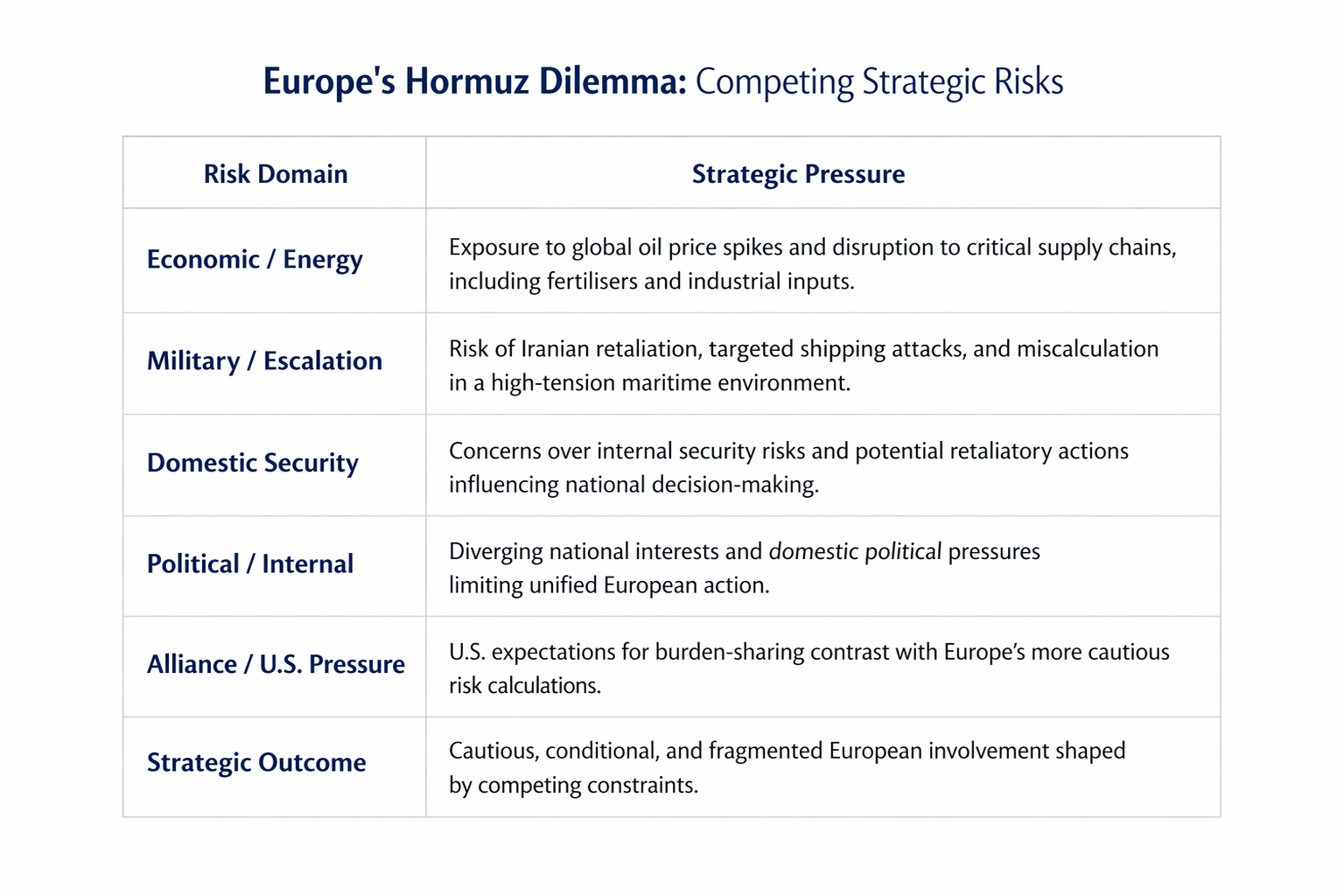
Europe faces a strategic dilemma as it balances military, economic, and domestic risks.
The Hormuz disruption exposes European industries to global price spikes and critical supply chains.
Escalation risks include potential Iranian-backed domestic retaliation and targeted attacks on vessels in the Gulf.
Domestic political pressure and security risks create a divergence in European strategy.
The U.S. frames the Hormuz crisis as burden-sharing, creating tension in the alliance, while Europe demonstrates cautious risk calculation.
The likely result is conditional European involvement and a cautious, fragmented response.
The Strait of Hormuz disruption has placed pressure on allies to coordinate a response, creating tension between traditional allies. European and U.S. perspectives on how to resolve the situation demonstrate a divergence, with U.S. expectations differing from cautious European states. An assertive U.S. is signalling the need for a joint strategy to secure the Strait, either through naval escorts or military action. Meanwhile, European decisions reflect a general reluctance to escalate militarily due to several risks. Even within Europe, the fragmented approach suggests a strategic tension with countries managing competing risks.
Europe’s response is influenced by competing strategic priorities. The dilemma is securing transit through the Strait while avoiding unnecessary escalation. European industries face significant pressure due to their reliance on raw materials that transit the Strait. Although Europe’s energy reliance on the Strait is relatively low, oil is a global product, and it is susceptible to price surges with widespread repercussions.
Since 2022 Europe’s reduction in Russian energy has resulted in European reliance on Middle Eastern fertilisers. The European agriculture sector will need to compete for supplies, increasing food and production prices. For European car manufacturers, low-cost aluminum from the Gulf States is now under supply chain pressure. The continent will face other price contagion effects in ingredients for plastics and the petrochemical industry. Europe is challenged with industry shortages of key resources as well as market price increases.
Any European military involvement would carry further risks. Iran has signalled that it will target the U.S. and its allies involved in any operations. The selective access strategy creates hesitation, as Iran has indicated that certain vessels can transit. This ambiguity has led to a cautious European approach, as any military participation could lead to naval assets or commercial vessels becoming Iranian targets. Uncertainty increases the risk of miscalculations, and with conflict thresholds difficult to interpret, any European military presence in the region may be interpreted as a threat by the IRGC. Europe must balance potential military engagement against the risk of being targeted while also considering de-escalation through negotiations in the hope of gaining some access to the Strait. Iran possesses capabilities beyond the Strait, with ballistic missile capacity that could reach European cities.
Along with external risks, European states must manage domestic pressures. Concerns about IRGC retaliatory attacks have also shaped some states' decision-making. Several attacks on Jewish sites across Europe have led to soldiers deployed in Belgium due to threats from proxy groups. Others may be influenced by domestic politics, such as Spain's Prime Minister Sanchez, who opposed U.S. military action and denied the U.S. the use of bases on Spanish territory and closed Spanish airspace. The complex internal dynamics reinforce the fragmented and limited response by European states. Europe must balance domestic pressure and strategic calculations in an evolving economic and security challenge.
Europe is also constrained by multiple risks across external and internal domains. The economic impact of the Strait’s disruption has repercussions for European industries and is likely to lead to inflation if prolonged. Domestically, leaders must also balance their own constituents' views while managing concerns about violent threats from IRGC proxy groups. The Trump administration has been vocal in its criticism of NATO, and although not specifically a NATO obligation, the U.S. has framed this scenario in alliance burden-sharing terms. The cautious European decision-making is likely only going to add to U.S. criticism of NATO. Furthermore, security commitments in the eastern flank with Ukraine require resources and political attention, meaning that any military involvement in the Gulf could leave Europe exposed. The European strategic dilemma is likely to continue to be cautious and fragmented in the short term, with alignment to U.S. military strikes remaining unlikely.