Access Denied: Maritime Competition and Chokepoint Strategy
Key Takeaways
The Hormuz disruption demonstrates a transferable model based on controlled access rather than denial.
China’s global port strategy suggests a long-term approach to securing maritime supply chains in an environment of great power competition.
A ‘shadow blockade’ could disrupt economies through inspections, ambiguity, and market forces.
There is a strategic asymmetry between the disruption model and the strategy to maintain access to chokepoints and avoid escalation.
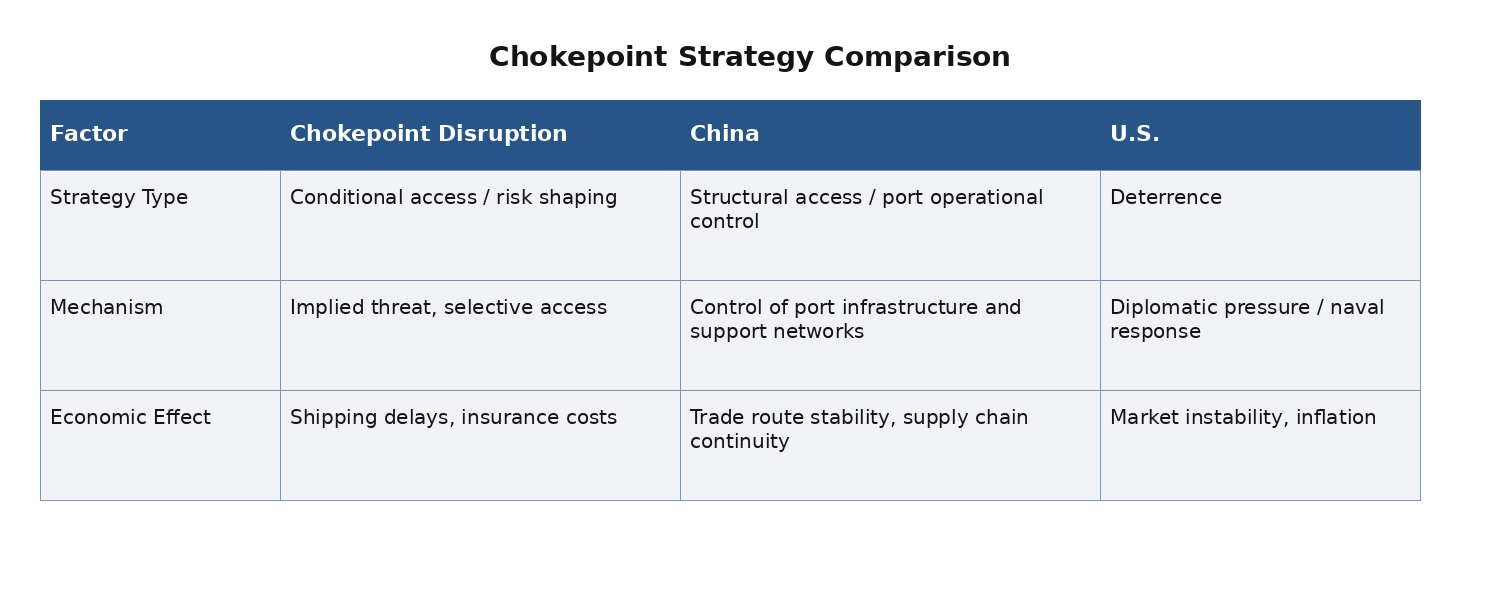
Controlling chokepoints through conditional access is redefining asymmetric maritime strategy. Control is exercised through risk, ambiguity, and market-driven forces. The disruption strategy in the Strait of Hormuz is not just about stopping global maritime flows but about who controls access. The IRGC does not need to close the Strait; it only needs to imply there is a risk in order to shape transit through the passage and enforce its access strategy.
The conflict has created ambiguity about the operational status of the Strait, with indications that the IRGC has granted limited transits following reports of negotiations. Statements from Iran have suggested that access will be denied to the U.S. and countries Iran deems to be U.S. allies. This strategy is about selective, conditional access, where permission may or may not be given, and potentially at a cost. Iran only needs to demonstrate influence over transit to apply global pressure while avoiding military escalation.
The situation in the Strait shows that a formal blockade is not required to control a chokepoint. Creating perceived risk for vessels through mines or naval interception causes operational ambiguity. Transits are halted without conflict, as maritime operators conduct risk assessments and consult with insurance companies.
The lack of clarity about safe passage is enough to enforce a disruption strategy. It is the market that reinforces the disruption through increased insurance premiums as routes become unviable, which creates market deterrence.
Vessels may wait outside the chokepoint in the hope of being granted access rather than using an alternative route. The selective access approach creates more uncertainty and slows transit further as ships delay finding alternative routes, which congests entry to the chokepoint. Control is not through stopping movement but through structuring risk, which is exercised through uncertainty, increased costs, and selective access.
Beyond Hormuz, this model is transferable and repeatable. China relies significantly on trade and energy imports to sustain its economy. The combination makes it particularly susceptible to supply chain disruption, especially maritime, which is why it is positioning itself within a system to maintain access. For example, China has invested considerably in global port infrastructure, with many in corridors where maritime crime is present. Maritime insecurity poses a risk to China; consequently, this port infrastructure is concentrated in higher-risk countries to maintain access.
On the surface, ports appear as practical investments or infrastructure, but they are rapidly becoming critical for supply chains in an environment of increasing great-power competition. The extent of the Chinese port strategy is evident, as it now reportedly operates 90 port terminals globally, logistically supporting trade routes across Africa, Asia, Europe, the Middle East, and South America. The strategy allows it influence over logistics, repairs, fuelling, and port access, which is about shaping conditions for the movement of resources, not influencing or blocking trade. While the Hormuz disruption is tactical and immediate, China’s is structural and long-term to avoid disruption. The Chinese port strategy has not gone unnoticed and has recently drawn a policy response from the U.S. in the National Security Strategy document, recognising the importance of preventing control over maritime chokepoints while avoiding protracted conflict.
The U.S. NSS document identifies the Middle East as an oil and gas chokepoint and underscores the importance of preventing an adversarial power from dominating the region or its chokepoints. While the NSS emphasises avoiding prolonged conflict, the current Hormuz disruption highlights the disconnect between strategy and response. The emerging chokepoint strategy can be applied below the threshold of war but has rapid global repercussions.
For countries seeking to counter chokepoint disruption, conventional responses are proving tactically complex. Conventional responses are risky, as any miscalculation can prolong the disruption in the Strait. It highlights the disparity between those who want to disrupt and those whose objective is to keep routes open; denial can be through veiled threats, while responses require significant planning and military capacity. The NSS recognises risk but not the strategy to restore access. The U.S. objective is prevention without escalation; however, to remove the threat of disruption likely requires significant military response, which is a strategic mismatch.
The Hormuz model can be applied to other strategically dependent countries, especially those reliant on imports. Taiwan is a strategically dependent economy that relies heavily on energy, food, and raw material imports for its modern economy. Roughly 95% of Taiwan's energy needs are imported, with its gas primarily imported by tankers. Although Taiwan has fertile land, it remains reliant on key food imports. As for its industry, global supply chains are vital to sustain Taiwan’s semiconductor economy.
For import-dependent island nations, there is the added risk of not having a land-based lifeline to transfer goods. As with Hormuz, maritime restrictions can control movement through progressive restrictions and by imposing conditional access. Even delays through imposed inspections create economic and logistical implications for an island nation, and the grounds for inspection could be broadly defined. Inspections may be a starting point to implement a form of shadow border that creates uncertainty, and for suppliers, ambiguity adds costs. This can trigger diplomatic and political tension, which creates a strategic dilemma: to escalate through intervention or stay below the threshold of war. Such inspections are not a formal blockade but could be framed as a health precaution, which makes a response difficult. As pressure builds, maritime insurance companies adjust policies due to uncertainty and risk, impacting economic and regional stability. A chokepoint disruption response is challenging to counter, yet simpler to implement, highlighting the asymmetry of the strategy.
Chokepoint influence controls access and movement. The strategy is reinforced through creating perceived risk, conditional access, and ambiguity, which have rapid economic impacts. Hormuz may serve as a template; it is not an isolated situation but one that can be implemented as political leverage.
Freedom of navigation may be challenged as access is granted by those who create the conditions for transit.