Sanctions and Seizures: Energy Flows and Europe’s Maritime Dilemma
Energy supply flows are becoming contested maritime space.
Sanctions are being enforced through seizures.
Russia is countering enforcement with naval escorts and deterrence.
Grey-zone submarine activity is occurring near critical infrastructure.
Europe must balance enforcement with rising escalation risk.
The maritime domain and energy flows are becoming increasingly contested, with limited enforcement through seizures in European waters. Despite economic sanctions imposed on energy transfers, countries such as Russia continue to circumvent them, triggering enforcement efforts. Recently, a structural shift has occurred among some European states. Enforcement operations indicate that sanctions are being imposed through seizures of oil, leading to escalation. There is increasing tension between sanctions, enforcement, and freedom of navigation.
In a joint operation between the Belgian Navy and the French Air Force, a suspected Russian tanker was intercepted in the North Sea. The tanker was transiting under a false flag through Belgium’s exclusive economic zone. The European operation followed earlier raids by the U.S. in the Indian Ocean on an Iran-linked tanker flying the Cook Islands flag. The operations over several weeks signaled a shift, demonstrating a pattern in maritime sanctions enforcement. Although the U.S. operation occurred in the Indian Ocean, it was conducted under an earlier agreement signed in 2019 with the Cook Islands. The two countries have a shiprider agreement allowing the U.S. to board vessels flying the Cook Islands flag.
The shadow fleet's covert approach in an ambiguous environment is now under overt protection. After months of seizures, Russia has signaled a willingness to provide naval capacity to escort the tankers carrying oil for the Ukraine conflict. In an attempt to increase pressure on Russia, British Prime Minister Starmer gave special forces permission to target shadow fleet vessels in British waters to reinforce European efforts. Rather than deterrence, enforcement is directly challenged by the Russian navy, with a frigate escorting the vessel through the English Channel unchallenged. A state-backed presence alongside the vessel signals a shift in conduct and a potential confirmation of its operator. The proximity of the two state actors also presents an escalation risk and operational constraints. Any British or European boarding attempts could be interpreted as a state-on-state confrontation.
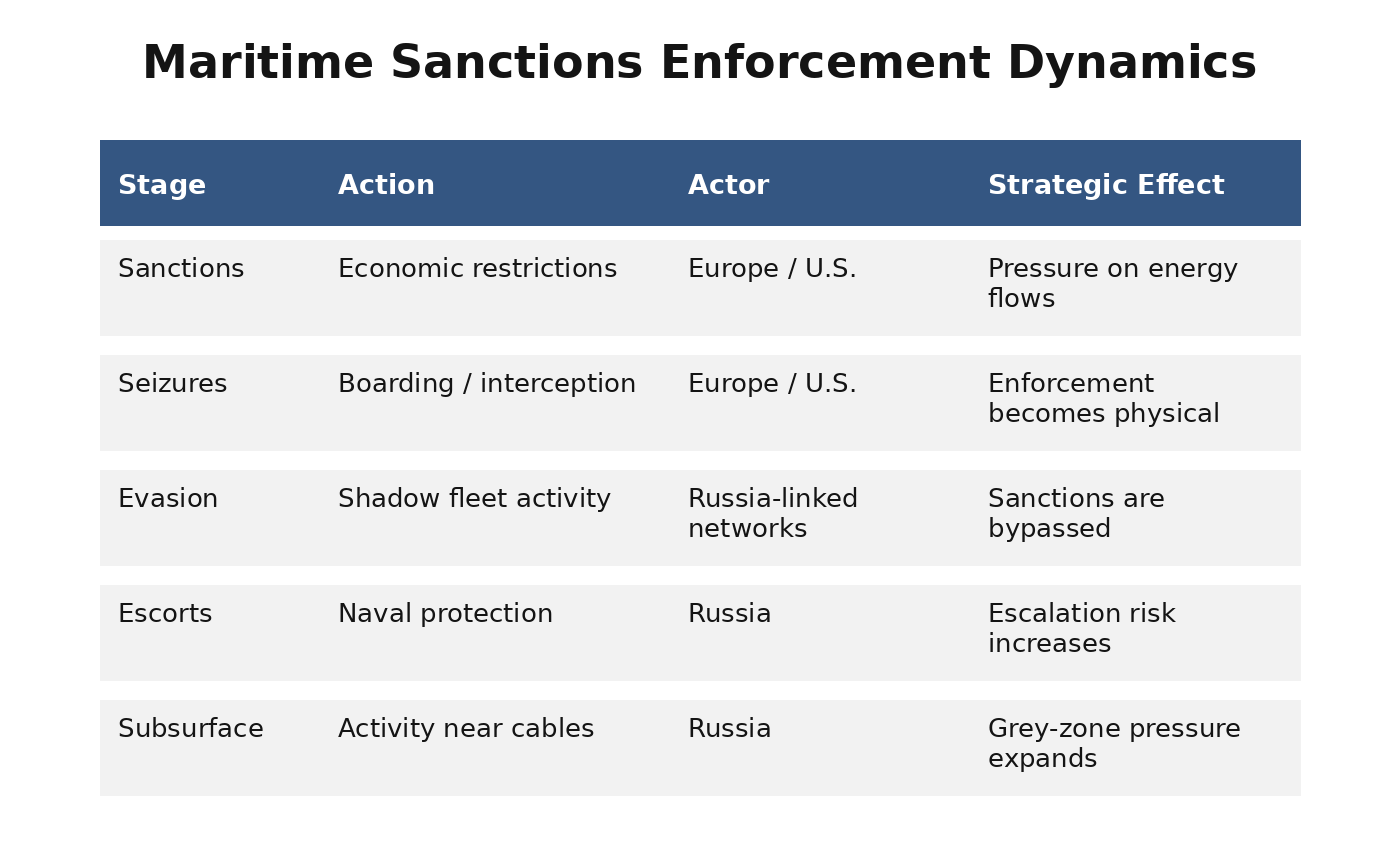
Maritime competition is not restricted to surface vessels, with Russian submarines tracked by the U.K. navy near cables and pipelines. Foreign states operating near critical infrastructure exert pressure without conflict. Such activity remains below the threshold of force. Undersea cables carry power and data, with several suspected sabotage incidents attributed to the shadow fleet. Activities are becoming more hybrid in nature. Beyond critical infrastructure, the submarine's conduct signals a Russian response to Britain and Europe, one of deterrence and warning. Russia is willing to reduce the distance between states to increase its leverage through militarised signalling.
Enforcement against the shadow fleet and the Russian response creates a strategic dilemma. Britain and Europe must decide whether to enforce sanctions and risk Russian escalation or to de-escalate efforts, weakening sanctions. While freedom of navigation remains, states retain some legal jurisdiction to patrol and enforce laws in their maritime zones. Yet, Russian naval deterrence makes legal enforcement and operations increasingly risky, with seizures leading to escorts and submarine deployments. In a congested and narrow maritime space, any miscalculation by these states could have consequences. This response in Europe may have wider implications for global sanctions enforcement, particularly increasing the risk of escalation.