Pacific Alignment Under Pressure: The U.S., New Zealand, the Cook Islands, and China.
Key Takeaways
New Zealand’s defence and security partnership with the Cook Islands signals a relationship shift under increasing strategic pressure in the Pacific.
The growing role of small states risks their being used as strategic leverage in regional power dynamics.
Open maritime registries have connected the Pacific to shadow fleet activity and global enforcement challenges.
Renewed U.S. interest in the Pacific is placing pressure on New Zealand to strengthen regional oversight and security alignment.
Smaller Pacific states are exposed to increased external pressure and must balance competing interests in great-power competition.
New Zealand’s recently signed defence and security partnership with the Cook Islands indicates a recalibration of the relationship under increasing regional pressure. The partnership signing coincides with New Zealand’s high-level engagement involving Foreign Affairs Minister Peters and Secretary of State Rubio. The discussion included shared commitments and security in the Pacific and Indo-Pacific. The invitation by Secretary Rubio signals a renewed U.S. focus on a region becoming strategically contested between the U.S. and China. For smaller actors, it highlights the pressure that traditional partners face, balancing competing interests as China expands diplomatically and economically in the Pacific. For New Zealand, the defence pact is not only a security matter, but also signals improved credibility in the region; the subsequent U.S.-NZ visit may demonstrate a closer alignment.
The Cook Islands have gained global attention recently. Significantly, the 2025 Comprehensive Strategic Partnership (CSP) with China led to a diplomatic decline with New Zealand, which suspended NZ$30 million in direct financial aid. The CSP was a challenge to New Zealand’s unique relationship with the Cook Islands, but also to its traditional position and influence in the region. Beyond recent diplomacy challenges, the Cook Islands' maritime governance has been associated with vessels engaging in oil sanctions evasion.
The Cook Islands' open maritime register has resulted in the shadow fleet flying its flag and carrying sanctioned oil. The open maritime register allows foreign vessels to register without a physical presence in the Cook Islands. States with links to shadow fleet sanctions evasion, such as Iran, Russia, and Venezuela, have used the Cook Islands flag on vessels to avoid sanctions and conduct grey-zone activities. Open maritime registries are a global security challenge, not just a regional security issue. The open maritime register exposes vulnerabilities in New Zealand's ability to influence strategic risks in its region.
The U.S. and European states have increased enforcement on the shadow fleet, which has brought greater attention to the Cook Islands register. With rising tension between enforcement and evasion, the U.S. may be looking to partners to monitor maritime spaces and reduce regulatory gaps like the open maritime register. For New Zealand, the pressure is to demonstrate oversight in the Pacific and alignment on international sanctions to ensure credibility. The added dilemma is New Zealand must balance U.S. security expectations with Chinese economic trade ties. In a region with increasing attention, Pacific states will need to manage multiple pressures in a complex strategic environment. Although the defence and security partnership differs from the CSP, it has drawn a Chinese diplomatic response reinforcing that its relationship does not target or constrain any third party, signalling an intent to continue its Pacific engagement.
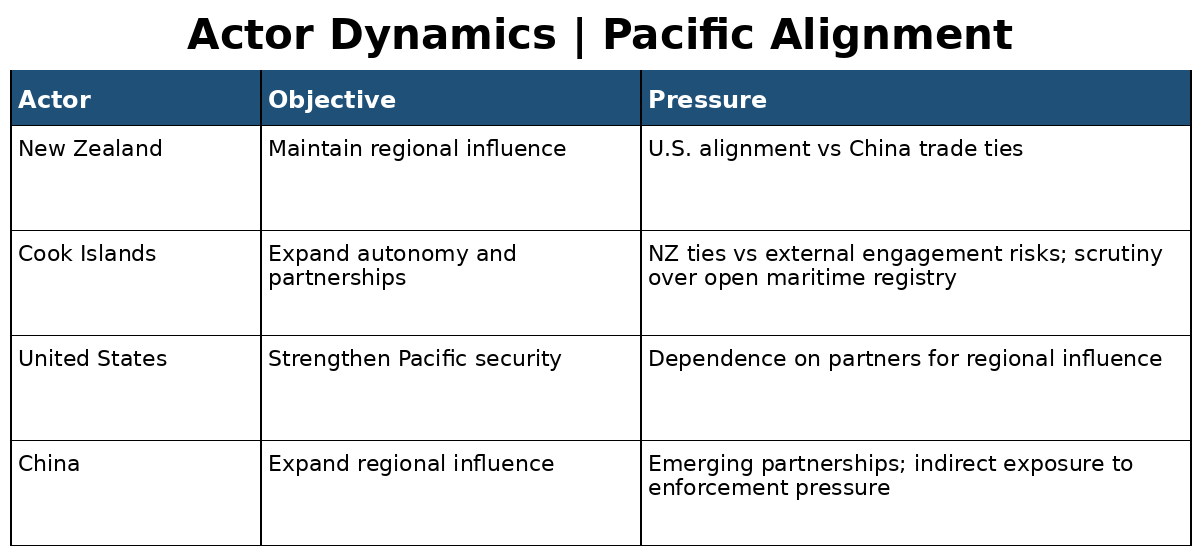
New Zealand and the Cook Islands are positioned in a region with increasing geopolitical competition. For a small state such as the Cook Islands, there have been gains; however, there is also growing pressure from China, New Zealand, and, indirectly, the U.S. Similarly, New Zealand is managing competing interests of security alignment, economic ties, and maintaining regional stability. Although smaller states signing partnerships and agreements appear to show increasing autonomy, these diplomatic decisions reflect increasing interest from larger states in strategic competition. Balancing multiple interests will become increasingly complex for these small states as strategic competition intensifies in the region.