Japan’s Policy Shift: From Defensive to Counterstrike
Key Takeaways
Increased tension in the East China Sea has led to a shift in Japanese defence policy from passive policy to strategic deterrence policy.
Japan’s defence budget increase enables the acquisition of counterstrike capability.
U.S. expectations of allied defence burden-sharing have resulted in Japanese military purchases that can be integrated into U.S. operations.
Japan’s strategic dilemma is to maintain deterrence while avoiding escalation.
Japan’s defence budget increase reflects a transition from passive military policy to a counterstrike capability. For decades post-WWII, Japan maintained a commitment to limited military capability. Japan built into its constitution a pledge to renounce war and the possession of offensive-capable forces. While Japan shifted to self-defence capabilities in the 1950s, it also adopted an anti-nuclear policy. With increasing tension in the East China Sea and nuclear-armed neighbours, Japan is recalibrating its defence policy, transitioning beyond defence toward strategic capability. The doubling of the defence budget signals a doctrinal shift, not a gradual increase, but a calculated expansion.
Japan is actively engaged in territorial disputes in the East China Sea. Japan faces growing regional threats, including a nuclear-armed North Korea and China’s reunification policy toward Taiwan. The increase in Japan’s defence budget reflects U.S. expectations for greater allied burden-sharing and a contested regional security environment. Simultaneously, Japan is reducing its reliance on U.S. deterrence amid uncertainty in security guarantees while developing more integrated military capabilities with the U.S. This approach is not symbolic but reflects a decision to increase Japan’s capabilities in conflict scenarios. Once focused on a defensive posture, Japan is now signalling active deterrence.
Japan’s geographical position places it in a contested maritime domain. In the East China Sea, China, Japan, and Taiwan have overlapping claims to the Senkaku/Diaoyu Islands. Control over maritime access is increasingly contested, with states seeking to monitor and restrict movement. In the Taiwan Strait, China’s grey-zone activities increase pressure on regional stability. Japan’s rearmament enables power projection, deterrence, and influence over maritime access. Because Japan lacks natural resources, it relies heavily on maritime supply chains, and any disruptions to these waterways would expose Japan's economic and energy vulnerabilities.
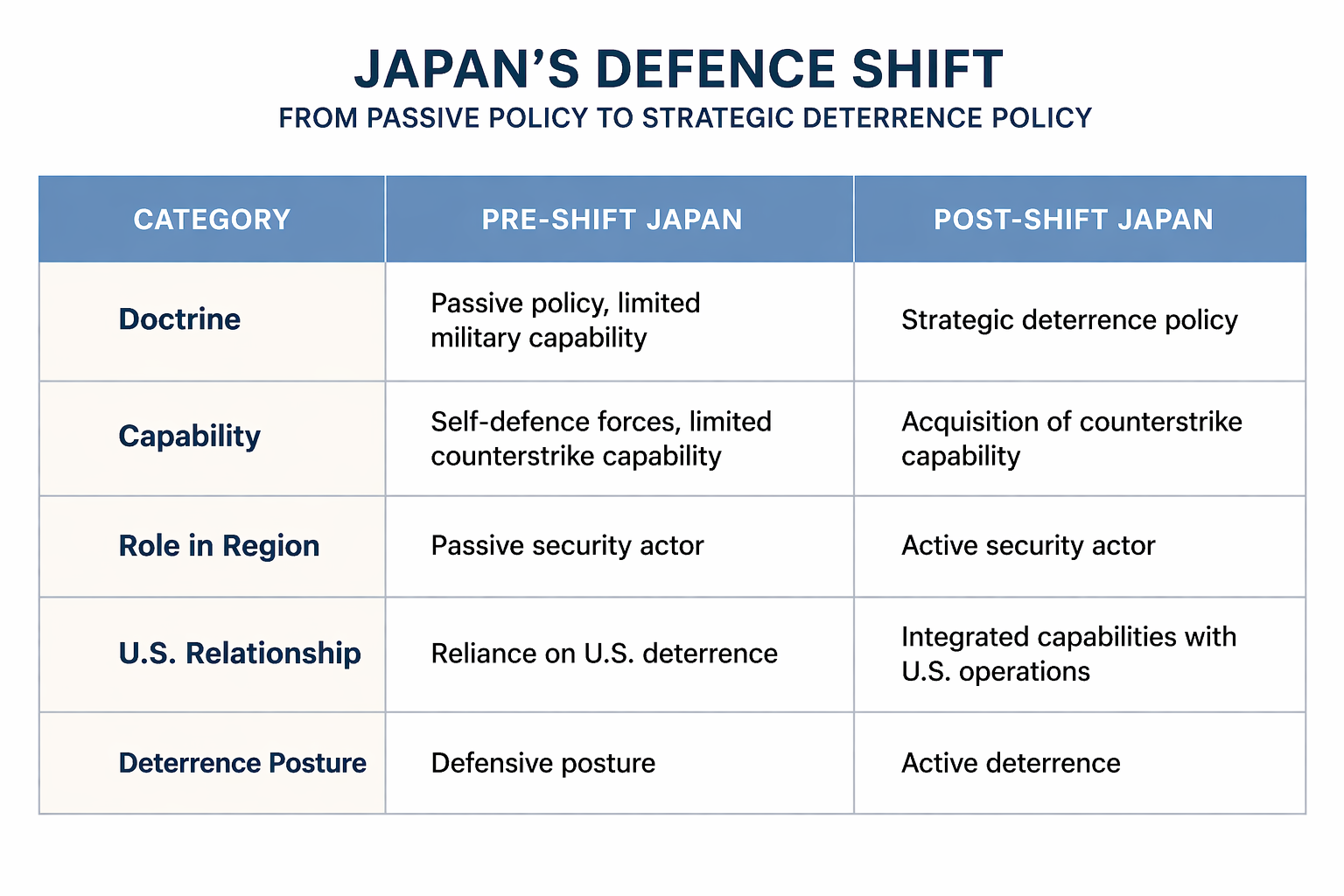
Acquiring strike capability with long-range missiles and F-35 fighters integrates with U.S. capabilities. China has criticised the decision and referenced several international agreements, including the Japanese instrument of surrender. The security dilemma in the region is becoming a contested deterrence environment and a broader security framework.
Japan’s historical defence policy is shifting to a contemporary deterrence approach as the region becomes contested. Rather than a passive state with a defensive capability, Japan is pivoting to an active security actor through its military acquisitions. The contested Indo-Pacific is experiencing increasing territorial disputes, incursions, and rearmament, which raises tensions. With a U.S. stance demanding more input from regional allies, Indo-Pacific states are now required to shape a more independent defensive strategy. Japan’s security dilemma is how to maintain deterrence while avoiding escalation with its shift in defence strategy. Any miscalculations could have widespread impacts on regional security, especially in a region that relies heavily on maritime chokepoints. Indo-Pacific competition is shaping the regional order, and Japan is signalling its role as a balancing power.