Conditional Access: How Navigation Is Being shaped in the South China Sea
Key Takeaways
Chinese maritime militia have formed a vessel barrier, creating a shadow border at the Scarborough Shoal.
China’s maritime activity suggests a strategy to control access to key maritime features
Multilateral military drills signal force projection and collective defence in the region.
Alleged cyanide poisoning in the Spratly Islands indicates a dual-impact approach of environmental damage and economic pressure.
Grey-zone activity risks eroding maritime law and intensifying sovereignty tensions.
The South China Sea continues to be a disputed maritime domain where states are shaping territorial influence through access. The Scarborough Shoal is becoming a control zone where the Chinese coast guard and maritime militia have implemented obstruction techniques at its entrance. Simultaneously, the U.S. held multilateral military drills in the Philippines alongside Japan, Australia, France, and New Zealand. Japan’s inclusion in the live-fire drills signals a deepening of military ties with the Philippines and a continuation of Japan’s more assertive defence doctrine. Beyond diplomatic channels, Chinese obstruction tactics and multilateral military exercises suggest the contest is increasingly operational.
Interactions between Philippine fishermen and the Chinese coast guard are not isolated incidents in the disputed maritime domain. However, the recent Chinese maritime strategy, with vessels forming a barrier at the entrance to Scarborough Shoal, signals an attempt at controlling access. This strategy is not about fully denying access but setting the entry conditions through the presence of the coast guard and maritime militia. China’s use of these vessels rather than naval ones also enables an enforcement presence that avoids military escalation, keeping the activity below the threshold of conflict. Restricted access inhibits the entry of Philippine fishermen, which has an economic impact and challenges sovereignty claims. The Scarborough Shoal is not just about contesting territory but also about setting the terms of access.
Incremental maritime challenges that remain diplomatically or militarily unanswered may have wider regional consequences. The South China Sea is a critical maritime trade route with contested chokepoints and territorial claims by states in the region. Access control of key maritime features can be applied incrementally, which risks normalisation of access control tactics across the South China Sea. Other maritime features, such as the Spratly Islands, could be replicated across the region if successful. States in the region have traditionally relied on a U.S. presence as a form of deterrence. The multilateral military drills signal force projection, including the use of surface-to-ship missiles and collective defence capability. A contrast in strategies is emerging between China’s gradual but persistent use of maritime vessels for control and the large joint force displays of power by regional alliances as a form of deterrence. Tension in the South China Sea is not shifting toward immediate conflict but developing systems of control and the actors that set these access conditions. As the South China Sea increasingly becomes a controlled maritime domain, different states may attempt to respond and shape access in various ways, risking the erosion of freedom of navigation and sovereignty.
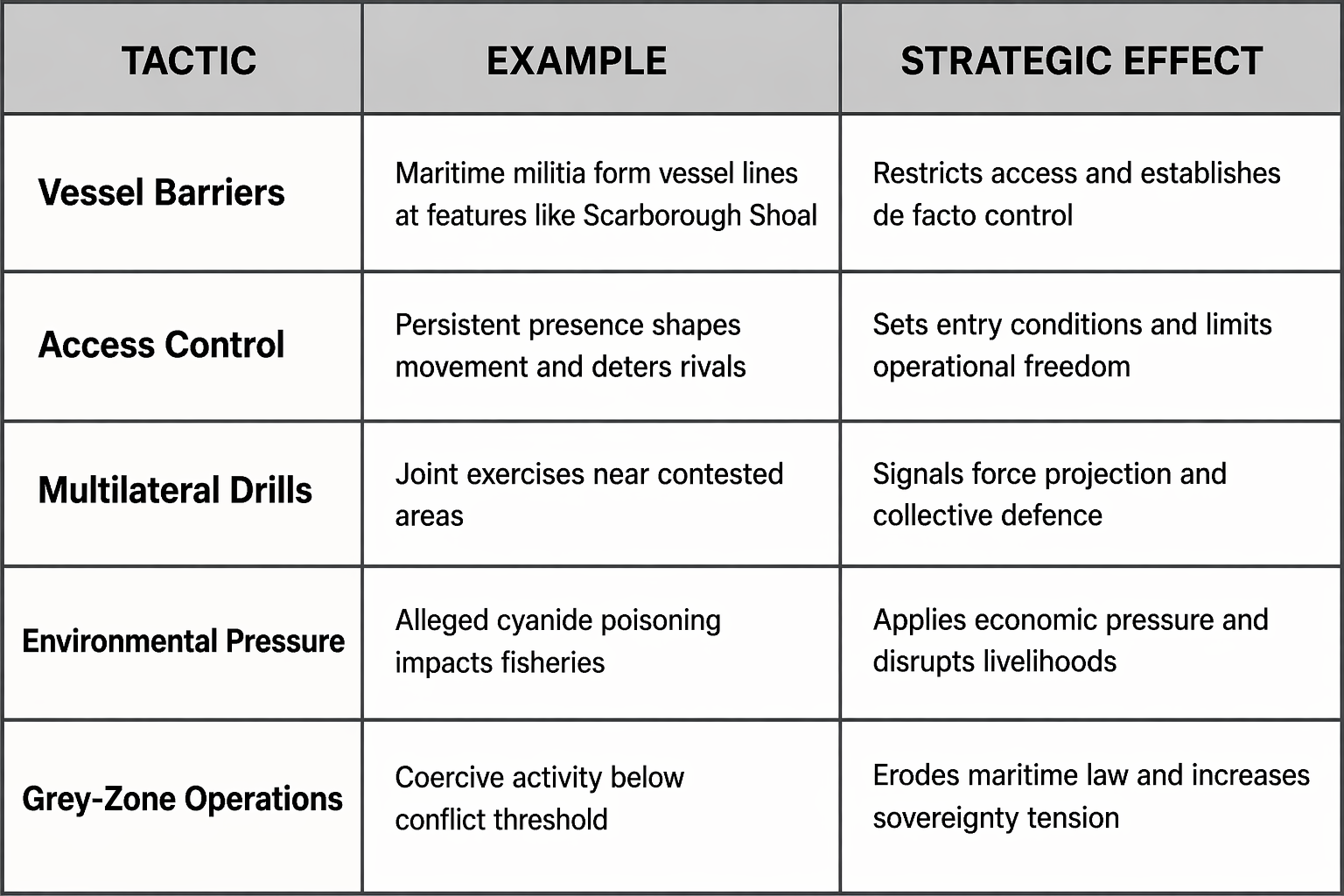
Beyond physical control of maritime space, other forms of indirect pressure can also be applied. The Philippines has alleged that Chinese-linked vessels have poured cyanide into disputed waters in the Spratly Islands as a form of sabotage targeting fishing activity. While the act remains unverified, the impact is wide-ranging, from economic losses for fishermen to environmental damage, while also exposing naval personnel to harmful substances. The alleged incident adds another layer to grey-zone activity, demonstrating that alongside controlling entry conditions, there can be economic and political repercussions. For fishermen, controlled access or suspected marine poisoning reduces income, while applying pressure on the Philippine government to respond. Any Philippine government response to contested sovereignty claims results in external tension with China and broader regional escalation. China’s grey-zone activity is multi-layered, with maritime obstruction in the Scarborough Shoal and environmental pressure in the Spratly Islands.
Grey-zone activity in the South China Sea is becoming systemic conduct, not isolated incidents. Recent events in the Strait of Hormuz suggest that maritime power is shifting. Even without formal closure, China’s use of vessels to form a barrier in the Scarborough Shoal creates disruption or semi-controlled access. It also shows that states can set the terms of maritime movement through a model that shifts freedom of navigation to conditional navigation. Influencing maritime spaces shifts power from naval capacity to the ability to regulate access through what can be described as shadow borders. It poses future challenges by eroding maritime law and the normalisation of access restrictions. The manipulation of maritime spaces suggests the emergence of a pattern in which maritime spaces risk becoming controlled-access environments, or managed maritime spaces, as a new operating model.