Iran—China—Russia Nexus: A U.S. Strategic Signal
Key Takeaways
Strikes on Iran indicate great-power signalling beyond regional security.
Iran’s economic and military partnership with Russia and China forms a strategic nexus.
Targeting Iran could impact Russian military supply chains and Chinese energy access.
U.S. intervention suggests pressure is being applied to adversary networks without direct confrontation.
Regional conflict exposes Russian and Chinese supply chain vulnerabilities.
Recent U.S. and Israeli air strikes signal a significant escalation following the 2023 Gaza-Israel conflict. While publicly stated motivations include degrading Iran’s nuclear facilities and targeting a regime known for state-sponsored terrorism in the region, the military action may also reflect a more complex calculation. The strikes on Iranian targets may be viewed through the lens of great-power competition, with the U.S. sending a signal to Iran, China, and Russia.
Iran’s funding and training of regional militant groups such as Hezbollah, Hamas, and the Houthis have increased instability for neighbouring states. By expanding its military capabilities through its missile arsenal, drone development, and nuclear programme, Iran has increased tensions. These ambitions may alter the regional balance of power and threaten shipping routes. U.S. and Israeli airstrikes indicate that the perceived threat required military targeting of nuclear facilities and missile infrastructure. In addition, the strikes targeting senior regime figures may suggest that Washington and Israel were unconvinced by negotiations with Iran, or the talks were unlikely to progress to the point of de-escalation. The strikes may reflect an intention to address a regional threat, but the wider geopolitical implications may point to additional motivations.
The 2022 Russian invasion of Ukraine has led to closer military cooperation between Russia and Iran. The evolving conflict has relied on drone technology, with Iran reportedly supplying Russia with Shahed-136 drones. Iran has also been assisting in training Russian operators and supporting Russian domestic drone production. While Russia has supplied some Yak-130 trainer aircraft, other reports suggest that Iran was seeking to upgrade to the Russian Su-35 fighter jets. More recently, Russia and Iran signed a comprehensive strategic partnership in January 2025, which includes military co-operation. There are some reports that Russia has received Iranian ballistic missiles. Additionally, there have been U.S. allegations that Russia transferred short-range ballistic missiles to Iran, which Russia has denied.
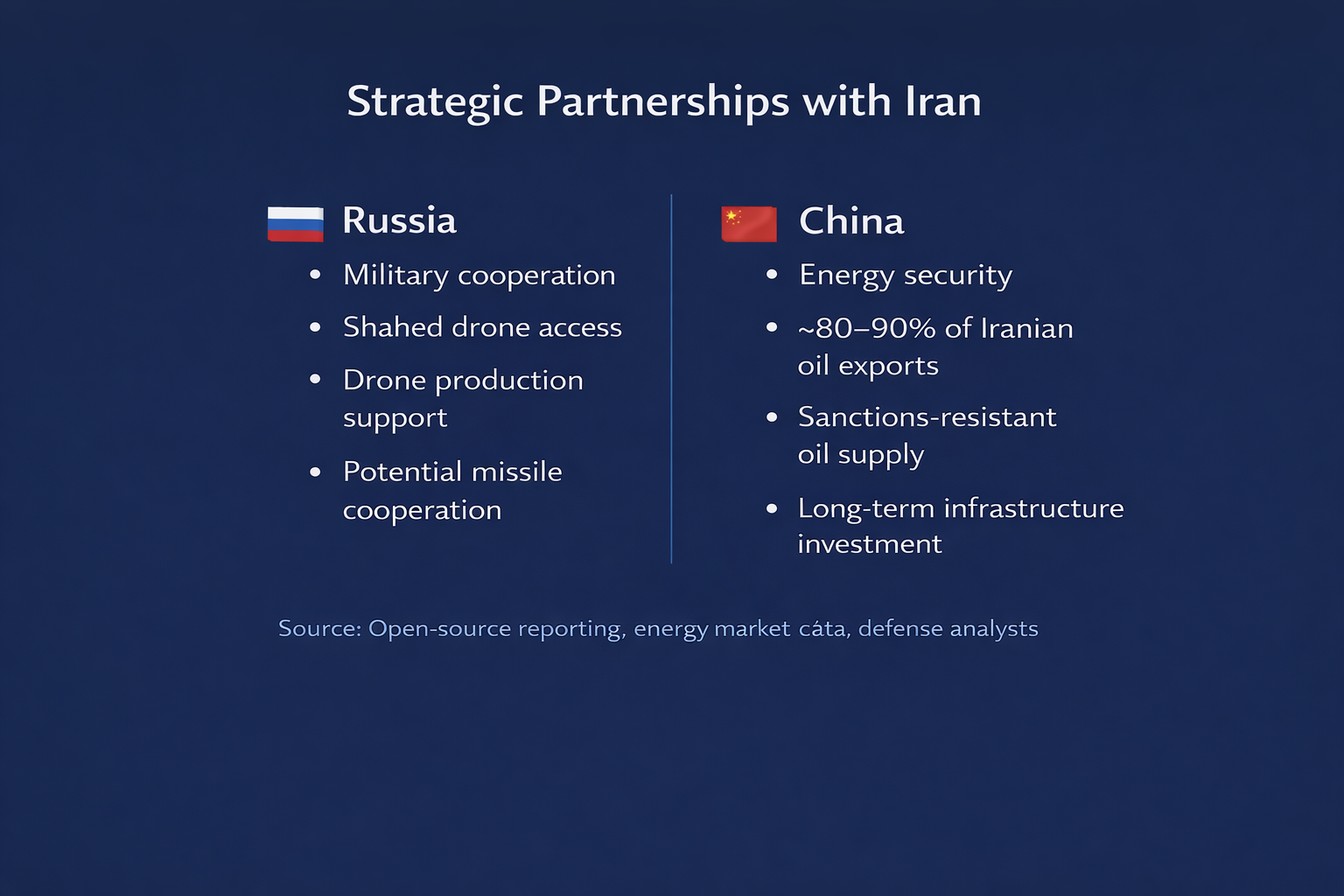
China and Iran’s relationship has reportedly developed into a closer partnership, with suggestions that it is designed to counter the U.S.-led international order. The 25-year cooperation agreement signed in 2021 has offered Iran some economic relief from sanctions, with China being able to circumvent sanctions and purchase Iranian oil. Reports suggest that as much as 90% of Iranian crude oil exports are sent to China. China has also invested in energy infrastructure to access Iranian raw materials. The partnership is primarily economic; however, China has been linked to technology used in Iranian cruise and ballistic missile systems, which some speculate may have been used in an attack on U.S. forces in Iraq. Arms sales have declined; yet, historically, China has reportedly exported a range of equipment, including anti-ship missiles, portable surface-to-air missiles, surface-to-air missile systems, and air search radar. Other cooperation between the two countries includes shared intelligence, with claims that it contributed to U.S. intelligence networks being dismantled in Iran and China. Both China and Russia have supported Iran at the UN Security Council and voted against the proposal to extend the arms embargo on Iran. A destabilised Iran may have consequences for China’s energy flows and influence in the region.
The U.S. and Israelis may have different but overlapping objectives. Weakening the Iranian regime will likely have regional impacts on militant groups, providing increased security for Israel. For the U.S., while this may also be partly the objective, there are also wider global implications. Great power competition is playing out in the Middle East, but U.S. military strikes also signal to adversaries outside the region. Iran is part of a strategic network that has developed in recent years and is emerging as an important nexus. Peace talks between Russia and Ukraine appear to have stalled, and European and U.S. efforts to apply military pressure on Russia remain complex. The targeting of Iran has implications for Russian drone and military supply chains. There may be Western hesitancy or uncertainty about directly targeting Russia, but the U.S. has shown that there are other strategies where pressure can be applied. The situation in Iran is unstable, and Russia may now need to find other countries for strategic support and military supplies.
China has sought greater influence in the region, and with the 2021 pact with Iran, China has secured energy supplies and an economic partnership. China may have decided against closer military ties within the strategic partnership to avoid supplying arms in an already volatile Middle East. As the situation in Iran remains uncertain, so too is China’s partnership with Iran. There is a risk that China may lose energy supplies and influence.
The recent strikes on Iran serve as a form of regional and international deterrence. Militant groups may now have lost their trainer, sponsor, and arms supplier, diminishing their capabilities. For Israel, the weakening of Iran has implications for its own national security. The U.S. also benefits, as these groups have targeted American interests in the region and beyond for decades. Yet for Iranian partners, the strikes signal that geopolitical alliances that impact U.S. interests come with consequences. The removal of Maduro and potentially the Iranian regime would have repercussions for Russia and China. The U.S. may not be openly challenging Russia or China, but the events this year may suggest that there are ways to counter the growing influence of China and apply pressure on Russia. If Iran is unable to supply Russia, it may force Russia to seek alternative strategic partners. Since 2024, Russia has increasingly diversified its partnerships through the emerging nexus with North Korea.