Yemen Conflict Accelerates the Operationalisation of the MECCA Agreement
STRATEGIC QUESTION
Is the conflict in Yemen accelerating the operationalisation of the MECCA Agreement?
KEY JUDGEMENTS
Escalation in Yemen and Houthi attacks against Saudi Arabia have accelerated the operationalisation of the MECCA Agreement, with indications of deeper military cooperation and the establishment of institutional mechanisms.
Strengthening Saudi Arabia’s defence capabilities could allow the Kingdom to reallocate military resources to Yemen, risking the Houthis interpreting MECCA support as indirect participation in the conflict and potentially expanding MECCA’s involvement in the regional conflict.
MECCA partners have reaffirmed their commitment to the collective defence clause, but the scale of support provided remains unknown. Further Houthi attacks against Saudi Arabia may test the MECCA Agreement and accelerate and deepen its operationalisation.
BACKGROUND
On 5 October 2026, MECCA Partners Saudi Arabia, Pakistan, and Turkey held a meeting to discuss the security escalation in the Middle East. A joint statement announced that a former Pakistani Lieutenant General was appointed as the group’s first Secretary-General for the next three years. The joint statement also reaffirmed the group's commitment to the agreement’s collective defence clause, stating that the group would provide military forces and capabilities to strengthen Saudi Arabia’s defence and counter current threats.
STRATEGIC ASSESSMENT
The joint statement by the group indicates that the MECCA Defence Agreement is shifting beyond a primarily political arrangement. The relatively rapid appointment of a secretary-general following a series of military consultations may indicate political unity while also contributing to the development of an institutional framework for the group. Simultaneously, the reaffirmation of the collective defence clause and measures being taken to strengthen Saudi Arabia’s defence capabilities indicate increased coordination and commitment to the defence pact. Although Houthi attacks against Saudi Arabia provided the first real-world test, the group's response suggests that the conflict is accelerating the pact’s operationalisation in accordance with the provisions of the agreement, with the group developing institutionally, politically and militarily.
Attacks against Saudi Arabia have been aerial in the form of drones or missiles. To strengthen Saudi defences, the group could provide air defence, intelligence, surveillance and reconnaissance, as well as technical support or personnel. With reports of 30,000 to 40,000 Pakistani troops deployed to Saudi Arabia to defend the Kingdom’s land borders, the group will need to ensure that measures taken remain within the defensive provisions of the pact rather than provide support for Saudi Arabia’s military campaign in Yemen. Strengthening the Kingdom’s defences may allow Saudi Arabia to allocate resources to the Yemeni government forces, and the Houthis may interpret the group’s involvement as tacit support for Saudi Arabia in the Yemen conflict. Any further Houthi attacks on Saudi Arabia risk testing the group's defence pact as the distinction between collective defence and direct involvement in the regional conflict becomes increasingly difficult to determine.
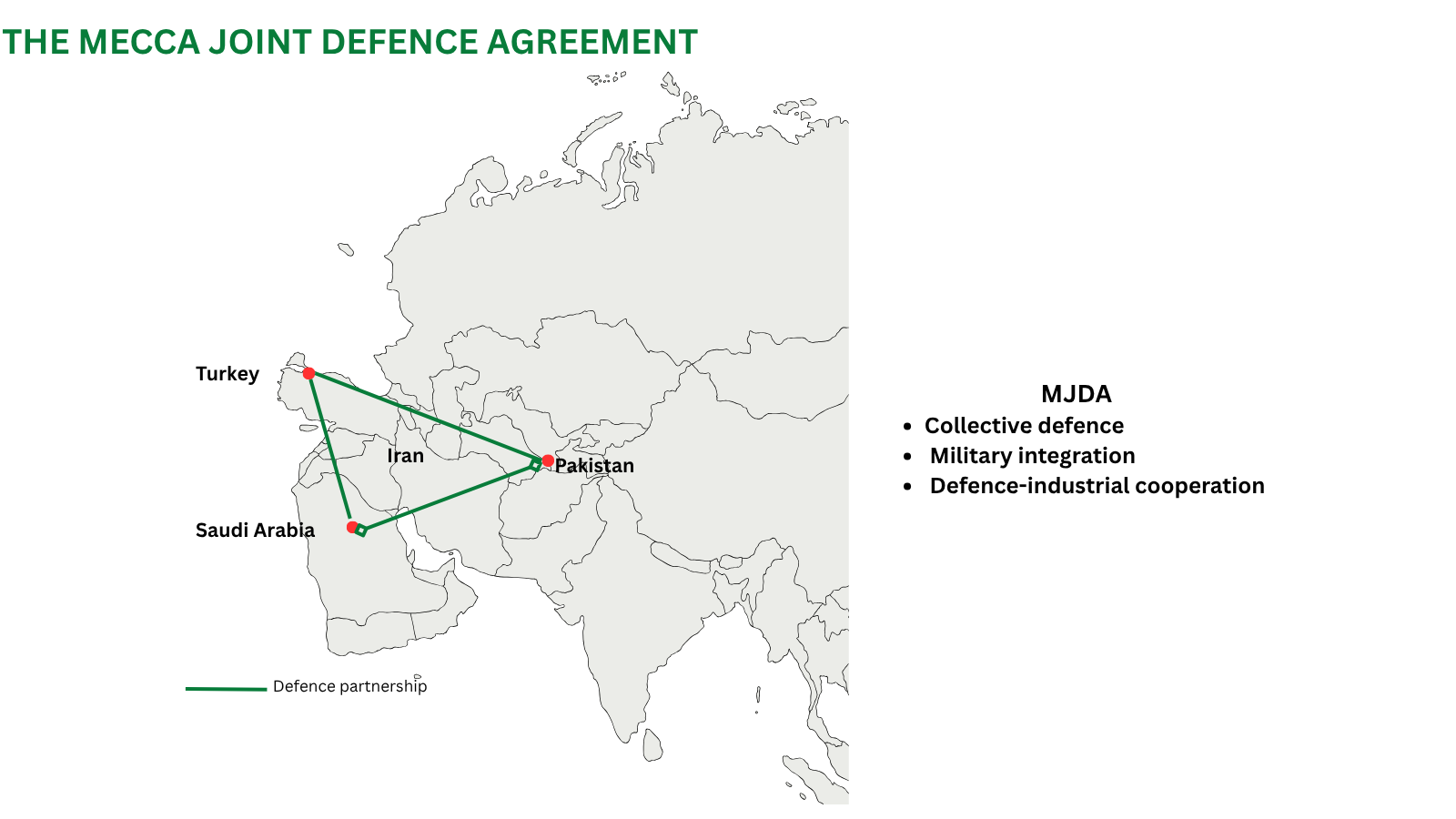
The joint statement has indicated the intention to strengthen Saudi Arabia’s defences; however, the details on how this will be achieved remain largely unknown. The practical measures and agreement to rapidly deploy military forces and capabilities to the Kingdom may take various forms but are not clarified in the statement and may face some internal constraints. As the statement stipulates that implementation will occur in accordance with national legislation, any deployment may require members to seek approval from their respective governments. Pakistan's and Turkey’s defence commitments to the Kingdom may also depend on how the Houthis react to the statement and the deployment of any military forces or capabilities, as an attack on Pakistani troops defending Saudi Arabia’s borders could lead to further escalation. Together, the group’s military consultations suggest that the pact is still developing, and deeper operationalisation may be measured through greater integration of command structures, broader troop deployments, coordinated operations and integrated air and missile defences.
WHAT TO WATCH
Confirmation of Pakistani and Turkish defence equipment, personnel, military capabilities or integrated air defences deployed to Saudi Arabia.
Development of joint command structures, military bodies and coordination mechanisms under the MECCA Agreement.
Indication that MECCA support is expanding beyond defence of Saudi Arabia towards operations in Yemen or Red Sea maritime security.
A military or diplomatic response from the Houthis to the MECCA joint statement that may indicate whether MECCA’s operationalisation is contributing to escalation or deterrence.
STRATEGIC INDICATORS
Operationalisation of the MECCA Agreement
▲ Increasing
Risk of MECCA involvement beyond Saudi territorial defence
↔ Mixed
Houthi–MECCA escalation risk
↔ Mixed
SOURCES
International Reporting and Analysis
Reuters — Pakistan, Saudi Arabia and Turkey Agree Rapid Force Deployment in Saudi Arabia
Reuters source
Reuters — Turkey Says It Could Help Meet Saudi Military Needs Under Defence Pact
Reuters source
Reuters — Pakistan Says No Military Response Discussed Under Mecca Pact Over Houthi Attacks on Saudi Arabia
Reuters source
Official Sources
Saudi Press Agency — Emergency Meeting of the Strategic Political and Defense Committee of the Makkah Alliance for Defense
Saudi Press Agency source
Ministry of Foreign Affairs, Pakistan — Joint Statement: Emergency Meeting of the Strategic Political and Defense Committee of the Makkah Alliance for Defense
Pakistan Ministry of Foreign Affairs source