Houthi Territorial Gains and Simultaneous Chokepoint Pressure
STRATEGIC QUESTION
How are Houthi territorial gains in the Red Sea increasing pressure on regional maritime and energy security?
KEY JUDGEMENTS
Territorial advances by the Houthis have captured key strategic positions, including the Port of Mocha and Greater and Lesser Hanish Islands, giving the Iran-backed rebel group greater influence over maritime activity around the Red Sea and Bab el-Mandeb chokepoint.
The Houthis’ territorial gains alongside Iraqi militia strikes against the Saudi East-West pipeline will reduce oil exports and likely lead to increased oil prices and shipping costs.
Dual attacks by the Houthis and Iraqi militias suggest some coordination between Shia-aligned, Iran-backed groups, which may provide greater leverage for Iran through simultaneous chokepoint pressure.
Washington’s reluctance to provide Saudi Arabia with direct military support may place additional pressure on the Mecca Joint Defence Agreement partners to respond under the mutual defence clause.
CORE ASSESSMENT
Houthi rebels in Yemen have rapidly captured significant territory over the last few days. The Iran-backed group seized the Port of Mocha, situated near the entrance to Bab el-Mandeb, which may provide the Houthis with greater capacity to restrict maritime traffic through the Red Sea. With the capture of two key islands, Greater and Lesser Hanish, north of Bab el-Mandeb, the Houthis now have multiple positions in and around Bab el-Mandeb that could increase risk and shape the operating environment for vessels using the Red Sea. The Houthis’ capture of strategically located territory highlights the importance of their geographical position, with commercial shipping now having to navigate elevated risk around Houthi-controlled points in the Red Sea. As the Strait of Hormuz disruption continues, the Houthi territorial advance and capture of strategic points in and around the Red Sea may further restrict the movement of oil exports, creating simultaneous chokepoint pressure.
BACKGROUND
Prior to the three-pronged attack on the Port of Mocha, the Houthis’ territorial stronghold was mostly to the northeast of the port, but the group also controlled the northern Port of Hodeidah. Saudi Arabia is the world's largest oil exporter and relies heavily on Bab el-Mandeb for the movement of oil exports, with approximately 12% of global seaborne oil trade and 8% of liquefied natural gas (LNG) transiting the chokepoint. Yemen’s civil war began in 2014, while attacks on Red Sea vessels commenced in October 2023 during the Gaza conflict. The U.S. conducted a bombing campaign against the Houthis in 2025, with a ceasefire later agreed under the condition that the Houthis stop attacks on U.S. vessels.
STRATEGIC ASSESSMENT
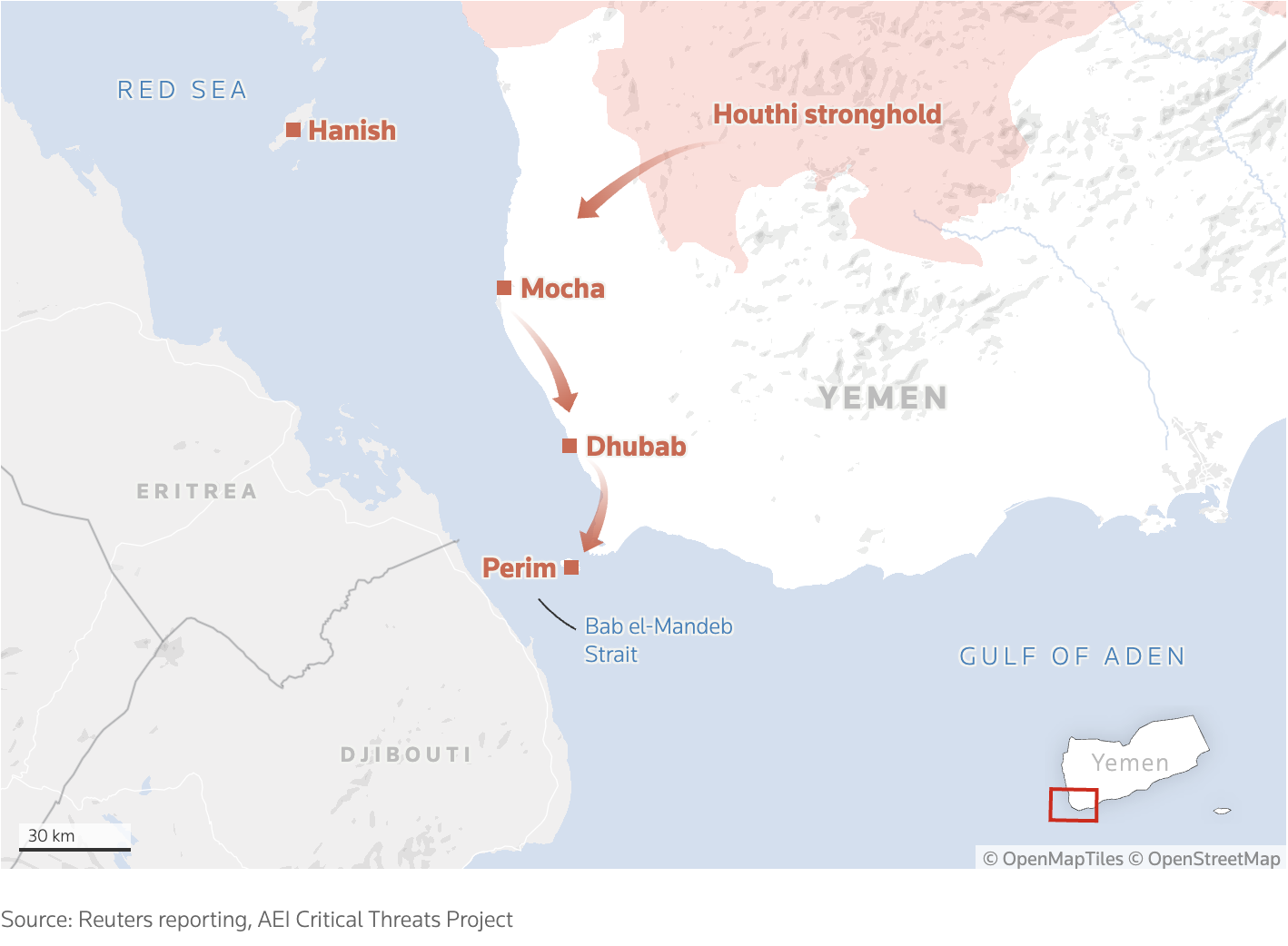
The Houthis’ coordinated attacks and rapid advance led to two strategic territorial positions being captured: the Port of Mocha and Greater and Lesser Hanish Islands. The Hanish Islands are located approximately 160 km north of Bab el-Mandeb, while the Houthis’ advances have brought them approximately 32 km from the U.S. base in Djibouti. The Houthis have used drone attacks and missile strikes against Saudi Arabia in retaliation for supporting government forces, with cruise missiles launched against Israel during the Gaza conflict in 2023, followed by drones, missiles, and speedboat strikes against commercial shipping in the Red Sea starting in November the same year. Over the last few years, the Houthis have demonstrated the capacity and willingness to conduct strikes against adversarial interests from less strategically significant positions. With the recent territorial gains, the Houthis may have a greater strike capacity and ability to create disruption in the Red Sea.
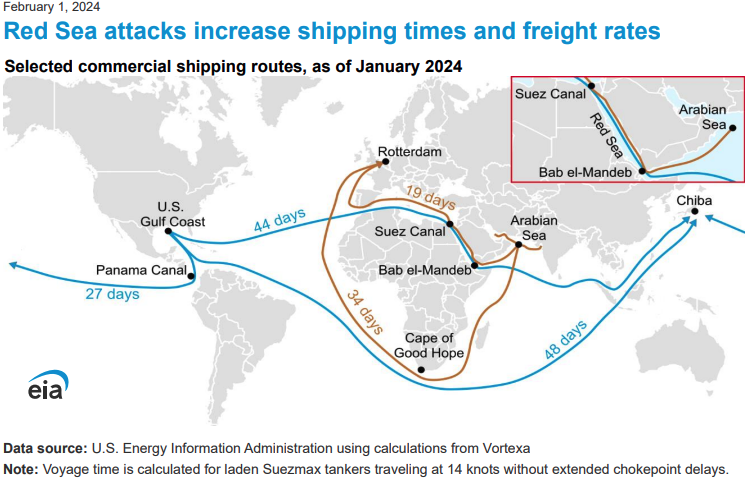
In response to the November 2023 attacks, vessels adapted sea routes to avoid the risk and disruption in the Red Sea. Shipping operators diverted from the Suez Canal route to the Cape of Good Hope, which increased the voyage time to reach Europe from 19 days to 35. The longer distance led to reduced vessel availability and increased freight costs. Over the weekend, 24 and 27 commodity vessels transited the Bab el-Mandeb Strait; however, the recent developments may force shipping operators to reassess the risk, particularly to very large crude carriers. With the Strait of Hormuz down to single-digit commodity vessel transits over the weekend, the Houthi advancement may create greater leverage for Iran with simultaneous chokepoint pressure.
Saudi Arabia has increasingly relied on its East-West pipeline and the UAE’s Habshan-Fuairah pipeline. With the repositioning of the Houthi forces, the rebel group may be able to conduct further coordinated attacks against Saudi Arabia. Drone strikes reportedly from Iraq struck in the vicinity of the East-West pipeline, causing damage and resulting in its closure, with some suggestions it may take five weeks to repair. The Iraqi attacks combined with the Houthi advance may indicate some coordination between the Shia groups to apply pressure on Saudi Arabia, with Brent prices increasing approximately 3% to USD 108 per barrel. Prior to the closure of the East-West pipeline on Saturday, Saudi Arabia had managed to reroute close to 4 million barrels a day, or approximately 4% of global oil supply. Oil prices are likely to increase given the disruption and current uncertainty over the status of Bab el-Mandeb.
Attacks on Saudi Arabian infrastructure from Iraq may pose a greater challenge for retaliation. An attack against Iraqi Shia militias aligned with the Houthis and Iran poses several challenges, with Iraq as sovereign territory potentially drawing an Iraqi government response, as well as risking escalation and a broadening of the conflict. Locating the points from which drones are launched in Iraq may be more complicated with the additional risk of civilians in proximity. Direct Houthi strikes could create a clearer basis to draw on the Mecca Joint Defence Agreement collective defence clause, creating an early test for the operationalisation of the MJDA for partners. Saudi Arabia remains under dual pressure from both the Iraqi militias and the Houthis with any retaliatory military action yet to be seen.
Washington has traditionally viewed Saudi Arabia as an ally but is yet to be drawn into openly supporting military action. Reports that Saudi Crown Prince Mohammed bin Salman sought support from Washington did not result in direct U.S. military action; however, the U.S. did provide intelligence-sharing and targeting support. With the U.S. already embroiled in the conflict in the Strait of Hormuz, the primary objective may be to avoid opening a second front in a regional dispute while continuing to make efforts to enforce freedom of navigation in Hormuz. The Red Sea disruption may also provide Iran with additional leverage, as reduced oil exports through Bab el-Mandeb are likely to have repercussions for global oil prices, placing additional pressure on Washington to resolve the disruption in Hormuz.
WHAT TO WATCH
The Houthis strengthening positions at the Port of Mocha and Greater and Lesser Hanish Islands, alongside any Yemeni government efforts to launch a counter-offensive.
Maritime shipping data indicating transit volumes and types of vessels using the Red Sea.
Statements from Saudi Arabia on the likely timeframe for repairs to the East-West pipeline alongside efforts to adapt export routes to the Red Sea disruption.
Saudi Arabian military strikes against Houthi targets and additional support for Yemeni government forces.
Saudi Arabian crude oil exports indicating reduced volumes.
Statements from MJDA partners regarding support, diplomatic or military, for Saudi Arabia.
U.S. diplomatic or military responses against targets to reduce Red Sea disruption.
STRATEGIC INDICATORS
Houthi Control around Bab el-Mandeb
▲ Increasing
Red Sea Transit Volumes
▼ Decreasing
Saudi Arabian Oil Exports
▼ Decreasing
Regional Collective Defence Coordination
↔ Mixed
SOURCES
International Reporting and Analysis
Associated Press — Houthi Territorial Advances and Seizure of Red Sea Islands
Associated Press source
Reuters — Houthis Reach Strategic Island at Bab el-Mandeb
Reuters source
Reuters — Saudi Pipeline Outage Threatens 4% of Global Oil Supply
Reuters source
Reuters — Hormuz Shipping Traffic Remains Below Average
Reuters source
Reuters — Hormuz Diplomacy, Regional Attacks and Shipping Disruption
Reuters source
Council on Foreign Relations — War in Yemen
Council on Foreign Relations source
Defense News — Saudi Arabia Sought U.S. Military Assistance Against the Houthis
Defense News source
Reuters — Saudi Arabia, Turkey and Pakistan Sign Joint Defence Agreement
Reuters source
Reuters — Pakistan Says No Military Response Discussed Under Mecca Pact Over Houthis
Reuters source
CNBC — Oil Prices, Iran War, Strait of Hormuz and Saudi Pipeline Disruption
CNBC source
The Independent — Saudi Pipeline Disruption and Oil Market Impact
The Independent source
United States Government
U.S. Energy Information Administration — Red Sea Attacks Increase Shipping Times and Freight Rates
U.S. EIA source