MONTHLY STRATEGIC OUTLOOK | AUGUST 2026
Executive Assessment
August was characterised by efforts to reduce strategic supply chain dependencies amid maritime disruption, changing security relationships and trade disputes. Across critical mineral supply chains, maritime routes, defence partnerships and economic security, states and shipping operators are accelerating efforts to build capacity, develop defence agreements and establish alternative maritime routes. Despite these measures and the broad efforts to diversify, existing dependencies remain difficult to replace. New infrastructure, industrial capacity and defence partnerships take time and investment, as well as sustained commitment and integration. In the short term, states and shipping operators will continue adapting to disruption while still reliant on the existing systems they are seeking to diversify away from.
Key Judgements
Critical Minerals: The U.S. and European Union are making deliberate efforts to reduce critical mineral supply chain dependence on China. Investment has been made, and legislative changes implemented to source critical minerals, build domestic processing capacity and develop integrated supply chains with global partners. In the near term, China is likely to retain its dominance in critical mineral separation, refining and processing, meaning dependence will persist.
Maritime Routes: Simultaneous maritime disruption is creating flow-on effects across multiple chokepoints. Transits through the Strait of Hormuz fell to single digits on certain days, with crude carriers potentially avoiding Hormuz due to heightened risk. As some buyers source more U.S. oil and vessels adapt their routes, the Panama Canal is experiencing congestion, exacerbated by low water levels during the summer. In Europe, continued conflict has reduced shipping volumes in the Black Sea, while low water levels are constraining key inland waterways. Commodity prices could face upward pressure as maritime disruption continues.
Defence Partnerships: Regional security architecture is changing through the formation of overlapping bilateral and trilateral partnerships in Asia and the Middle East. U.S. security policy ambiguity is contributing to efforts by some states to develop additional security partnerships. Security partnerships reflect deeper security ties extending beyond diplomacy into joint exercises, intelligence sharing, procurement, technology, production and logistics.
Economic Security: Economic policy and national security are becoming more closely intertwined as the U.S., EU and Japan seek to reduce supply chain dependency, particularly on Chinese critical mineral processing and other strategically important imports. The U.S. announced restrictions on foreign equipment and strategically important components to reduce security risks while supporting domestic production. The use of tariffs as an international trade tool has led to retaliation between the U.S. and Canada following the breakdown in trade discussions. Canada is providing financial assistance to affected industries, while the wider consequences of the trade escalation remain uncertain.
Cross-Theme Judgement: Seeking to reduce strategic dependencies across maritime routes, critical minerals, defence and trade requires significant investment. Investment in building domestic capacity, constructing energy infrastructure, developing maritime routes and absorbing the costs of trade measures will be more difficult for some states than others. In the immediate term, costs are likely to increase as trade patterns, industrial production and supply chains adjust to a changing international market.
Outlook: Supply chain infrastructure could become more diversified and resilient as investment in energy pipelines in the Middle East, alternative maritime routes and critical mineral processing capacity progresses. In the immediate term, projects will require time and financing while maritime disruption continues and states seek to reduce supply chain dependence, meaning they are likely to continue relying on existing infrastructure and routes. Security partnerships are developing; however, they will require sustained commitment and integration, alongside continued defence spending. As these partnerships involve fewer members than larger bloc agreements, they may face fewer coordination barriers to operationalisation. Economic security encompasses supply chains, national security and trade policy and is likely to remain an important policy focus as states adapt to changing relationships across these areas.
DOMINANT TRENDS
Critical Minerals: Competition Across the Value Chain
Critical mineral competition has centred on processing and refining capacity. With China controlling approximately 90% of global rare earth processing capacity, the country’s position has created not only a processing bottleneck but also a dependence on China for access to critical minerals. Supply chain dependence has given China strategic leverage that can be used in geopolitical competition through export restrictions and other enforcement measures. The U.S. and partners are building integrated mine-to-magnet supply chain capacity through projects such as the expansion of White Mesa Mill, while viewing access to critical minerals as a national security priority.
Diversification efforts have accelerated; however, the benefits are unlikely to be realised in the short term. Although Japan has pursued diversification and decoupling policies for over 15 years, including investment and stockpiling, the country’s experience demonstrates the long-term challenge of reducing dependence on China's critical mineral supply. With Chinese critical mineral export restrictions currently in place, Japan’s supply chain vulnerabilities remain exposed, indicating that even deliberate efforts to diversify may have reduced reliance but have not eliminated supply chain risk.
Securing access to critical minerals is becoming part of geopolitical competition, particularly among resource-rich states in Africa. Mrima Hill in Kenya is the subject of an international tender process with consortia competing for access to its critical mineral deposits essential for the defence and advanced technology sectors. As the competition for critical minerals increases, so does the bargaining position of countries with significant deposits. African states such as Kenya, Tanzania, the Democratic Republic of Congo, and Malawi have all indicated ambitions to expand processing and domestic value addition, rather than remaining focused primarily on extraction, strengthening their position within critical mineral supply chains.
China’s Processing Leverage and Supply-Chain Diversification
Over recent decades, China has developed the expertise and infrastructure to become the dominant producer of rare-earth elements (REE). China’s labour regulations, environmental standards, and subsidies supported the rapid expansion of the processing sector. By 2010, China accounted for 97% of global light rare earth (LREE) mining, but diversification had reduced its share to 58% by 2024. Despite diversification efforts, China still accounts for 88% of global oxide separation capacity and 93% of metal refining. Dependence on Chinese processing is more pronounced for heavy rare earth elements (HREE), where China maintains near-complete dominance across the supply chain with over 90% of oxide separation, metal refining, and permanent magnet production. Regardless of the source of extraction, almost all rare earth concentrates require processing in China, creating a separation and refining bottleneck in the supply chain. Discovering critical mineral deposits does not reduce reliance on China’s processing capacity.
China’s dominance in critical mineral processing has created supply chain dependence that can be used as diplomatic leverage. Following Japan’s comments on Taiwan, China imposed export restrictions on critical minerals, including yttrium, terbium, gallium and dysprosium, which are essential for Japan's advanced technology sector. China also imposed additional export controls on Japanese companies linked to the defence industry, citing Japan’s re-militarisation as justification. Japan has now gone months without dysprosium oxide and terbium oxide, both of which are used in high-performance magnets. Simultaneously, exports of yttrium to the U.S. increased in July, suggesting that restrictions may differ between countries. Other Chinese enforcement measures include the detention of Japanese nationals over alleged breaches of restrictions on dual-use products, alongside inspections of Japanese corporate offices. The restrictions and enforcement measures highlight China’s strategic leverage derived from dependence on its critical mineral processing capacity.
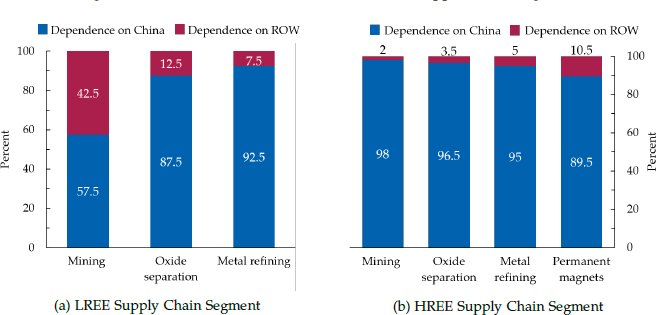
Rare-Earth Supply-Chain Dependence on China by Segment
Source: IMF, 2026.
Dependence on China’s critical mineral processing has led to diversification efforts aimed at reducing China’s role in the supply chain. In particular, as global competition has increased, the U.S. and its allies have accelerated their critical mineral policies beyond extraction to processing, separation, and downstream capacity. The Department of War has provided funding for projects such as the expansion of White Mesa Mill in Utah to produce heavy rare earth oxides, reinforcing the view that securing supply chains is a matter of national security. The expansion of White Mesa Mill will enable the production of alloys, rare earth metals, and magnets crucial for the defence, energy, and automotive sectors, as well as robotics and data centres. The development at White Mesa Mill may provide some relief for allies, with a Japanese manufacturer announcing that it will use terbium (Tb) oxide produced at the Mill.
Greater collaboration to strengthen critical mineral supply chain resilience is occurring through the creation of integrated supply chains. The expansion of White Mesa Mill will also incorporate supply from the Donald project in Australia, the Vara Mada Project in Madagascar, and the Bahia Project in Brazil, with monazite processed at the Mill and oxides sent to South Korea for use at its metal and alloy facility. The expansion and associated projects will create an integrated mine-to-magnet supply chain aimed at supplying magnets for electric vehicles, phones, robots, combustion engines, and wind turbines.
Japan’s critical mineral supply chain diversification could serve as a template for the measures and timeframes required to reduce dependence. In 2010, Japan began its decoupling strategy from China after China’s economy surpassed Japan’s and a territorial dispute exposed Japan to supply chain leverage. At the time, Japan relied on China for 90% of its rare earth imports and, through diversification measures, including stockpiling, investment in alternative suppliers, recycling, and material substitution, reduced its reliance on Chinese rare earth imports to 58% by 2018. Despite Japan’s efforts and an investment of USD 1.2 billion, the country still relies on China for rare earths, demonstrating that reducing supply chain dependence is a long-term process.
Africa and Producer-State Value Addition
The shift in focus from extraction to processing capacity has created opportunities for producer states to leverage agreements to secure greater domestic value from their mineral resources, particularly in Africa. Kenya’s Mrima Hill has attracted international tender competition among U.S., Chinese, and Australian consortia for access to its critical mineral deposits. Previous estimates from 2013 valued the deposits at USD 62 billion. Geological surveys have identified critical minerals such as niobium and neodymium, essential for the defence and technology industries, including applications in magnets, semiconductors, and steel production. With seven consortia shortlisted for the tender process, including groups from China and the U.S., Mrima Hill highlights the geopolitical competition for access to non-Chinese rare-earth deposits.
Other African states are also showing a broader trend towards greater involvement in mineral processing to increase domestic value from their resources while expanding refining capacity. Malawi has maintained a suspension of new mining licences alongside a ban on raw mineral exports; however, a rare earth processing plant is currently under construction and expected to begin by the end of the year. Bilateral cooperation between Tanzanian President Samia Suluhu Hassan and DRC President Félix Tshisekedi suggests that collaborative alignment may also provide greater leverage. Both countries have agreed to cooperate on mining and mineral processing through a critical mineral strategic partnership covering geological data, value addition, investment, and processing. African states, traditionally positioned at the extraction stage of mineral supply chains, are now seeking greater involvement in processing and value addition through foreign critical mineral partnerships and regional agreements.
Assessment Outlook
China’s dominance in critical mineral processing is likely to remain in the near term. Developing technical expertise in separation, refining, and downstream production can take years, as Japan’s experience indicates. While countries move towards diversification measures, the risk that China could leverage its position through export restrictions and enforcement measures will remain. However, as recent export data indicates, the risk is not uniform and may vary depending on factors such as territorial disputes, diplomatic disagreements, or retaliation.
In the medium term, competition is likely to continue over access to critical mineral deposits as states seek to build integrated supply chains. The policy shift towards integrated critical mineral supply chains indicates that states will continue to develop processing and downstream manufacturing to reduce bottlenecks and dependence on Chinese processing. The U.S. and its allies are likely to require further diversification measures such as joint agreements and multilateral projects to build supply chain capacity and resilience. Such agreements are likely to strengthen the bargaining position of countries with critical mineral deposits, particularly in Africa, with many already signalling their intent to develop domestic processing capacity to increase their role in the value chain.
Maritime Chokepoints: Disruption, Adaptation and Alternative Routes
Maritime transit through the Middle East chokepoints of the Strait of Hormuz and Bab al-Mandeb remains disrupted. While projectile attacks have been limited, continued threats have reduced the volume of vessels crossing the chokepoints. Fewer than 20 commodity vessels passed through the Strait of Hormuz over the weekend of 21–23 August as Iranian and U.S. blockades restricted traffic and the threat of projectile attacks persisted. Although some vessels may disable AIS transmissions, tracked vessel data indicates that transits are 90% below pre-conflict baselines. Risk tolerance may differ by vessel type, as vessels transiting on Thursday, 20 August, included no very large crude carriers (VLCC) or liquefied natural gas (LNG) tankers, and of the eight vessels that entered the Gulf between 21 and 23 August, six were empty, with two tankers exiting carrying liquefied petroleum gas (LPG). The data suggests shipping operators may be assessing risk differently depending on vessel type, cargo, and route.
Compounding Middle East maritime disruption is the heightened risk at Bab al-Mandeb. The Houthis' threats against Saudi Arabia-linked vessels and infrastructure have elevated risk at the chokepoint, reducing shipping volumes. Attacks on an Egyptian-owned cargo ship led to fatalities aboard the vessel, alongside the deaths of two Yemeni rescuers. On 20 August, maritime data indicated that 23 commodity vessels transited, compared with 34 on each of the previous two days; however, vessels operating without transponders were not included. Similar to transits through the Strait of Hormuz, crossings did not include VLCC or LNG tankers; however, two Suezmax crude tankers bound for Vietnam and India did exit. The absence of VLCC and LNG tankers from both chokepoints on 20 August may indicate that shipping operators perceive greater risk to larger carriers or remain unwilling to expose these vessels to current conditions.
The disruption in the Gulf has resulted in shipping operators adopting various measures. Two Chinese state-controlled shipping companies, which operate more than 100 VLCCs and carried approximately 50% of China’s crude imports from the Middle East before the conflict, are avoiding both chokepoints. The two operators have opted for ship-to-ship (STS) oil transfers outside the Gulf, reducing their exposure to risk, with STS volumes exceeding 600,000 bpd in June and July. Reports also suggest Chinese operators will continue to avoid the Gulf by sending some supertankers to Fujairah or Omani ports for loading. Alternative transfer methods have proven profitable, with daily margins reaching approximately USD 110,000, compared with USD 30,000–40,000 per day on a similar route before the conflict. Operators are reducing risk by adapting logistics routes, which have helped maintain supply chains while remaining profitable. Even for countries like China, which maintain relations with Iran, diplomatic relations may not sufficiently reduce maritime risk, suggesting that operators remain exposed regardless of state relations.
Black Sea Economic Warfare
Black Sea disruption is escalating through repeated attacks on maritime infrastructure and vessels as part of a broader campaign of economic warfare. Ukrainian attacks on the port of Novorossiysk, which handles approximately 700,000 bpd, led to a suspension of crude exports. Previous loadings from Novorossiysk in July were close to 1 million bpd, demonstrating the port’s importance to Russian exports and its significance as a target for Ukraine. Oil exports are reportedly down to around 400,000 bpd, with exports from Russia’s western ports 15% below planned loading volumes.
Ukraine experienced an escalation of Russian attacks in July, with 35 attacks on vessels in port, 22 at sea, and 67 strikes on port facilities. The economic pressure led President Zelensky to call for a truce on Black Sea attacks, which was rejected by President Putin without guarantees that Ukrainian attacks on Russian energy infrastructure would also cease. The failure to reach a truce indicates that attacks on economic infrastructure have become part of reciprocal coercion in the conflict. Black Sea economic warfare is not only causing disruption to Russian and Ukrainian economic sectors but also affecting global commodity prices.
The reciprocal Ukrainian and Russian strikes on Black Sea infrastructure have raised maritime risk, requiring shipping operators to adjust costs to reflect higher insurance premiums. Ukraine's drone strikes on tankers at the Caspian Pipeline Consortium terminal in Novorossiysk have more than doubled daily tanker charter rates to USD 400,000. In particular, Suezmax owners operating Russian shadow fleet vessels were experiencing higher premiums due to the ongoing uncertainty and security risks. The destabilisation of the Black Sea has imposed additional costs as shipping operators adjust to higher risks across the maritime corridor amid conflict escalation.
Russia’s escalation campaign during July is expected to reduce August grain exports from 5 million tonnes a month to 1.5 million, likely placing pressure on global grain supplies and prices. Alternative grain routes exist; they can be complex, combining road and rail, while low water levels in the Danube have constrained maritime options. Reduced grain supplies may increase food insecurity, as approximately 27% of global wheat exports are supplied by Ukraine and Russia. Major importers remain exposed to Black Sea disruption, including Egypt, which sources over 80% of its wheat from Russia and Ukraine, and Indonesia, which is expected to import 600,000 tonnes across July to September. Instability may force importers to source alternative supplies at higher prices from exporters such as the U.S. and Australia. Black Sea economic warfare heightens risk and constrains commodity supply, affecting global commodity prices and food security.
Panama Canal Congestion and Supply-Chain Pressure
The Panama Canal is experiencing disruption from several factors that are placing pressure on the route. Drought conditions have lowered water levels, requiring the Panama Canal Authority to reduce the maximum draft and potentially forcing cargo ships to carry lighter loads to transit the canal. With reduced water levels, the daily ship limit will likely be lowered, increasing wait times for global maritime supply chains. As Asian importers pivot towards U.S. crude supplies due to the conflict in the Middle East, the Panama Canal faces additional pressure, contributing to congestion and higher transit costs. Reports indicate August transit-slot auction prices hit USD 1.1 million, around 16 times the average from the previous year, with over 100 vessels reportedly waiting compared with 40 vessels in January. Middle East chokepoint disruption can place additional pressure on other maritime routes elsewhere as states seek alternative routes and suppliers. With alternative routes facing other constraints, supply chains experience longer wait times and higher prices.
Alternative Routes and Infrastructure
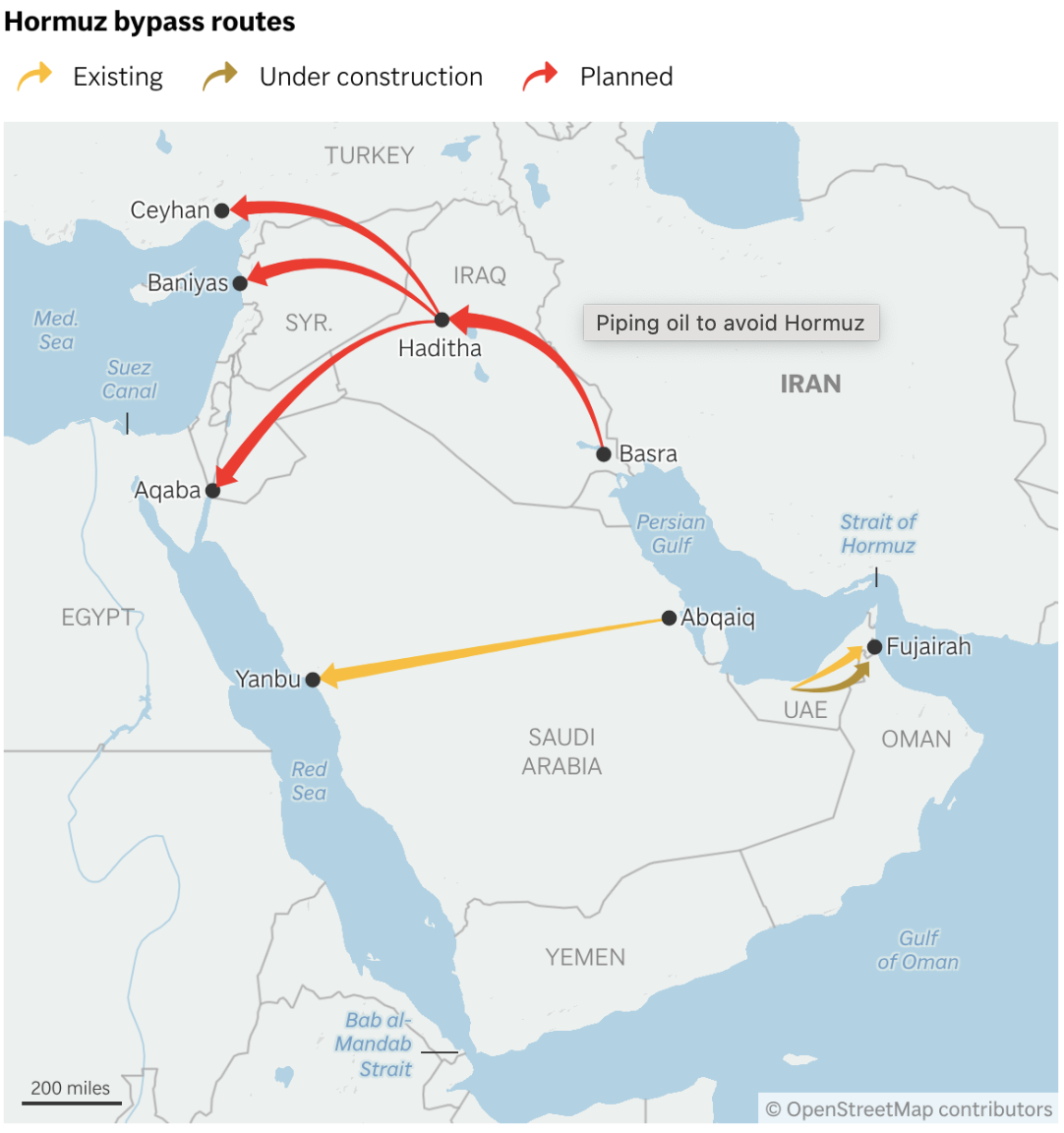
As maritime chokepoint pressure continues, efforts are also underway to develop alternative energy transport routes. Middle Eastern states are expanding pipeline capacity to reduce dependence on the Strait of Hormuz and Bab al-Mandeb, with seven pipelines either under construction or planned. Three of the four planned pipelines will bypass both Hormuz and Bab al-Mandeb altogether. Saudi Arabia has relied on existing infrastructure, with the East-West pipeline operating near its maximum capacity of 7 million bpd, although it is not immune from Houthi attacks, as demonstrated by attacks in 2019. The UAE already operates the 1.8 million bpd Habshan-Fujairah pipeline, while construction of a new parallel pipeline to Fujairah is expected to add a further 1.2 million bpd of bypass capacity. French company TotalEnergies is investing in the Fujairah project while also partnering in a pipeline from Baghdad to Syria, demonstrating international investment and cooperation in energy infrastructure development. Continuing chokepoint disruption has strengthened the case for expanding existing infrastructure while investing in additional partnerships. The bypass infrastructure developments suggest that these adaptations may not be temporary but instead form part of longer-term Gulf energy infrastructure aimed at reducing route dependence.
Pressure on the Panama Canal has increased the relevance of an alternative land-based trade corridor. Mexico has invested USD 4 billion in the Interoceanic Corridor of the Isthmus of Tehuantepec (CIIT), which connects ports on the Gulf of Mexico and Pacific coasts by rail. While the land corridor is projected to carry a fraction of the annual volumes that pass through the Panama Canal, it may offer an alternative that could relieve chokepoint congestion and potentially reduce transit times. However, the CIIT faces constraints, with further investment required in development hubs alongside improvements to road connectivity and energy supply.
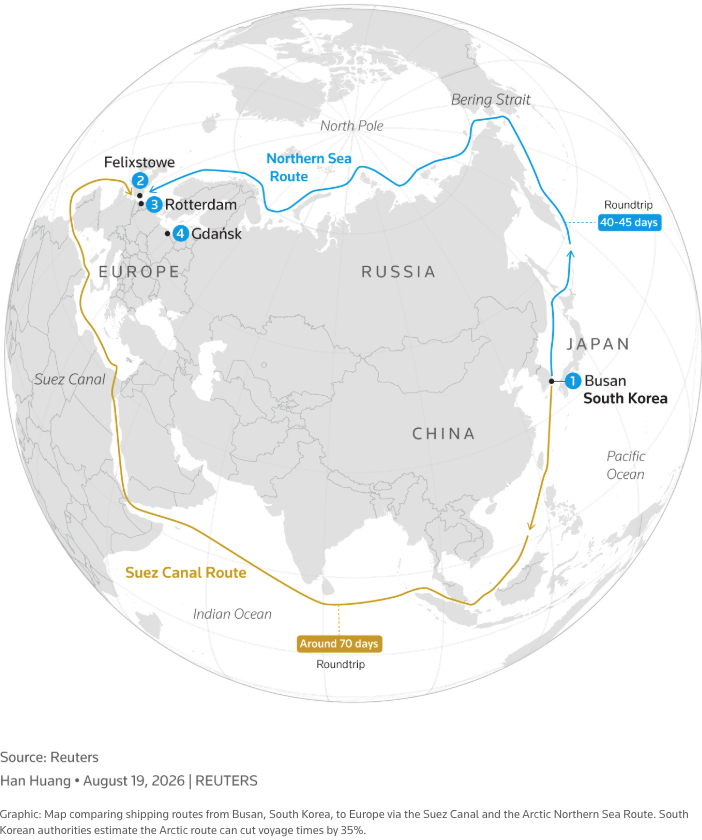
Other routes that previously saw limited use are also emerging, such as the Northern Sea Route (NSR). The NSR connects Asia and Europe through the Arctic, offering benefits for temperature-sensitive cargo such as electric vehicles, lithium batteries, and solar products. With Chinese and South Korean vessels already using or trialling the route, other countries have also expressed interest, including India and Japan. The route could reduce voyage times by approximately 35% compared with existing routes, while South Korea’s current trial voyage is expected to take 40–45 days. However, the NSR faces constraints, as unpredictable conditions can require icebreaker support, while commercial navigation remains largely limited to summer months. While the route may be emerging as a commercial option, it remains limited and underdeveloped, although it could become a more frequently used alternative.
Assessment Outlook
Maritime disruption in the Gulf remains elevated, with shipping operators continuing to evaluate risk. Transits in the Strait of Hormuz remain substantially below pre-conflict levels, while the extension of maritime disruption to Bab al-Mandeb has exposed vessels to Houthi threats and attacks, further affecting transits. Marine traffic data indicates the absence of VLCC and LNG carriers, suggesting that shipping operators are assessing risks differently. Some Chinese operators have opted to reduce their exposure to risk by conducting STS transfers outside the Gulf and at alternative loading points while benefiting from higher margins. Other adaptations include Asian operators purchasing U.S. oil, which, along with low water levels, is placing additional pressure on the Panama Canal. As the risk to vessels persists, alternative routes, infrastructure and operational measures are emerging, with some adaptations possibly becoming longer-term responses.
Reciprocal economic warfare in the Black Sea appears to be escalating. With Ukrainian strikes on Russian energy infrastructure and Russian attacks on Ukraine's grain infrastructure increasing, calls for a truce have proved unsuccessful, and President Putin has indicated an intention to expand targeting. Shipping operators are responding to the escalation in the Black Sea, with tanker rates and insurance premiums rising, reflecting heightened risk. Reciprocal economic warfare has reduced both Russian energy exports and Ukrainian grain exports, placing pressure on global food security and prices.
In the medium term, alternative routes are being developed that may provide additional transport capacity while reducing reliance on Gulf chokepoints. Saudi Arabia’s East-West infrastructure provides existing capacity, while the UAE is expanding its network through pipeline development. With seven pipelines under construction or planned, three of the four planned pipelines will avoid both Hormuz and Bab al-Mandeb. The involvement of companies such as TotalEnergies suggests that infrastructure development is not solely a state project but is attracting international investment as a viable alternative. Other maritime routes, such as the NSR, are emerging as possible alternatives for Asian carriers; however, the NSR remains constrained by ice conditions, seasonality, and limited infrastructure. Asian importers pivoting to U.S. oil have added to congestion in the Panama Canal, while low water levels are creating further pressure, demonstrating that alternative supply routes can also face constraints. Alternative routes are likely to strengthen supply chain resilience in the medium term; however, global trade will still depend on existing maritime chokepoints, which these alternatives are unlikely to replace.
Defence Partnerships: From Cooperation to Integration
Europe continues to expand its support for Ukraine through defence agreements and increased funding. The United Kingdom has established a new partnership with Ukraine to develop military capability and share defence technology. Ukraine’s technological developments and operational experience have positioned the country at the forefront of modern warfare. Part of the agreement will give the UK access to Ukraine's Avengers AI Labs database, which provides real-world data to train AI models. Using sensors and cameras, the Avengers Lab captures battlefield data on air defence, drones, tanks and infantry. While the UK will advance its understanding of battlefield data, Ukraine will have access to British expertise from research universities and technology companies, potentially improving its capacity to adapt to rapidly changing modern warfare.
Ukraine will also benefit from the recent decision by UK Prime Minister Burnham to share classified information on military technology. The decision to share information on an essential component of the Storm Shadow cruise missile, a French-British collaboration, will potentially allow licensed assembly in Ukraine, expanding its domestic long-range strike production capacity. Earlier this year, President Macron signed a letter of intent to establish the legal framework for the project, and with UK support, Ukraine will be able to begin assembling missiles. Collaboration between France and the UK to release military technology suggests greater coordination in supporting Ukraine, with this approach increasingly focused on building Ukraine’s own military capacity.
European support for Ukraine has expanded through bilateral agreements and wider European Union funding. President Zelenskyy met with President Stubb of Finland and signed three memorandums of cooperation to deepen defence ties across land, maritime and air capabilities. Simultaneously, the EU approved €6.1 billion for defence procurement covering missile defence systems, missiles, ammunition and radar. Closer collaboration between the EU and Ukraine offers mutual benefits, as Ukraine leverages its modern warfare expertise to access European resources, while European partners gain access to Ukraine’s battlefield knowledge. Although not fully integrated, Europe and Ukraine are building defence-industrial capacity that is likely to expand and potentially extend beyond the immediate security challenge in the Russia-Ukraine conflict.
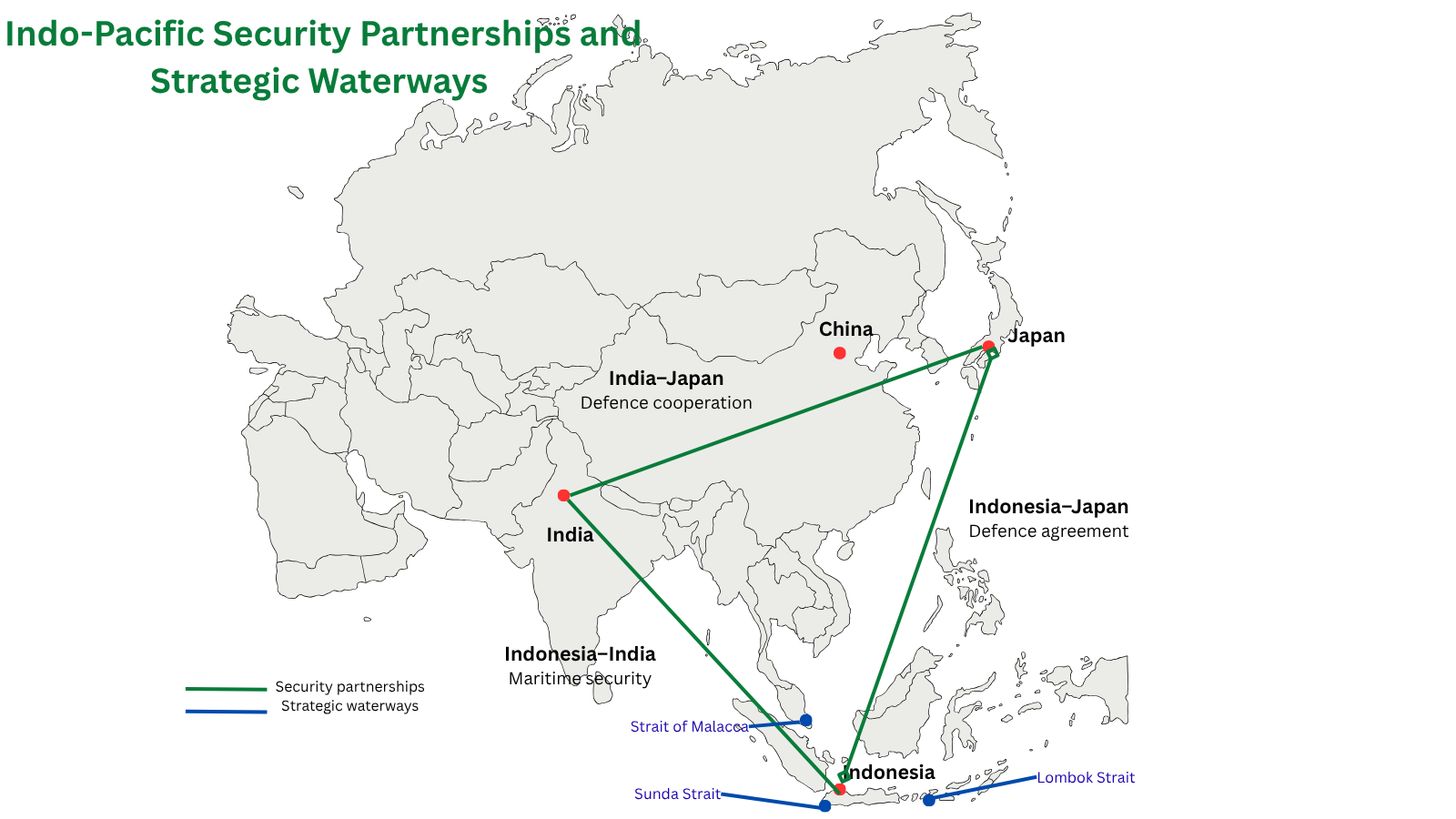
Japan and India’s defence relationship is becoming more operational and potentially more integrated at an industrial level. For the first time, Japan’s defence minister visited Mumbai, while Japanese and Indian vessels conducted bilateral exercises. The visit reaffirmed defence cooperation in technology, including the transfer of UNICORN to India, and commitments to 2+2 meetings and deeper bilateral exercises, such as the planned Japan-India Air Force “Veer Guardian” exercise. Six initiatives were agreed under a memorandum of arrangement on maritime security to deepen maritime defence cooperation. The agreement includes strengthening the Indian Navy’s mine countermeasures, potentially shipbuilding, reciprocal repair and maintenance services, cooperation on defence technologies, training exercises, and 2+2 discussions. With the signing of the cooperation agreement, accelerating defence integration appears to be a priority across maritime and air domains.
Japan’s efforts to accelerate partnership-building also extend to its bilateral relationship with Australia. Under the Framework for Strategic Defence Coordination, Japan and Australia signalled the operationalisation of their partnership in response to the deteriorating strategic environment. The initiative includes information and intelligence cooperation, Australia’s acquisition of Japanese frigates, joint development and production of defence capabilities, weapons and technology testing, and joint training exercises. While Japan and Australia have longstanding relations, efforts to accelerate cooperation and integration suggest that both partners recognise the strategic importance of operationalising existing agreements and strengthening regional deterrence.
While Japan is deepening bilateral defence partnerships, it is also expanding trilateral cooperation. Japan, Australia and Indonesia held their inaugural virtual meeting of defence ministers to initiate discussions and commitments to regional peace and stability. Although only in the initial stages, Japan has existing bilateral partnerships with Australia and Indonesia, suggesting that the trilateral relationship could develop into a more formal agreement. Japan has indicated not only a willingness to forge partnerships but also a desire to accelerate their integration and operationalisation as reliance on its traditional partner, the U.S., remains ambiguous, alongside increased maritime activity with China’s People's Liberation Army Navy.
Saudi Arabia’s diversification strategy and Pakistan’s growing engagement in the Middle East have culminated in a trilateral defence agreement with Turkey. The Mecca Joint Defence Agreement (MJDA) between Saudi Arabia, Pakistan, and Turkey was signed on 7 August amid heightened tensions in the region and contains a collective defence commitment. A bilateral agreement between Saudi Arabia and Pakistan exists, but the addition of Turkey to the MJDA brings together a nuclear-armed state and NATO member, potentially strengthening deterrence. Saudi Arabia has a diversification strategy focusing on economic and defence matters, and the current conflict in the region, coupled with U.S. security policy ambiguity, may be accelerating its efforts to develop defence partnerships. The trilateral agreement and Pakistan’s wider engagement in the Middle East suggest a potential shift in the region’s security architecture.
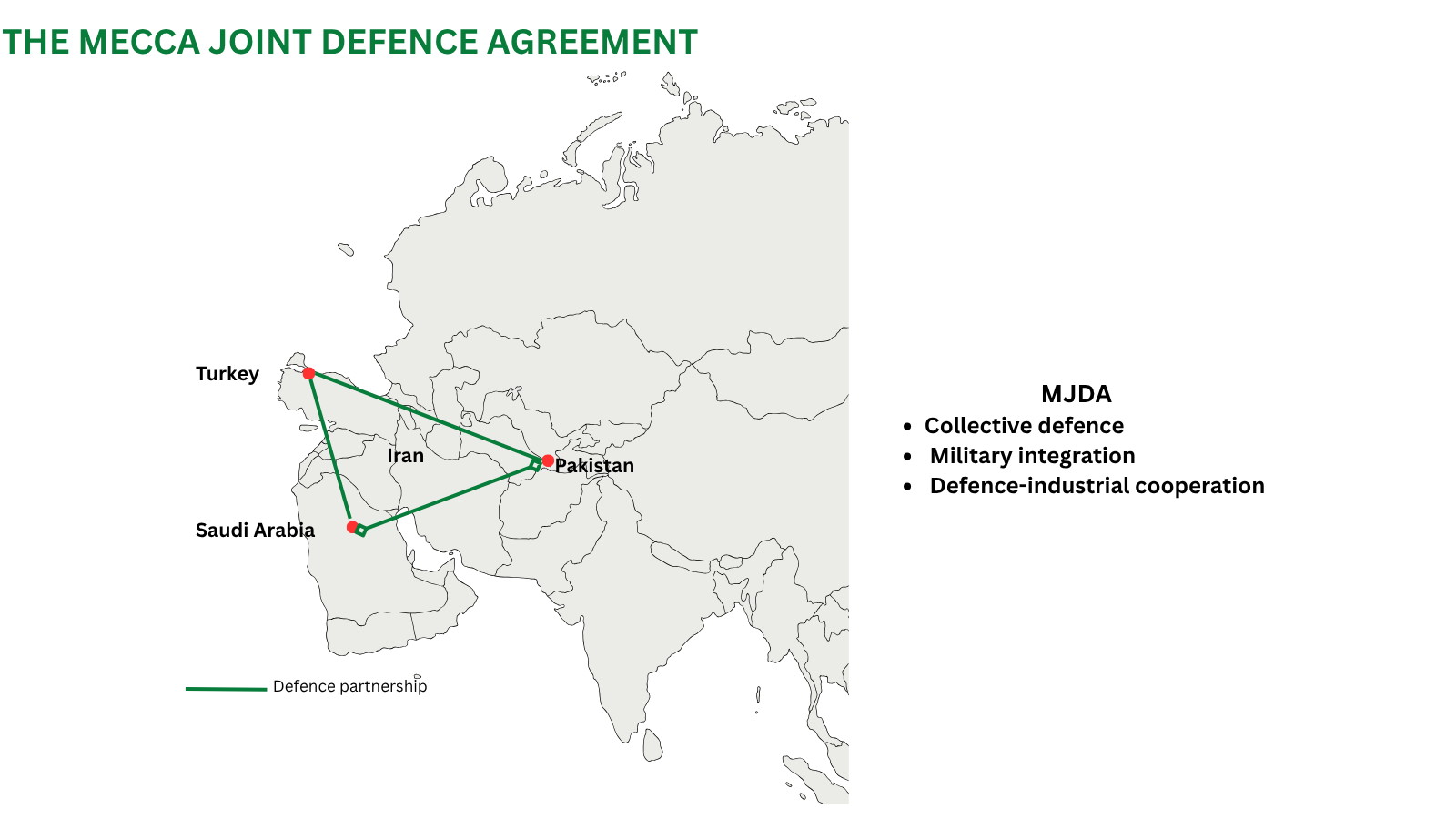
The MJDA will strengthen collective defence through mechanisms designed to deepen military integration and operational capabilities. While the agreement will include joint military exercises, it will extend beyond procurement and supply into defence-industrial cooperation, joint development and production, cooperation on unmanned systems and air defence, technology cooperation, and maintenance and logistics support. The strength of the agreement may lie in the diversity of its members. With Turkey’s experience in joint military exercises, naval production and interoperability through NATO, Turkey may provide expertise and improved training, while Saudi Arabian financing could accelerate defence production. The MJDA is shaping up as not only a mechanism for military coordination but also a defence-industrial partnership aimed at reducing external dependence and improving capacity amid a changing regional security environment.
Assessment Outlook
Regional security architectures are changing globally as states seek to reduce dependence. Across the Asia-Pacific, Europe and the Middle East, states are forming bilateral and trilateral defence partnerships, either deepening existing relationships or forming new ones. Although many states have existing relationships, the latest agreements are extending beyond procurement and diplomatic cooperation into deeper operational and industrial integration. Through joint development projects, production, technology and research, intelligence sharing, maintenance and logistics, training and operational integration, deeper security integration is becoming an important feature of agreements. To reduce dependence and build regional security capacity, many states may view these types of agreements as important to their own security.
Many of these agreements are in the initial stages and have yet to require significant commitments from their members. Deepening security ties will require time and resources, as well as a willingness to participate, because access to defence technologies and expertise and intelligence sharing remain sensitive. Expanding production capacity and implementing agreements will require significant financing, which could create political tensions, as demonstrated by Italy's defence funding request. Overlapping security arrangements may provide greater security; however, they will likely require careful balancing by members such as Turkey, with its NATO membership, and Indonesia, with its broad regional relationships. In the medium term, conducting joint military exercises is likely to be logistically and financially achievable; however, deeper integration of these partnerships may require more time, resources and trust.
Economic Security: Strategic Trade and Supply Chain Resilience
European Economic Security
European Commission President Ursula von der Leyen has signalled greater urgency in EU efforts to reduce economic dependence, invest in European industry and counter unfair competition. Von der Leyen highlighted Europe's growing trade dependence, specifically naming China, with imports from China rising 45% over five years and the trade deficit approaching one billion euros per day. Following China’s recent critical mineral restrictions on European manufacturers, von der Leyen acknowledged Europe’s heavy dependence on China for critical mineral supply chains and the economic leverage this dependence can provide. The speech marks a stronger emphasis on supply chain vulnerabilities and the need for greater European independence to improve economic security.
European initiatives include several measures to address economic and trade challenges. Part of the new policy is designed to simplify rules and requirements to improve competitive conditions through an omnibus package aimed at reducing administrative burdens by 2029. Other measures include simplifying the European acquis and accelerating authorisations to reduce regulatory barriers and costs for European companies. A key challenge is creating fairer conditions, in particular for European businesses competing with Chinese companies that receive subsidies or other forms of state support. To counter unfair practices, von der Leyen stated that Europe must be willing to use trade-defence mechanisms, as reflected in the growing number of investigations. Europe is seeking to improve business efficiency by streamlining legislation while also developing capacity in key sectors to reduce supply chain dependencies and strengthen economic security.
U.S. Supply Chain and Infrastructure Security
The U.S. announced higher tariffs on key components used in unmanned aircraft systems (UAS). With modern warfare evolving, UAS have proved effective across a range of combat roles. UAS have multiple uses, including law enforcement, environmental monitoring, disaster relief, search and rescue and aerial mapping. U.S.-manufactured drones depend on imported components, creating a potential national security risk. Unreliable supply chains, alongside cybersecurity vulnerabilities, have raised security concerns, particularly during wartime or when components are restricted through economic pressure. To address domestic production shortfalls, the U.S. has established an incentive programme to invest in U.S. production capacity and imposed tariffs of up to 100% on some sensitive drones and components and 25% tariffs on smaller drones. The proclamation on unmanned aircraft imports demonstrates growing efforts to reduce supply chain dependency and expand domestic production as a matter of national security.
Import restrictions are also extending beyond dual-use military hardware to equipment used in critical infrastructure. To secure critical infrastructure, President Trump declared a national emergency and banned some foreign equipment from electricity grids. The executive order aims to reduce cyber risks to critical software and digital capabilities and follows the discovery of undocumented communication devices in some Chinese solar power inverters. The U.S. security approach addresses not only reliance on foreign sources but also the vulnerabilities that foreign technology embedded in critical infrastructure could create. Supply chain dependence and infrastructure security are viewed as interconnected, with Washington regarding industrial capacity as integral to national security.
Trade Fragmentation and Economic Costs
Building domestic capacity has created tension between close economic and security partners as trade policies become increasingly strategic. Breakdowns in U.S.-Canada trade talks have resulted in Canadian retaliatory tariffs following the U.S. decision to impose 50% tariffs on certain Canadian products. The political nature of tariffs was demonstrated through statements by the Canadian industry minister, who indicated that products were targeted to apply political pressure. The comments highlight that retaliatory tariffs are not solely about creating fair trading conditions but can also serve as economic leverage to achieve political outcomes. Despite decades of free trade, the dispute highlights that the U.S. is placing greater priority on national industries and domestic production, potentially at the expense of international economic integration. The cost of escalating trade disputes also extends beyond tariffs, as governments may need to support affected industries.
Trade warfare not only affects imports but also creates pressure for government financing to mitigate the economic consequences. Canada announced measures to support tariff-affected industries by providing billions of dollars in financial assistance for trade defence, domestic industry and workers. Simultaneously, the Business Development Bank of Canada will offer interest-free loans of between C$2.5 million and C$5 million. The Canadian response demonstrates trade disputes can create broader financial costs, requiring governments to provide support and investment to mitigate their effects. How these support initiatives can sustain affected industries and whether further stimulus will be required remain uncertain. This creates additional challenges for countries with less capacity to provide financial support to sustain targeted sectors. In the short term, these additional costs are likely to be significant.
Assessment Outlook
Economic policy is shifting towards greater supply chain resilience and reduced dependence. With countries dependent on specific components or critical minerals sourced from foreign imports, trade is becoming intertwined with national security. The U.S. and EU have signalled plans to invest in diversifying supply chains, reducing dependencies and building domestic capacity. Reducing supply chain dependence and building domestic capacity limit reliance on foreign components and minerals while also helping to ensure that critical infrastructure remains resilient to cybersecurity vulnerabilities created by foreign technologies. Economic security can involve measures against trading partners, including EU trade investigations and U.S. tariffs, which are likely to increase tensions in global trade, particularly where supply chain dependencies already exist.
The measures required to build domestic capacity and reduce supply chain dependence may also create economic costs. Some EU companies have faced Chinese restrictions on critical minerals, which have created economic pressure, particularly in advanced technology, automotive and defence industries. The breakdown in trade relations between the U.S. and Canada also highlights that tariffs are only one part of trade disputes, with retaliation and domestic government investment needed to sustain targeted industries and provide financial relief. Countries will have different capacities to absorb trade shocks, meaning that those unable to provide financial assistance are likely to face greater repercussions. In the short term, some supply chain fragmentation is likely as suppliers and importers adapt to changing international trade conditions.
Emerging Risks
Black Sea economic warfare could expand further into commercial infrastructure as President Putin signals a widening of potential targets. Attacks on ports, vessels, energy infrastructure, grain and oil exports may increase shipping insurance costs and further reduce export volumes.
Maritime disruption and chokepoint congestion across multiple maritime routes could increase pressure on global supply chains and affect prices. The Suez Canal, Red Sea, Strait of Hormuz and Panama Canal face constraints, while European waterways such as the Danube are also affected by low water levels. Transit times, reduced freight loads and increased insurance costs could reduce product availability and raise costs for energy and commodities.
Hormuz enforcement against blacklisted vessels and VLCCs could increase maritime disruption. Attacks or enforcement actions in Hormuz could increase as Iran seeks additional political leverage. Houthi attacks could also expand beyond targeting Saudi-linked vessels towards energy infrastructure.
Security partnerships could create competing or overlapping obligations. Indonesia and Turkey have developed new security relationships while remaining partners in other arrangements. Security architecture is evolving, and agreements like the MJDA could include additional members, while other regional security arrangements may also develop.
Trade fragmentation could expand through tariffs, industrial protection and retaliation, increasing tension and economic pressure between trade partners, with greater impacts on states with limited capacity to provide financial assistance to affected sectors.
Defence-industrial agreements may fail to translate into operational capacity between partners. August agreements contain commitments to production, intelligence sharing, technology transfers and joint projects, all of which face implementation risks.
Strategic Indicators
U.S. and EU Critical Mineral Diversification ▲ Increasing
Non-Chinese Critical Mineral Processing Capacity ▲ Increasing
Maritime Chokepoint Pressure ▲ Increasing
Black Sea Economic Warfare ▲ Increasing
Alternative Route and Infrastructure Investment ▲ Increasing
Defence Partnership Agreements and Operationalisation ▲ Increasing
Defence-Industrial Integration ▲ Increasing
U.S. and EU Economic Security Measures ▲ Increasing
Global Trade Fragmentation ▲ Increasing
What to Watch
Critical Minerals: Progress on EU and U.S. diversification projects, including investment and extraction agreements in Africa, alongside further Chinese restrictions or changes to export licensing.
Maritime Chokepoints: Data on shipping volumes, transit times and insurance costs across Hormuz, Suez, the Red Sea and Panama; indications that global disruption is affecting commodity prices and supply chains.
The Black Sea: Further Ukrainian attacks and an escalation of Russian attacks against economic infrastructure, ports, vessels and energy export infrastructure; further declines in grain and oil export volumes.
Defence Partnerships: Indications that partnerships are moving beyond commitments into operationalisation through joint exercises, technology transfer, intelligence cooperation, procurement and joint production.
Middle East Security Architecture: Indications of MJDA operationalisation or possible expansion to additional members alongside broader Pakistani engagement.
Economic Security: U.S. onshoring policies or restrictions targeting foreign dependencies, alongside EU trade defence measures and investment to reduce supply chain dependency.
Trade Fragmentation: Further U.S. tariffs and additional measures against Canada alongside Canadian responses and evidence of tariff impacts affecting investment, production and political approval ratings.
Sources
Critical Minerals and Supply-Chain Diversification
International Monetary Fund — Rare Earths / Critical Mineral Supply Chains
IMF source
Reuters — China’s Rare-Earth Exports to the United States
Reuters source
South China Morning Post — China Detains Japanese Executives in Dual-Use Technology Export Probe
SCMP source
Energy Fuels — Commercial-Scale Heavy Rare-Earth Plant Under Construction in Utah
Energy Fuels source
Energy Fuels — Heavy Rare Earths Qualified by Japanese Permanent-Magnet Manufacturer
Energy Fuels source
Carnegie Endowment for International Peace — China Decoupling Beyond the United States: Comparing Germany, Japan and India
Carnegie source
Financial Times — Critical Minerals / Supply-Chain Diversification
Financial Times source
The Nation — Malawi Mining Licence Freeze
The Nation source
Diramakini — Tanzania and DRC Cooperation
Diramakini source
Maritime Chokepoints, Energy and Alternative Routes
Reuters — Fewer Than 20 Ships Transit Strait of Hormuz Over Weekend
Reuters source
Reuters — Hormuz Ship Crossings Hover in Single Digits
Reuters source
Reuters — Chinese State Shippers Deploy Tankers Outside Gulf to Avoid Chokepoints
Reuters source
Associated Press — Oil and the Strait of Hormuz
Associated Press source
Saudi Aramco — First Quarter 2026 Results
Saudi Aramco source
Reuters — TotalEnergies to Invest in Expansion of Fujairah Oil Export Pipeline
Reuters source
Reuters — Panama Canal Tightens Draft Limits as Water Levels Come Under Pressure
Reuters source
Seoul Economic Daily — El Niño Drought Forces Panama Canal to Cut Ship Traffic
Seoul Economic Daily source
SupplyChainBrain — Panama Canal Backlogs Swell as Water Levels Fall
SupplyChainBrain source
The Guardian — Hormuz Alternatives and China’s Northern Sea Route
Guardian source
Reuters — South Korea Ship to Test Arctic Commercial Route
Reuters source
Black Sea Economic Warfare and Supply Disruption
Seatrade Maritime — Black Sea Drone Strikes Send CPC Tanker Rates to $400,000 a Day
Seatrade Maritime source
Euractiv — Black Sea Drought and Hormuz Crises Squeeze Global Food Security
Euractiv source
Reuters — Russia’s Sheskharis Terminal Halts Loadings After Drone Attack
Reuters source
Reuters — Oil Exports From Russia’s Western Ports Drop Below Plan
Reuters source
Reuters — Ukraine Turns to Alternative Grain Export Routes as Russia Blocks Ports
Reuters source
Reuters — Global Wheat Buyers Brace for Supply Squeeze Amid Black Sea Attacks
Reuters source
Defence Partnerships and Defence-Industrial Integration
UK Government — UK and Ukraine Partnership to Develop Defence Technology and AI
UK Government source
Defence Industry Europe — Britain Authorises MBDA to Share Classified Storm Shadow Data With Ukraine
Defence Industry Europe source
President of Ukraine — Ukraine and Finland Sign Three Cooperation Documents
President of Ukraine source
European Commission — Commission Approves €6.1 Billion for Ukraine’s Defence
European Commission source
Japan Ministry of Defense — Defence Cooperation, August 2026
Japan MOD source
Japan Ministry of Defense — Defence Cooperation, August 2026
Japan MOD source
Australian Department of Defence — Enhancing Australia–Japan Defence Cooperation
Australian Defence source
Japan Ministry of Defense — Defence Cooperation, August 2026
Japan MOD source
ANTARA — Indonesia Outlines Expanded Military Cooperation With Japan
ANTARA source
Reuters — Saudi Arabia, Turkey and Pakistan Sign Joint Defence Deal
Reuters source
Reuters — Turkey, Pakistan and Saudi Arabia to Form Political and Military Mechanisms
Reuters source
The National — Turkey, Saudi Arabia and Pakistan to Establish Political and Military Mechanisms Under Defence Pact
The National source
Economic Security and Trade Fragmentation
European Commission Audiovisual Service — EU Economic/Security Material
European Commission source
Financial Times — Economic Security / Trade Policy
Financial Times source
White House — Adjusting Imports of Unmanned Aircraft Systems and Components Into the United States
White House source
Reuters — US Order Bans Some Foreign Equipment From the Energy Grid
Reuters source
Government of Canada — Countermeasures and Support in Response to US Tariffs
Government of Canada source
Reuters — Canada Announces $20 Billion in Retaliatory Tariffs on US Goods
Reuters source