Systems Sanction: A Russian Pressure Campaign
Key Takeaways
Ukraine continues to employ a drone strike campaign on Russian military and energy infrastructure.
The European and United Kingdom’s expanded sanctions indicate a convergence of pressure on Russian supply chains and economic systems.
Concerns raised by Russian politicians suggest the conflict may be extending beyond the battlefield.
Russia may adapt in strategy but respond conventionally in the short term.
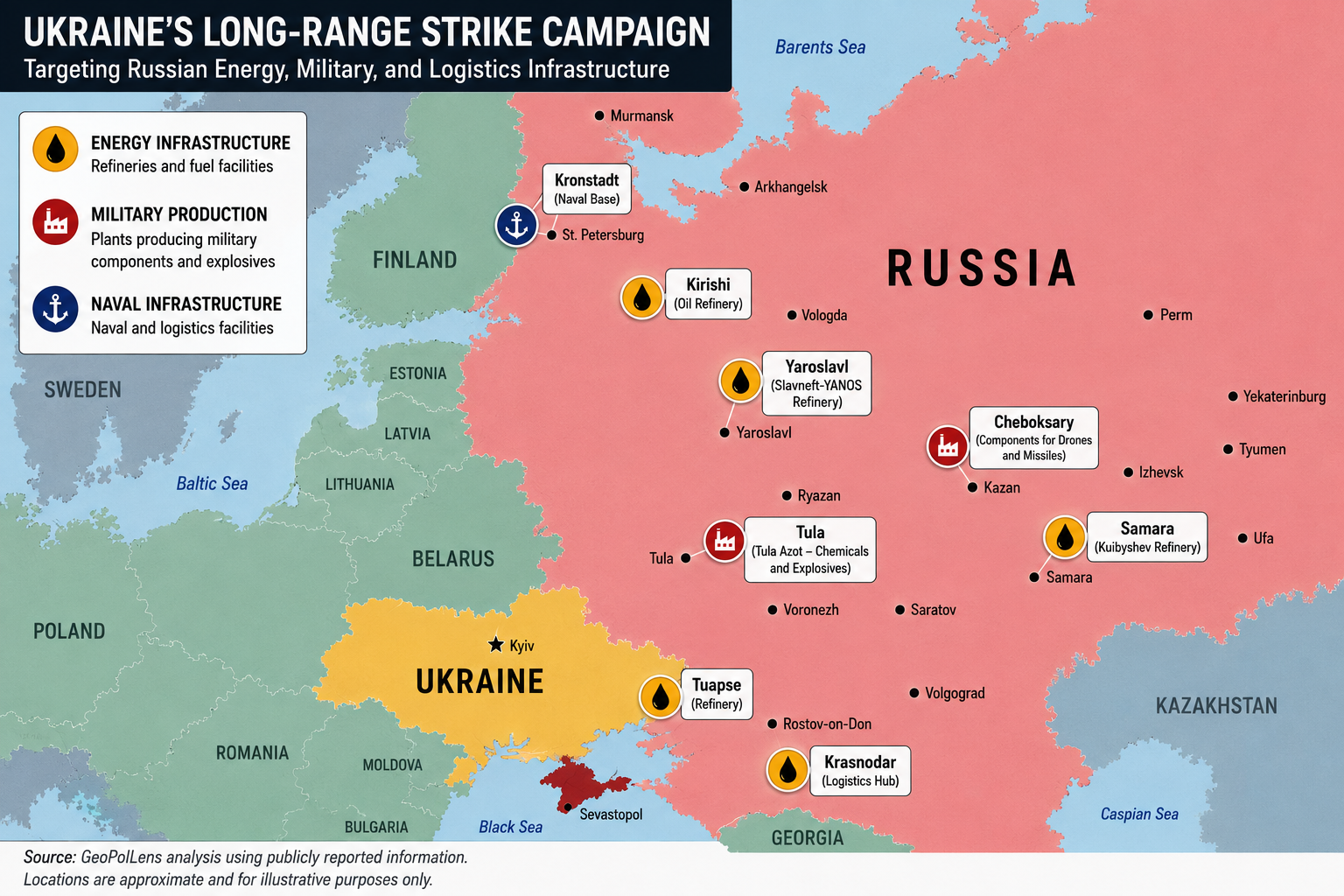
Recent Ukrainian drone strikes across western Russia have demonstrated significant reach and damage inflicted. Ukraine’s strikes have reached oil refineries, military and naval infrastructure, and logistics hubs in what President Zelenskiy has framed as “long-range sanctions." Drone capabilities have expanded relatively quickly considering the Unmanned Systems Forces (USF) were only established one year ago, according to Zelenskiy. It is difficult to assess the exact impact of such strikes; however, the Ukrainians claim to have struck $40 billion worth of Russian targets. The distance a drone can reach may be significant, but it is the targets being struck that are more important.
The USF has hit targets that span the length of western Russia from Kronstadt near Finland to Krasnodar in the south. Distances from Ukraine now show that the USF can strike targets 1000 km inside Russia. Targets may appear in scattered locations; however, what is being struck reveals an important pattern of economic and military supply chain pressure. Ukraine’s asymmetrical USF campaign is now able to damage critical infrastructure used to sustain Russia’s frontline operations.
Oil infrastructure has been a constant target of the USF, with several refineries being struck. One of the largest Russian refineries, the Slavneft plant in Yaroslavl, was hit 700 km inside Russia in the northwest. Slavneft refines approximately 15 million tons a year into products such as gas, diesel, and jet fuel. Other energy infrastructure targets include Kuibyshev in Samara, which produces motor fuels; the Tuapse refinery on the Black Sea coast; and the Kirishinefteorgsintez oil refinery near Leningrad.
Although the targets are geographically spread, the energy infrastructure strikes appear intended to reduce Russian military mobility. Fuel sustains transport networks, aviation, and logistics but also applies economic pressure domestically on fuel availability. The dual strategy is reportedly having a regional impact, with widespread fuel shortages and fuel rationing in Crimea, although it is difficult to know how much to attribute to Ukrainian strikes. It is not only energy infrastructure being targeted, but also military facilities.
According to Zelenskiy’s statements and reported satellite images, various military facilities were hit. Rather than drones, Ukrainian Flamingo cruise missiles struck the military facility in Cheboksary that reportedly manufactures components for drones and missiles, in particular, navigation systems to avoid Ukrainian signal jamming. Tula Azot, a chemical plant used in explosives production, was also reportedly hit. Instead of Ukraine targeting battlefield operations, these two targets support Russia’s military production and its ability to conduct operations. The reported use of cruise missiles suggests that Ukraine is willing to employ capabilities beyond drones. However, despite the strike capability, the targets remain military infrastructure that sustains Russian military operations. Ukraine is not the only country with the objective of targeting military supply chains.
Both the European Union and the United Kingdom announced new sanctions recently. The increase in sanctions from Western countries has also targeted the shadow fleet, but unlike previously, the sanctions have expanded. Like the EU, the UK announced the inclusion of service providers and insurers of shadow vessels, among other sanctions targeting military procurement and financial systems. The close announcement of these sanctions shows that, like Ukraine’s strikes, the objective is increasingly to target energy revenue, oil production, military production, and financial systems that sustain Russia’s war effort. While the mechanisms may differ, the convergence of pressure on Russian support systems remains, with Russian politicians now discussing the cost of the war.
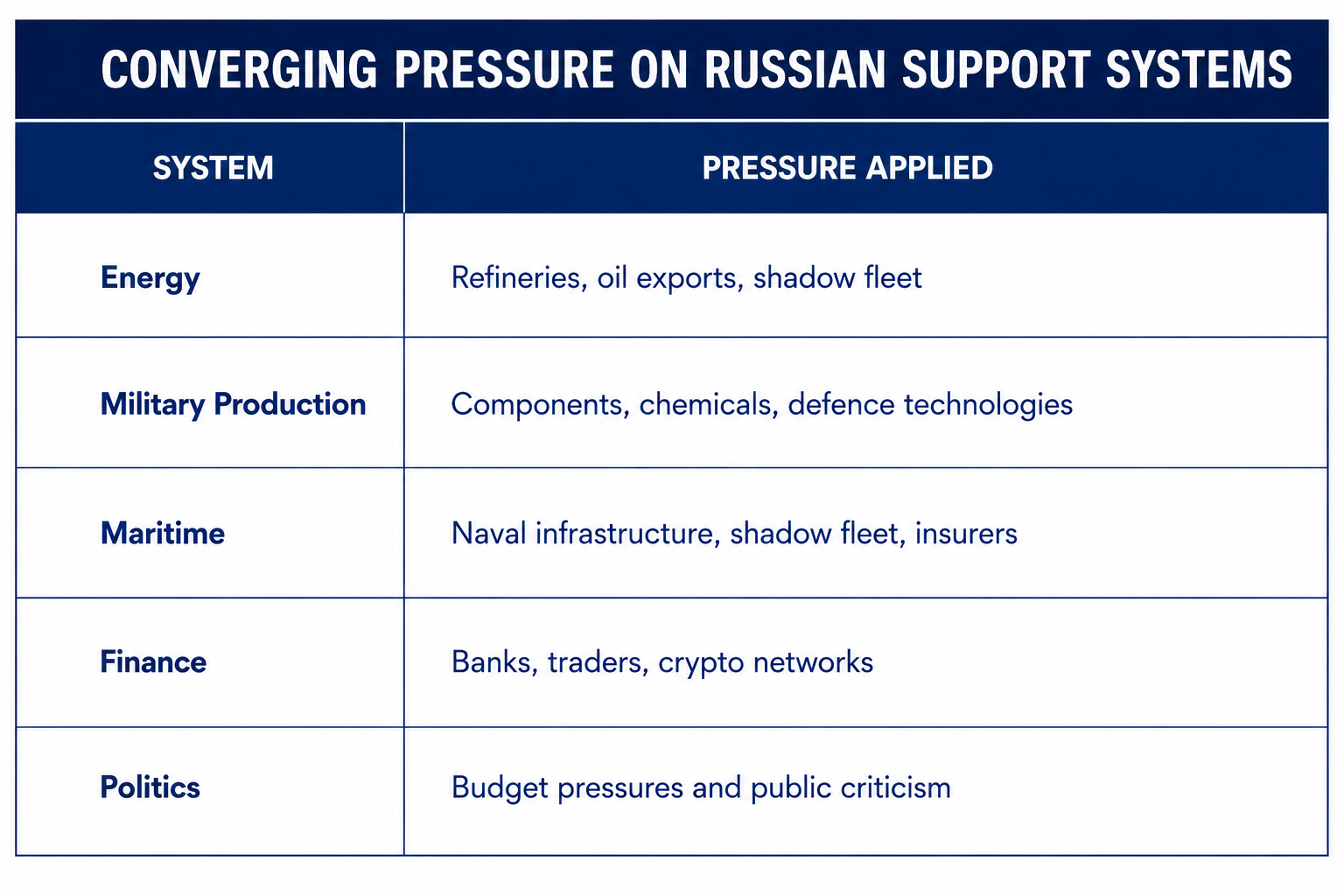
The financial impact of the war on Russia may be becoming more evident. According to the Financial Times, the finance ministry requested a funding freeze on non-related spending to finance war costs, with the budget expected to overspend by $28 billion. The move suggests that funding is not unlimited, and the diversion of Russian funds toward military expenses may come at the expense of public spending. Politicians have raised concerns, including Vyacheslav Markhayev, a deputy of the State Duma from Russia’s Communist Party, who reportedly said “... The country is on the brink of a social explosion…” and that there is a risk of social unrest. Critics appear not to be dissidents but party members or Kremlin loyalists. The converging sanctions and military strikes may have a cumulative effect, one that not only impacts military production and logistics networks but also creates economic and political pressure. However, the political implications remain limited and speculative.
Despite USF's long-range sanction strikes, the Russian military has persisted in conducting its campaign. Russia’s drones and missiles have continued to strike targets across Ukraine, indicating that while Ukraine’s strikes impose costs, they have not immediately prevented Russian operations. Warfare adapts, and Ukraine's asymmetrical advantage may be temporary as Russian air defences, electronic warfare, and drone capabilities evolve. Until then, Russia may respond using conventional weaponry in which it retains an advantage.
Targeted strikes on energy, military, and logistics infrastructure alongside sanctions appear to be an effort to slow Russia’s military operations. Rather than solely contesting territory, the USF is conducting an economic and military pressure campaign. Western sanctions are also providing a convergence of pressure on many of the same support systems, exposing Russian supply chain vulnerability. The USF and Western sanctions are relatively recent, and while Russian strikes continue, it is yet to be seen how Russia may adapt its own strategy. What was more a war of attrition has evolved into one where resilience, adaptation, and supply chains are increasingly crucial.
Sources
https://www.yanos.slavneft.ru/en/about/company/
https://www.lubesngreases.com/lubereport-americas/11_17/drones-hit-yaroslavl-base-oil-refinery/
https://www.rosneft.com/about/Rosneft_today/
https://www.rosneft.com/about/Rosneft_today/
https://rosneft.com/business/Downstream/Neftepererabotka/OilRefineries/KuibyshevRefinery/
https://kyivindependent.com/ukraine-strikes-chemical-plant-in-russias-tula-oblast/
https://www.independent.co.uk/news/world/europe/russia-ukraine-war-finance-putin-b2985849.html
https://www.ft.com/content/93674b5c-06ea-4e49-a005-dc08e1091574?syn-25a6b1a6=1
https://www.stuff.co.nz/world-news/360992501/russian-mp-warns-putin-were-brink-social-collapse