Sustaining Power: The Role of Infrastructure and Systems in Conflict
Key Takeaways
Targeting systems that support economic or military power may be how power is increasingly contested.
Infrastructure strikes are not limited to land-based targets, with maritime routes also being disrupted.
Sanctions, disruption, or strikes on infrastructure, logistics, energy, shipping, or financial markets are part of the modern battlefield.
Weaker actors can impose costs on larger and more conventionally powerful adversaries.
Warfare has traditionally relied on territorial gains, frontline movements, and borders; however, this may be changing. Although captured territory remains a visual marker of success, recent conflicts suggest that technological advances and evolving tactics are reshaping how military power is applied. Targeting critical infrastructure to impose economic pressure, or striking supply chains, energy systems, and logistics networks to constrain military operations, has become an increasingly used tactic in modern conflict. Success on the battlefield is no longer measured solely by territory but by an actor's ability to adapt in order to sustain operations and impose economic cost on an adversary. For states and non-state actors unable to compete through conventional military or economic power, this approach offers a way that offsets certain disadvantages. Recent conflicts in the Middle East and Ukraine highlight how critical systems are becoming an important part of warfare.
Ukraine’s advances in drone technology have provided an example of tactical change. Deep drone strikes into Russia have specifically targeted infrastructure that supports Russia’s military. Energy infrastructure, including pipelines, was hit, which, according to the International Energy Agency (IEA), led to Russia's crude output decreasing 460,000 barrels per day. With approximately 16 refineries hit since January, some calculations estimate drone attacks have destroyed 700,000 barrels per day of refinery capacity. The IEA estimated that Russian oil products were at the lowest levels on record for April and March. Ukraine has demonstrated the ability to reach Russian military logistics inside occupied territory and inside Russia without having to use large-scale conventional ground offensives. Strikes on naval infrastructure and near St. Petersburg highlight the broad range that Ukraine currently possesses.
Zelenskyy's statement that “In practice, there are almost no safe roads left for the occupier in the south and east of our country" shows the tactic applies pressure on Russia's supply chains and any troop movements inside occupied territory. Ukraine’s tactic achieves several objectives: it limits Russia’s ability to resupply the frontline and it avoids Ukrainian infantry casualties. It targets infrastructure rather than residential areas, demonstrates strike reach, and creates psychological warfare on the Russian population, while infrastructure damage imposes an economic cost. Ukraine is not attempting to capture Russian territory or fight conventionally. The objective appears to be to reduce Russia’s capacity to resupply the frontline through targeted infrastructure strikes, which may have slowed Russia’s gains.
Israel has employed similar measures against Iran by targeting infrastructure. Strikes on companies that supply electricity, water, and oxygen to Iran’s largest petrochemical complex were an effort to impose economic costs on the Iranian regime. Targeting energy sources disables critical infrastructure; however, targeting support infrastructure may avoid damaging petrochemical infrastructure long-term, which risks global repercussions. Israel has hit other strategic targets such as the Shahid Ahmadi-Roshan Natanz enrichment complex, ballistic missile sites, and gas fields. The dual approach damages military capacity and economic cost by reducing industrial output and energy supplies. Neither Israel nor Iran has indicated territorial objectives in the conflict but has rather focused on imposing costs and degrading military capabilities.
Infrastructure strikes are not limited to land-based targets, with maritime routes recently being disrupted. Maritime chokepoints function as critical infrastructure and global trade routes, particularly for energy supplies. Both the Strait of Hormuz and the Red Sea demonstrate how chokepoints can be used as leverage and exert pressure. The Houthis have targeted commercial shipping in the Red Sea, forcing vessels to be rerouted, incurring transportation costs and delays in transit times. In the Strait of Hormuz, the Iranian regime’s threats have had impacts on energy supplies, insurance premiums, and supply chains, which all impose added costs. Unlike conflict for territory, maritime disruption does not only impose pressure on a single adversary but also has a global impact on markets. Small actors, state and non-state, can impose disproportionate global costs through limited attacks or even the threat of attack.
On June 9th, European President von der Leyen released a statement on the 21st sanctions package against Russia. In efforts to counter the shadow fleet, the EU added another 30 vessels to the list of 632 sanctioned. Taking a step further, the sanctions announced are also targeting the shadow fleet support network providing services or bunkering. It is not only the movement of sanctioned oil, but the EU has also identified critical infrastructure where Russian oil is traded, such as ports, airports, and refineries. By restricting the sale of LNG tankers to Russia, the EU is now implementing a sanctions strategy that extends beyond transportation and into the facilitation of the process itself. A further economic cost announced is through the targeting of Russian financial infrastructure with the ban of another 31 Russian banks, crypto firms, oil traders, and third countries that partake in facilitating measures to avoid sanctions. The broad strategy encompasses the restrictions on technologies associated with the Russian military, such as metals and alloys. In a complex situation, the EU has not targeted territory or escalated battlefield conflict but rather focused on the systems that sustain military and economic power.
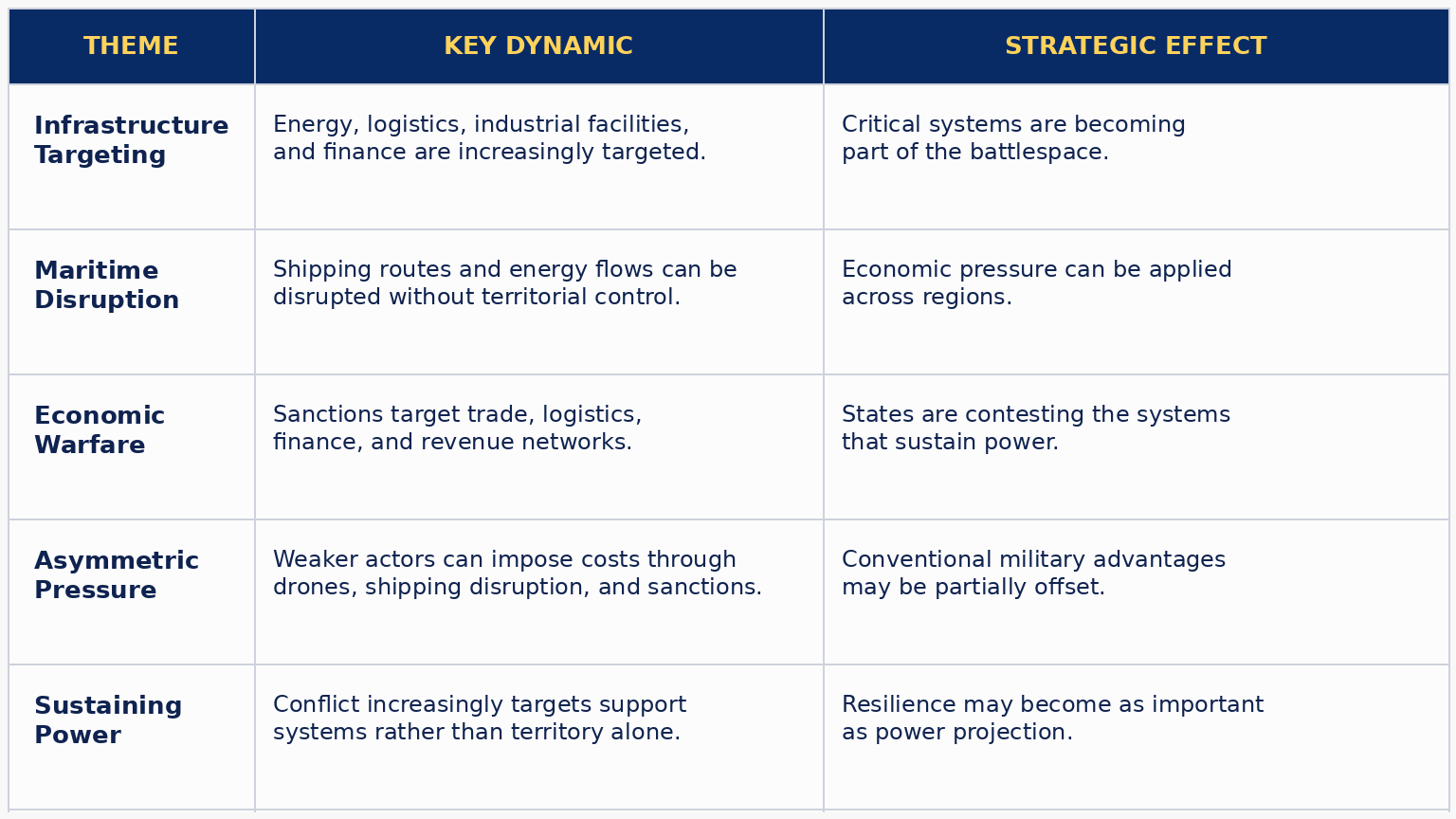
In a globalised world, targeting systems that support economic or military power may be how power is increasingly contested. Sanctions, disruption, or strikes on infrastructure, logistics, energy, shipping, or financial markets are part of the modern battlefield. For weaker actors, the strategy can also impose costs on larger, more conventionally powerful military actors. The advantage is that economic, military, and political effects can be created simultaneously, which has widespread impacts. Recent conflicts demonstrate that power projection alone is becoming insufficient; the ability to support and sustain power is equally important. At present, those actors targeting these systems may hold an advantage; however, it is yet to be seen how those targeted will respond and whether efforts will be made to defend critical systems. States may need to not only protect borders but also systems and networks that sustain them.
Sources
https://ec.europa.eu/commission/presscorner/detail/de/statement_26_1314