The Indo-Pacific’s Strategic Shift: Asia’s Changing Security Environment
Key Takeaways
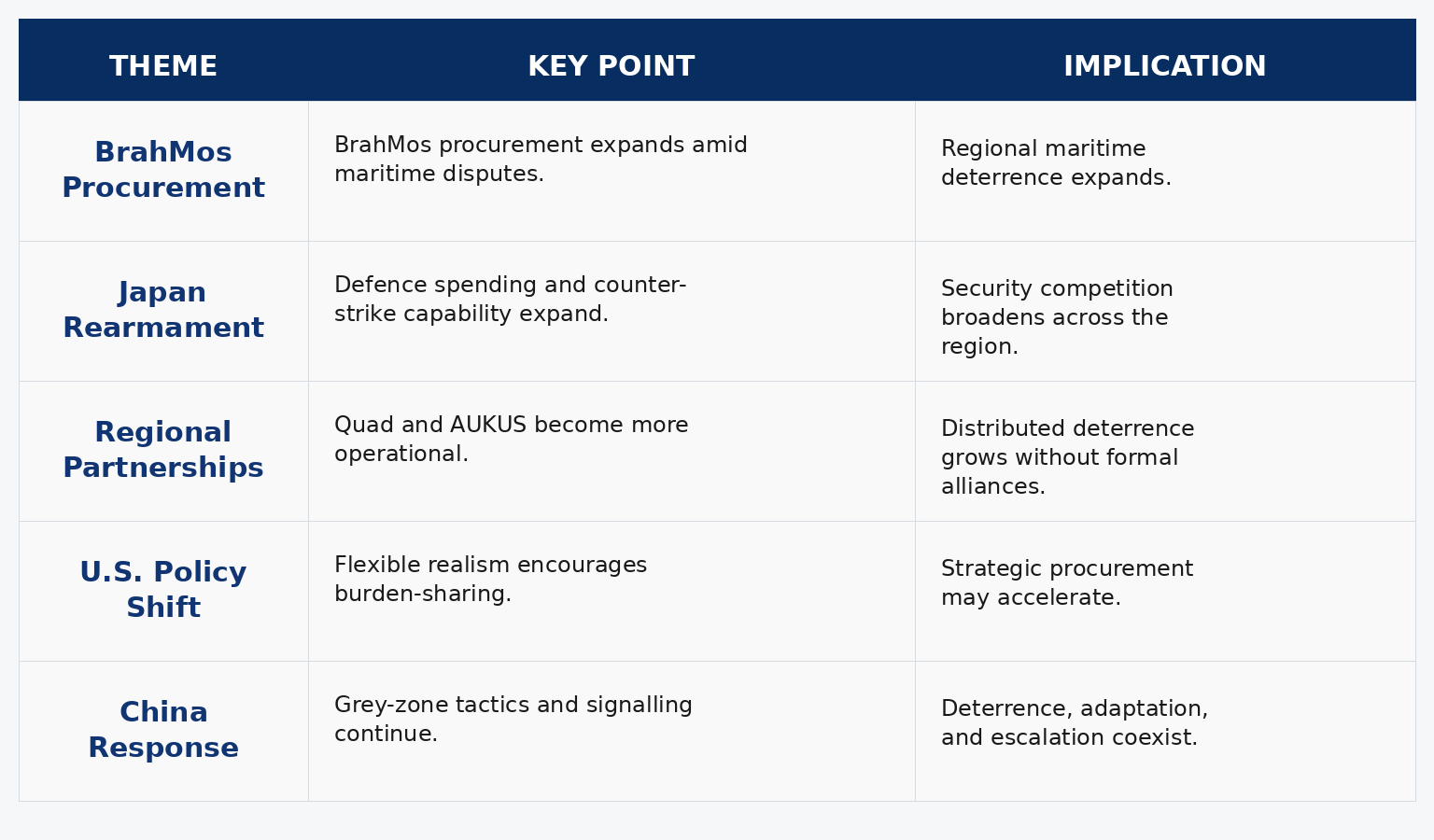
India’s sale of BrahMos cruise missiles to regional states shows it is becoming a defence exporter.
Vietnam, the Philippines, and Indonesia are moving toward defensive deterrence procurement.
Japan’s defence budget signals deterrence beyond the South China Sea.
The Quad and AUKUS demonstrate that partnerships in the region are becoming more operational.
U.S. flexible realism may have accelerated strategic procurement in the region.
A Chinese response is likely to include escalation in current tactics.
The reported deal signed between India and Vietnam for BrahMos supersonic cruise missile systems could be more than an arms transfer. Asian states may be moving toward obtaining specific military capability, interoperability, and defence partnerships through an approach motivated by overlapping interests. In a region increasingly contested, the Indo-Pacific is experiencing maritime disputes and coercion that are now being met with strategic deterrence efforts.
The BrahMos agreement makes Vietnam the third country after the Philippines and Indonesia, with reports that Thailand and Malaysia are also expressing interest. Regional maritime concerns could be entering a new phase as the BrahMos is primarily an anti-ship missile; it suggests Asian coastal states recognise the need for deterrence, particularly in the South China Sea.
India is now a defence exporter in the region. As a regional power, India has demonstrated a willingness to be a security provider to regional partners through its growing defence export industry. The advantage of the BrahMos is its multi-platform versatility. The supersonic missile can be used on land, at sea, and sub-sea, making it a valuable procurement for coastal states with limited naval capacity but requiring a cheaper, faster form of deterrence. As India appears to be willing to share weapons technology, it may gradually become an important security provider in the region.
Both the Philippines and Indonesia are involved in maritime territorial disputes, which may be why they have procured BrahMos. Recently, Chinese coast guard or maritime vessels blocked Philippine fishermen from entering the Scarborough Shoal in the South China Sea. Along with the Spratly Islands, these maritime territories are increasingly areas where coercive tactics are employed. For Indonesia, the Straits of Malacca, Lombok, and Sunda place the country in an important strategic position. With the 6th largest Economic Exclusion Zone and overlapping claims in the South China Sea, the procurement of BrahMos strengthens maritime deterrence over strategic waterways. Regional deterrence is not limited to the South China Sea, as Japan is also repositioning its defence posture.
Japan’s post-WWII position of a defence-oriented military is transitioning to counter-strike capability. The country’s defence expenditure rose by 9.7% at the end of 2025. Recent procurement provided Japan with Joint Strike Missiles that can be fitted to F-35 jets, giving long-range strike capabilities. Similar to the South China Sea, Senkaku/Diaoyu Islands in the East China Sea have overlapping claims from Japan, China, and Taiwan. Japan’s strategic weapons procurement and defence budget spike reflect a growing pattern in the region. Regional states are shifting towards trying to balance security in contested territories through deterrence while avoiding escalation.
It is not only individual states procuring military capabilities but also the posture of emerging regional groups. Until recently, the Quad, made up of Australia, India, Japan, and the U.S., has been less operational in its approach to the region. However, the recent Quad-Fiji agreement and condemnation of North Korea, while calling for the denuclearisation of the country, signal that the group may be becoming more active diplomatically in the Indo-Pacific. Simultaneously, Australia, the United Kingdom, and the U.S., as the members of AUKUS, have signed an agreement to develop Uncrewed Underwater Vessels (UUVs). Early this month, Chinese undersea monitoring devices were discovered in Indonesian waterways. Undersea capabilities are becoming recognised as a domain where emerging technology is being developed to counter conventional naval capabilities.
The Quad and AUKUS differ from other groups such as NATO. These groups have overlapping interests, but without the framework or definitive commitment that traditional alliances have. Nevertheless, the contested Indo-Pacific is becoming a sphere where overlapping interests and multiple actors are converging to address growing concerns.
The recent Indo-Pacific developments may have been accelerated by the current U.S. administration's National Security Strategy. Central to the NSS is how the U.S. will respond based on national interests, particularly as the strategy outlines flexible realism. In Secretary of War Pete Hegseth's Singapore speech, he stated that “...the era of the United States subsidizing the defense of wealthy nations is over. We need partners, not protectorates. We seek alliances built on shared responsibility, not dependency.” With strategic ambiguity, long-standing regional partners that have traditionally relied on U.S. security assurance may have reassessed their role in the strategy.
Perhaps to partners, Hegseth's comments acknowledging efforts from South Korea, Japan, the Philippines, Australia, Indonesia, Thailand, Malaysia, and Vietnam will provide comfort. Hegseth’s singling out of India as “... a critical anchor to hold the line. A powerful India, acting in its own self-interest, advances our shared goal of maintaining a balance of power across the region.” potentially signals that the U.S. could approve of its arms sales.
Developments in the Indo-Pacific indicate a changing security environment. Instead of traditional security pacts like NATO, the region is subtly shifting to distributed deterrence, where overlapping interests are constructing security policy. While there is little central coordination, contested maritime territory has shaped military expenditure and deterrence procurement. The challenge for Asian states is balancing deterrence while avoiding escalation. Regional policy may appear recent; however, it has been building over time, perhaps accelerated by U.S. security expectations. These strategic partnerships are unlike formal alliances; they may be flexible, which could align with U.S. policy.
The incremental rearming in Asia may draw accelerated responses. China’s foreign ministry issued a statement after the Quad-Fiji agreement stating that third parties should not be targeted and that "we are consistently against forming exclusive groupings and inciting bloc confrontation." The use of the Chinese coast guard in grey-zone activities and diplomatic signalling, as well as the recent discovery of underwater monitoring systems, suggests that China is unlikely to reassess its positioning.
Asia may be moving toward distributed deterrence, creating resilience to coercive practices. However, partnerships could also create strategic competition. As states build deterrence capabilities, China is likely to respond. This may lead to a cycle where deterrence, adaptation, and escalation coexist.
Sources
https://turdef.com/article/japan-takes-delivery-of-jsm-cruise-missiles-for-f-35-fighters
Chinese Foreign Ministry Press Conference (28 May 2026) — Mao Ning remarks on bloc confrontation and the Quad
https://www.fmprc.gov.cn/mfa_eng/xw/fyrbt/202605/t20260528_11919951.html