Hormuz: From Chokepoint to Control Point
Key Takeaways
Iranian projectiles have struck vessels in the Strait, prompting retaliatory U.S. strikes.
Commercial shipping continues to transit the Strait using two reported routes, with unsanctioned vessels using the Omani route and sanctioned or Iranian-linked vessels using the Iranian route.
Commercial shipping operators are absorbing higher insurance premiums and freight rates.
Oman has reaffirmed its commitment to upholding international maritime law while continuing diplomatic engagement with Iran
Recent projectile strikes on commercial shipping in the Strait of Hormuz continue to disrupt maritime traffic. Despite diplomatic efforts, two projectiles have struck commercial vessels, prompting U.S. retaliatory strikes against Iran. In response, Iran reportedly launched missiles and drones at U.S. military sites in Bahrain and Kuwait. Although both sides have reportedly agreed to halt further strikes and resume talks, commercial shipping continues to transit the Strait. Rather than signalling the closure of Hormuz, recent developments suggest vessels are adapting by using different routes or transiting under U.S. naval escort.
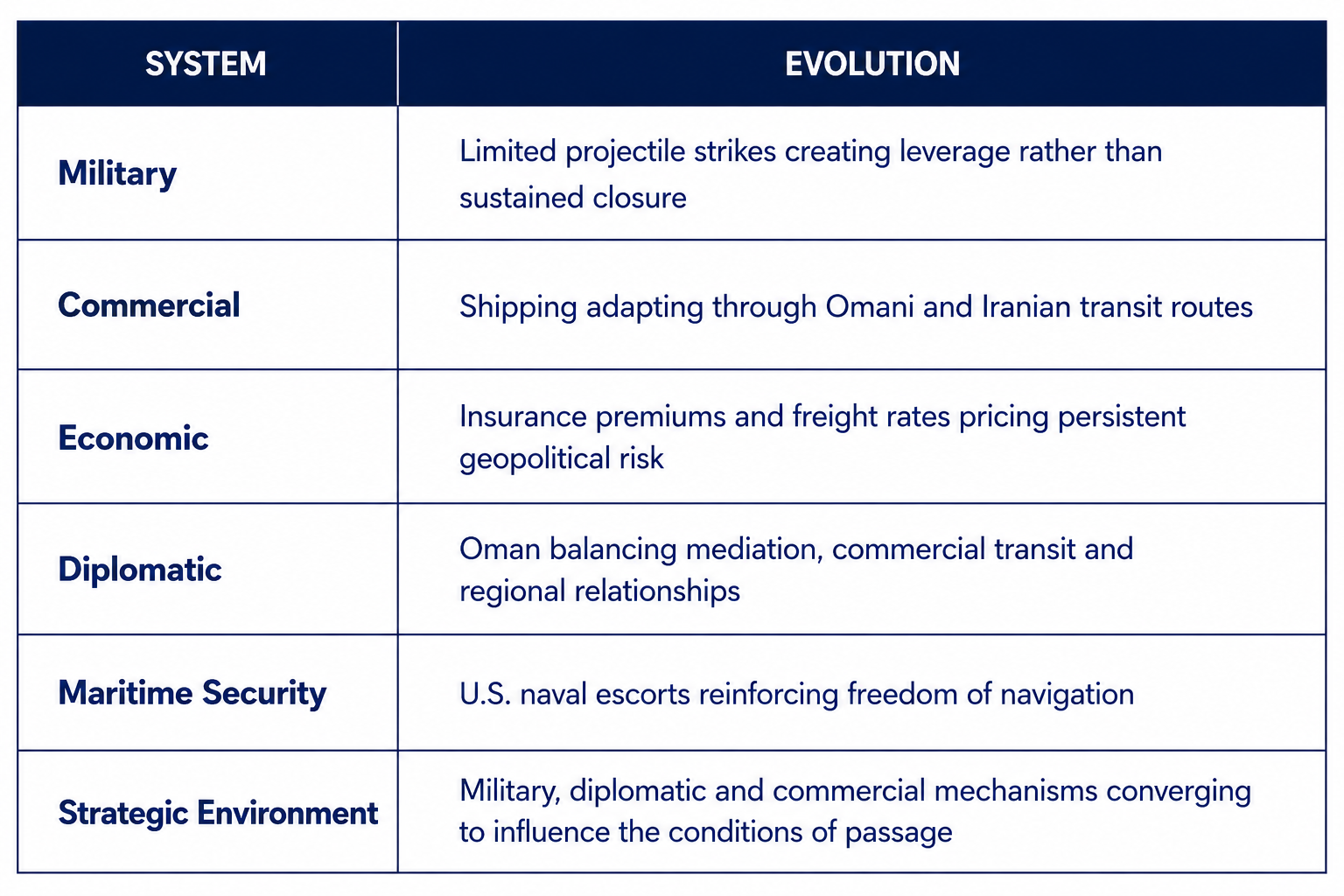
Since the start of the conflict, much analysis has focused on Iran’s ability to close or control the Strait. This has led to interpretations of whether the Strait is open or closed. However, recent developments suggest that the situation is becoming more complex. According to Kpler, maritime traffic data showed transits were up 105% day on day on 24 June, while Lloyd's List's separate data recorded transits had increased 270% over the previous week.
More importantly, data revealed a fragmented maritime operating environment and the types of vessels that were transiting under different conditions. HFI Research’s analysis of maritime traffic data observed that vessels using the Iranian route were recorded as sanctioned or linked to Iran, while vessels using the Omani route were unsanctioned. The focus may be shifting from Iran’s ability to impose conditions in the Strait towards how Hormuz is governed. If Bloomberg reports are accurate, Oman may also become an important stakeholder in shaping the post-conflict maritime environment.
The Strait has traditionally been viewed as a chokepoint primarily under Iranian control. Recent shipping data and reports suggest that commercial vessels are using different routes, shifting the focus from whether vessels can transit to how they transit. With sanctioned vessels reportedly following the Iranian route, unsanctioned vessels using the Omani route, and some commercial shipping transiting under a U.S. naval escort, the maritime operating environment has evolved. Navigation now depends on security requirements, insurance, sanctions compliance, commercial risk, and diplomatic relationships. Despite the changing conditions, commercial shipping appears to be adapting to increased risk and uncertainty rather than avoiding the Strait altogether.
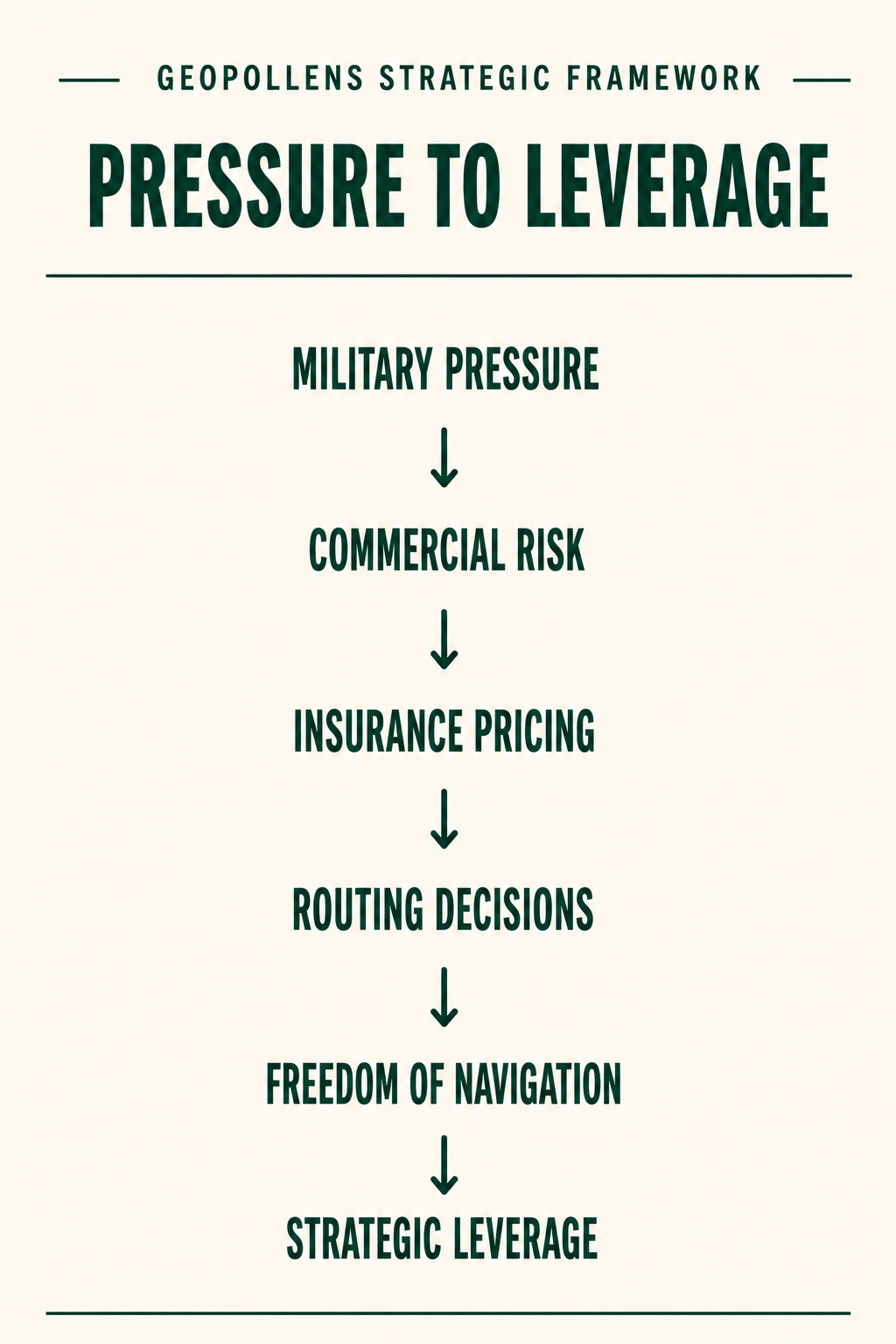
The evolving maritime environment is becoming a space shaped by several factors. As the conflict has progressed, the chokepoint has become more complex, with maritime security, military, economic, commercial, and diplomatic interests beginning to overlap. Iran continues to influence transit through military capability, although this has largely been limited to the use of threats and projectiles. As a deterrent, the U.S. has used naval escorts to protect commercial shipping and enforce freedom of navigation. Conditions in the Strait are becoming intertwined with military, diplomatic, commercial, and economic factors becoming interdependent.
Insurance premiums have reportedly increased, showing that commercial interests are adapting to conditions by pricing in additional risk while also making transit possible. Some reports suggest tanker hire rates increased from approximately $106,000 a day to $190,500, with very large crude carriers' daily earnings rising by $50,000 to $470,000. The willingness of commercial operators to absorb these costs may also reflect the continued demand for Gulf crude exports, such as the Abu Dhabi National Oil Company offering tenders. Despite the risk, insurance premiums have recently eased, and tanker revenues have averaged above $100,000 a day. While the risk of kinetic activity remains, both the U.S. and Iran have demonstrated some degree of restraint. Iran may be using limited disruption as leverage in negotiations, while the U.S. has launched targeted strikes in response. Rather than withdrawing from the Strait, commercial shipping appears to be interpreting the conflict through pricing adjustments, which have allowed vessels to continue to transit despite an elevated risk and uncertainty.
Oman’s role in how the Strait will operate is unclear, with conflicting reports emerging. Arab News reported on Thursday, 26 June, that at a meeting with Gulf foreign ministers in Bahrain, the Strait will remain toll-free. However, the next day, according to Bloomberg, Oman informed European officials that Hormuz was unlikely to return to pre-conflict conditions with fees required for navigation services or de-pollution of the waters. As of Monday, 29 June, Ynet reported that Omani Foreign Minister Badr al-Busaidi had referred to upholding international law, including the UN Convention on the Law of the Sea, after holding discussions with Iran. The statement may indicate that Iran and Oman are at least in discussions about the Strait. Earlier, Ynet reported that an Iranian official had indicated Tehran's anger at the Oman alternative route, which undermined Iran's position over the Strait. Given the recent developments, it remains unclear as to how these statements or discussions will translate into practical arrangements as the situation continues to evolve.
Oman’s position is one that is developing into the role of diplomatic mediator while also having to balance its foreign relations. With the addition of the Omani transit route, it may need to balance international expectations to allow commercial transit while also managing its relationship with Iran as a stakeholder in the Strait. Oman has reportedly been working with France and partners to de-escalate and clear mines while continuing diplomatic engagement with Iran. Oman is emerging as an important strategic partner in the current and future management of Hormuz. Its challenge will be to uphold freedom of navigation, maintain its relationship with Iran, support Gulf partners' energy exports, and maintain its role as mediator while avoiding becoming directly involved in the strategic competition surrounding the Strait.
Assessment
The situation in the Strait suggests that multiple factors are becoming interconnected. Military, economic, diplomatic, and commercial behaviour are shaping the conditions under which Hormuz functions. The strategic objective may not be the closure of the Strait but the creation of leverage through limited projectile strikes. Although these strikes continue to create uncertainty, commercial shipping has largely absorbed the additional costs through higher pricing and evolving security arrangements. Managing routing, pricing, freedom of navigation, and insurance introduces multiple interacting pressures that may create a dynamic and unpredictable operating environment characterised by continuous disruption. The Hormuz chokepoint is developing into a control point, where military, commercial, and diplomatic mechanisms intersect to influence the conditions of passage.
What to Watch
The frequency, timing, and targets of Iranian projectile attacks against commercial vessels, particularly after reported commitments with Oman to uphold international maritime law.
The scale of U.S. responses to Iranian projectiles, including retaliatory strikes, diplomatic statements, and naval escorts to enforce freedom of navigation.
Maritime tracking data indicating changes in commercial shipping behaviour, including freight rates, insurance premiums, and types of vessels transiting via different routes.
Gulf crude production, tender activity, and export volumes.
Oman’s diplomatic engagement with Iran, Gulf states, and Western partners.
Any formal regional agreements regarding the future operation of the Strait.
Sources
https://www.arabnews.com/node/2648575/middle-east
https://www.arabnews.com/node/2648575/middle-east
https://www.ynetnews.com/article/byz9v11l7fx